15 Saudi CEOs featured in Forbes’ “Top 100 CEOs in the Middle East in 2022”

This year’s list consists of CEOs from 26 different nationalities who manage companies that have a total combined revenue of over $5 trillion. (Forbes Middle East)
Short Url
Updated 11 July 2022
Follow

15 Saudi CEOs featured in Forbes’ “Top 100 CEOs in the Middle East in 2022”

  • Aramco chief Amin Nasser emerged as this year’s number one for the second time in a row
  • UAE had the most entries at 19, followed by Egypt and Saudi Arabia with 16 and 15 entries, respectively

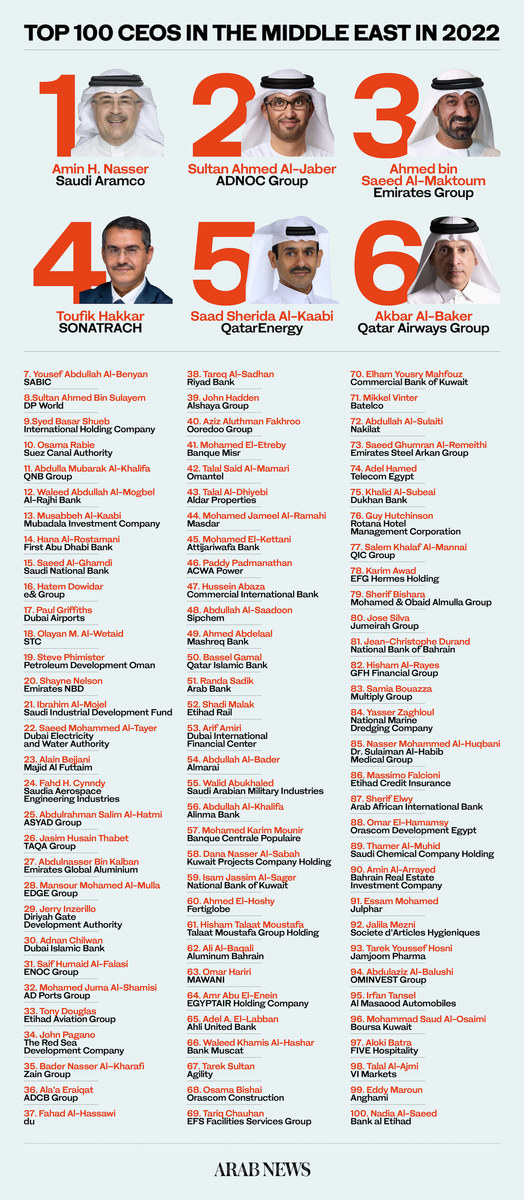
LONDON: Forbes revealed on Wednesday its “Top 100 CEOs in the Middle East” ranking, with 15 Saudi CEOs featured on this year’s list. 

The UAE dominates the list with 19 entries, followed by Egypt with 16 and Saudi Arabia with 15. 

"This list is a part of Forbes Middle East endeavour to recognize corporate excellence in the middle east and north Africa," Khuloud Al Omian, Editor in chief and CEO of Forbes Middle East told Arab News. "The top 100 CEOs in the Middle East, through their work have created massive positive impact on the region by fostering innovation, creating value for their countries and shareholders, and working towards a more sustainable future."

Amin H. Nasser, CEO of Saudi Aramco, topped the list for the second time in a row, followed by ADNOC’s Sultan Ahmed Al-Jaber in second place and Emirates Group CEO Ahmed bin Saeed Al-Maktoum in third place.

SONATRACH’s Toufik Hakkar, QatarEnergy’s Saad Sherida Al-Kaabi and Qatar Airways Group’s CEO Akbar Al-Baker dominate ranks four, five and six, respectively. 

This year’s list consists of CEOs from 26 different nationalities who manage companies that have a total combined revenue of over $5 trillion. 

"The list inspires the youth to strive for excellence like the CEO's who feature on the list," Al Omain added. "Many of the CEO's who feature on the list manage some of the biggest companies in the world as well as the most important assets in their respective countries."

Banking and financial services are the most represented sector on the list with 27 CEOs, followed by eight telecom CEOs and seven that each head energy and logistics companies. 

According to Forbes, the CEOs were ranked based on five criteria, including impact on the region, experience, size of company, achievements and innovations. 

Gabon cuts off Facebook, TikTok after protests

Updated 33 sec ago
Follow

Gabon cuts off Facebook, TikTok after protests

Libreville, Gabon: Facebook and TikTok were no longer available in Gabon on Wednesday, AFP journalists said, after regulators said they were suspending social media over national security concerns amid anti-government protests.
Gabon’s media regulator on Tuesday announced the suspension of social media platforms until further notice, saying that online posts were stoking conflict.
The High Authority for Communication imposed “the immediate suspension of social media platforms in Gabon,” its spokesman Jean-Claude Mendome said in a televised statement.
He said “inappropriate, defamatory, hateful, and insulting content” was undermining “human dignity, public morality, the honor of citizens, social cohesion, the stability of the Republic’s institutions, and national security.”
The communications body spokesman also cited the “spread of false information,” “cyberbullying” and “unauthorized disclosure of personal data” as reasons for the decision.
“These actions are likely, in the case of Gabon, to generate social conflict, destabilize the institutions of the Republic, and seriously jeopardize national unity, democratic progress, and achievements,” he added.
The regulator did not specify any social media platforms that would be included in the ban.
But it said “freedom of expression, including freedom of comment and criticism,” remained “a fundamental right enshrined in Gabon.”

‘Climate of fear’

Less than a year after being elected, Gabonese President Brice Oligui Nguema has faced his first wave of social unrest, with teachers on strike and other civil servants threatening to do the same.
School teachers began striking over pay and conditions in December and protests over similar demands have since spread to other public sectors — health, higher education and broadcasting.
Opposition leader Alain-Claude Billie-By-Nze said the social media crackdown imposed “a climate of fear and repression” in the central African state.
In an overnight post on Facebook, he called on civil groups “and all Gabonese people dedicated to freedom to mobilize and block this liberty-destroying excess.”
The last action by teachers took place in 2022 under then president Ali Bongo, whose family ruled the small central African country for 55 years.
Oligui overthrew Bongo in a military coup a few months later and acted on some of the teachers’ concerns, buying calm during the two-year transition period that led up to the presidential election in April 2025.
He won that election with a huge majority, generating high expectations with promises that he would turn the country around and improve living standards.
A wage freeze decided a decade ago by the Bongo government has left teachers struggling to cope with the rising cost of living.
Authorities last month arrested two prominent figures from the teachers’ protest movement, leaving teachers and parents afraid to discuss the strike in public.