



RAWALPINDI: A Pakistani chef and entrepreneur who runs her own cafe and shop in London has been recognized for her achievements in retail and e-commerce by Forbes, which put her on its prestigious “30 under 30” list this month.
Zahra Khan, who is 30 years old and the mother of two girls, is the founder of two of London’s culinary hotspots — Feya Cafe and DYCE. She is a graduate of the Tante Marie Culinary Academy and is committed to encouraging female equality in business.
Khan opened Feya Cafe on Bond Street just months after the birth of her first daughter in 2018. The award-winning dessert parlor DYCE opened soon after, followed by the flagship Feya Knightsbridge in December 2019.
Speaking to Arab News, Khan said she was nominated for the Forbes list by her team and did not expect to be recognized.
“I had just woken up and I knew the list was going to be released [on April 9], but they were meant to send an email as well and my inbox was empty, so I was a bit disappointed,” Khan said in a phone interview. “But then I pulled up the list anyway to see. As I started scrolling down, I saw my name. It was an amazing feeling!”

Forbes ‘30 Under 30’ honoree Zahra Khan at her office desk in London. (Supplied)
This is how the Forbes listing describes Khan:
“Immigrant Zahra Khan defied Pakistani cultural stereotypes and launched a career in the UK focused on empowering women. The chef and mother of two runs Feya cafes and shops. She employs 30 full-time staff, hires female illustrators to design packaging and donates 10 percent of retail profits toward professional coaching for women.”
Khan said she initially went to university to study medicine but then turned towards the culinary world, graduating from the Tante Marie Culinary Academy in Woking, England, before launching Feya, whose wares include chocolates, specialty spices and jams.
Khan has been nominated for the NatWest Everywomen Awards 2020 (The Artemis Award), London Business Mother of the Year 2020 (Venus Awards), Business Owner of the Year and Businesswoman of the Year (National Women’s Business Awards 2020) and Young Entrepreneur of the Year 2019 (Federation of Small Businesses UK).
“In Pakistan, we don’t have as many opportunities for women as men. I recognize that and I also realize that I’m lucky that I’ve got the opportunity to actually move and experience living in different countries,” said Khan, who studied at Ryerson University in Toronto before going to culinary school in the UK.
“It was an eye opener, I learned so much and I wanted to bring about change when I was in the position to give back.”
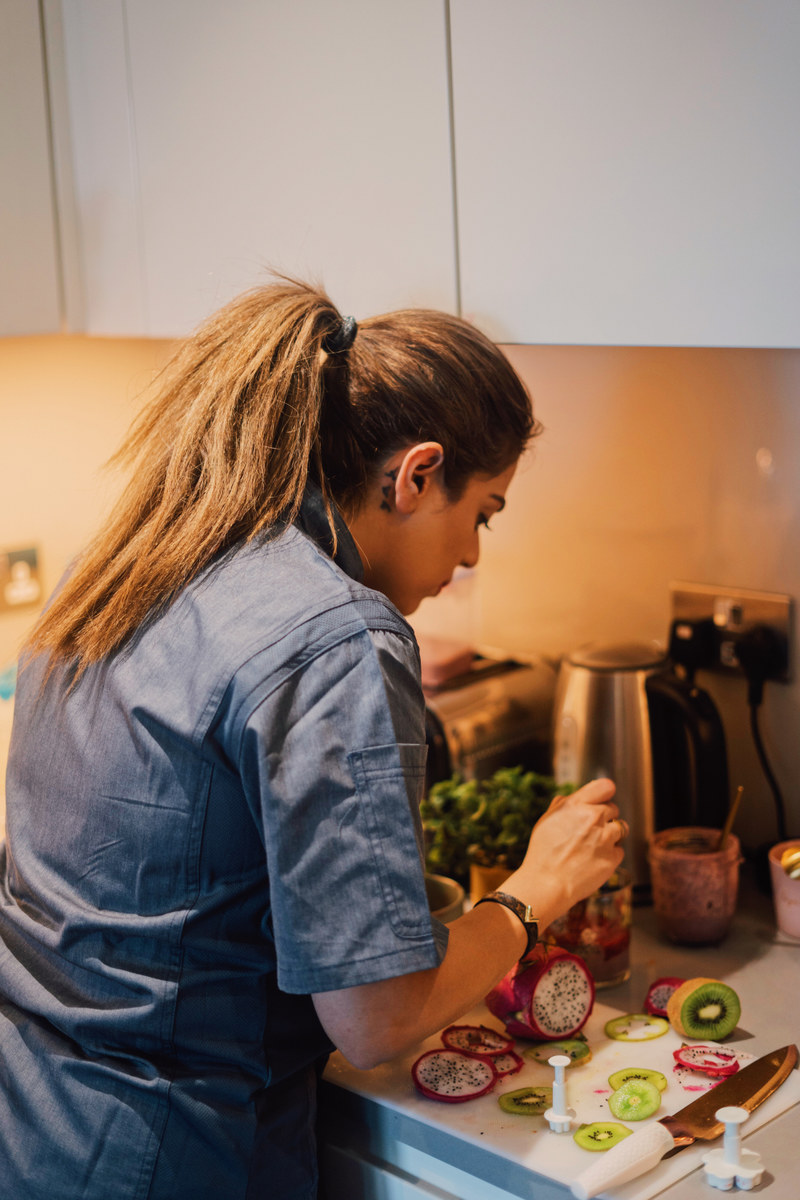
Forbes ‘30 Under 30’ honouree Khan tackles a recipe in her kitchen in London. (Supplied)
Khan launched Feya Cares at the start of the pandemic in collaboration with the Young Women’s Trust, a feminist organization in London working to achieve economic justice for young women.
Feya Cares tackles issues faced by women within the professional space, such as racial and gender inequality; 10 percent of the profits from the sale of Feya Retail products are donated to the Young Women’s Trust. Feya Retail is the line she launched around the same time that features various luxury products such as teas, jams and chocolates.
“Every woman can run her own business, even if it is a small-scale, home-based venture,” said Khan. “I want to show that it can be done.”


