Tunisian interior ministry says there are threats to president’s life

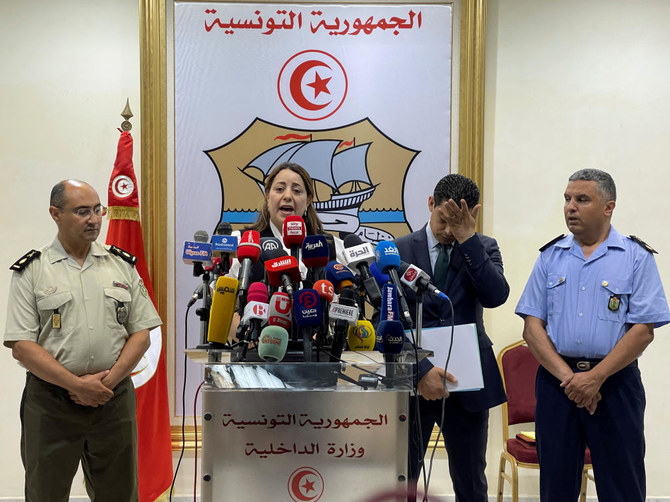
Official spokesperson of the Ministry of Interior, Fadhila Khlifi, speaks during a news conference in Tunis on Friday. (Reuters)
Short Url
Updated 24 June 2022
Follow

Tunisian interior ministry says there are threats to president’s life

  • The ministry said both internal and external elements were involved in plans targeting the president
  • An attacker was arrested after injuring two police while targeting a security point outside a Tunis synagogue overnight

JEDDAH: Security chiefs in Tunisia have uncovered plots to assassinate President Kais Saied amid concerns over a growing political crisis, they said on Friday.

The threats were revealed as an attacker previously jailed on terrorism charges and released in 2021 tried to stab two police officers guarding a synagogue in the center of Tunis.

“According to credible information and investigations still underway, the president of the republic and the presidency as an institution are the target of serious threats,” Interior Ministry spokeswoman Fadhila Khelifi said.

“There is a plan by groups both at home and abroad to target the security of the president” and to “damage state security and create chaos,” she said.

In Tunis, the man armed with a knife attacked police deployed to guard the Grand Synagogue in the city center, wounding two officers before he was overpowered. The ministry said an investigation was underway.

Before its independence from France in 1956, Tunisia was home to over 100,000 Jews, but emigration has brought their numbers down to about 1,000.

Since the so-called “Arab Spring” revolution that overthrew dictator Zine El-Abidine ben Ali in 2011, a number of jihadist attacks in Tunisia have killed dozens of people.

The latest attack comes amid a deep economic and political crisis almost a year since Saied assumed complete power in July 2021. The president’s opponents accuse him of a coup for ruling by decree and preparing a new constitution that he plans to put to a referendum next month.

Opposition to Saied has broadened over recent months as nearly all major political parties and the powerful labor union have come out against his plans, holding street rallies against him.

However, while critics of the president say his moves have raised concerns over rights and freedoms won in the 2011 revolution, there has been no widespread crackdown on the opposition.

Saied says his moves are legal and were needed to save Tunisia from years of political
paralysis, economic stagnation and the malign influence of Islamist groups.

Ahmed Nejib Chebbi, a prominent left-wing politician and Saied opponent, cast doubt on claims of a plot to kill the president. “This is just to justify new arrests and to take revenge against his rivals,” Chebbi said. “The president is politically isolated and is trying to stir up public sympathy.”

Ennahdha, the Islamist party that had dominated Tunisian politics before Saied took power, dismissed the threats as “theater.”


Deal is signed in Beirut to transfer 300 Syrian prisoners in Lebanon to their home country

Updated 4 sec ago
Follow

Deal is signed in Beirut to transfer 300 Syrian prisoners in Lebanon to their home country

  • Lebanon’s Deputy Prime Minister Tarek Mitri and Syria’s Justice Minister Mazhar Al-Wais expressed hope that this step will boost confidence and progress relations
  • Lebanon and Syria have signed an agreement to transfer over 300 Syrian detainees from Lebanese prisons to continue their sentences in Syria
BEIRUT: Lebanon and Syria signed an agreement Friday to transfer more than 300 Syrians from Lebanese prisons to continue serving their sentences in their home country, a step that will likely help improve strained relations between the two neighbors.
The signing came a week after Lebanon’s Cabinet approved a treaty with Syria for the transfer of prisoners. The deal was signed at the government headquarters in the Lebanese capital, Beirut, by Lebanon’s Deputy Prime Minister Tarek Mitri and Syria’s Justice Minister Mazhar Al-Wais.
“This is a very important first step on the road of a comprehensive treatement regarding Syrian prisoners in Lebanese prisons,” Mitri told reporters, adding that the implementation of the agreement would start on Saturday.
“Both countries want to move forward but there are some pending matters,” Al-Wais said. “This step will boost existing confidence and we hope that relations will progress more.”
Mitri said that next, officials from the two neighboring countries, will discuss the transfer of Syrian detainees who are still waiting trial in Lebanon.
Lebanon and Syria have a complicated history, with grievances on both sides. Many Lebanese resent nearly three decades of domination and military presence in their country by Syrian forces that ended in 2005.
Many Syrians resent the role played by the Lebanese militant group Hezbollah when it entered Syria’s civil war that broke out in 2011 in defense of then-President Bashar Assad and his government. Assad was overthrown in December 2024 and fled to Russia where he is now in exile.
After Assad’s fall, relations with Syria’s new Islamist-led authorities remained tense and skirmishes occurred along the unmarked border between the two nations.
Mitri also said Saturday’s signing was “an expression of a joint political will that states that the Lebanese-Syrian relations are based on confidence and mutual respect.”
Asked whether the deal will include Lebanese citizens such as Sunni Muslim cleric Ahmed Al-Assir, Mitri said that it only covers Syrian prisoners.
There are about 2,500 Syrian prisoners in Lebanese prisons and jails, some of whom are held on charges related to their involvement with armed opposition groups that sought to overthrow Assad — in some cases, the same groups that are now ruling Syria.
Earlier this week, Mitri told The Associated Press that most of the detainees who will be transferred to Syria were not convicted of violent crimes. Some of those convicted of violent crimes may be transferred if they have already served seven and a half years of their sentence in Lebanon, he said.