After two-year dip, number of Pakistanis seeking jobs in UAE rises by 120% — consul general

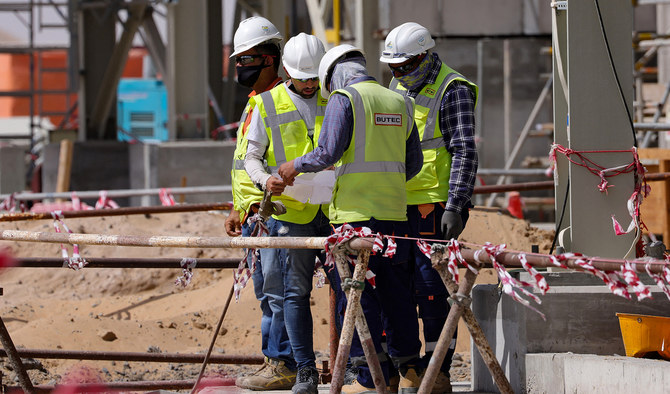
Workers are pictured next to a waste management facility under construction at the Bee'ah company in Sharjah, UAE, on September 2, 2021. (AFP/File)
Short Url
Updated 23 June 2022
Follow

After two-year dip, number of Pakistanis seeking jobs in UAE rises by 120% — consul general

  • COVID-19 pandemic hampered manpower export from Pakistan and other regional countries
  • Pakistanis registered with Bureau of Emigration to work in UAE halved to 27,442 in 2021

DUBAI: After a sharp decline in the number of Pakistanis who moved to the UAE for jobs in 2020 and 2021, mostly owing to the coronavirus pandemic, a senior diplomat said the numbers had risen once more - by about 120 percent.

As per data from the recently released Pakistan Economic Survey, the number of Pakistanis registered with the Bureau of Emigration and Overseas Employment (BE & OE) to work in the UAE halved to 27,442 in 2021 as compared to 53,676 in 2020. 

According to the survey, the COVID-19 pandemic has hampered manpower export to the UAE not only from Pakistan but other regional countries as well. Seventy percent of the job market for Pakistanis in the UAE is made up of unskilled labor including gardeners, riders, taxi drivers and security guards as well as people working in the hospitality industry.

In an interview with Arab News this week, the Consul General of Pakistan to the UAE, Hassan Afzal Khan, quoted unpublished data from the BE & OE and said as of May 2022, the total number of Pakistanis seeking jobs in the UAE had increased to 62,615 - a jump of 120 percent from the past year.

“According to these figures, there is a massive improvement in the number of Pakistanis who want to migrate to the UAE,” Khan said.

The decline in migration in 2020-21 was attributed to the local market becoming highly competitive for job-seekers, especially for the semi-skilled, he said.

With this unusual decline, the UAE became the fourth largest destination of preference for the Pakistani diaspora in 2021 as compared to previous years when it was the second major destination for South Asian nationals, after Saudi Arabia, according to the Economic Survey.

“As per the recent survey, we can see that the UAE hasn’t lost its place and is back on the second spot after Saudi Arabia,” said Khan.

The consul general said the mission was working to raise the minimum wages of Pakistani nationals in the UAE from the current Dh800 to Dh1,200 (approximately $330) per month to meet the increasing costs of living.

“We are trying to ensure that any contract that comes to us now meets the minimum wage criteria with the added benefits so that workers here can earn and send a substantial amount back home,” he said.

The reduced numbers of workers in the UAE has economic implications for Pakistan as overseas Pakistanis are major contributors to remittances.

The UAE remained the second largest source of remittances to Pakistan in the July-March financial year 2021-22 and remitted $4.28 billion (2022) as compared to $4.52 billion in 2021.


Pakistan, global crypto exchange discuss modernizing digital payments, creating job prospects 

Updated 8 sec ago
Follow

Pakistan, global crypto exchange discuss modernizing digital payments, creating job prospects 

  • Pakistani officials, Binance team discuss coordination between Islamabad, local banks and global exchanges
  • Pakistan has attempted to tap into growing crypto market to curb illicit transactions, improve oversight

ISLAMABAD: Pakistan’s finance officials and the team of a global cryptocurrency exchange on Friday held discussions aimed at modernizing the country’s digital payments system and building local talent pipelines to meet rising demand for blockchain and Web3 skills, the finance ministry said.

The development took place during a high-level meeting between Finance Minister Muhammad Aurangzeb, Pakistan Virtual Assets Regulatory Authority (PVARA) Chairman Bilal bin Saqib, domestic bank presidents and a Binance team led by Global CEO Richard Teng. The meeting was held to advance work on Pakistan’s National Digital Asset Framework, a regulatory setup to govern Pakistan’s digital assets.

Pakistan has been moving to regulate its fast-growing crypto and digital assets market by bringing virtual asset service providers (VASPs) under a formal licensing regime. Officials say the push is aimed at curbing illicit transactions, improving oversight, and encouraging innovation in blockchain-based financial services.

“Participants reviewed opportunities to modernize Pakistan’s digital payments landscape, noting that blockchain-based systems could significantly reduce costs from the country’s $38 billion annual remittance flows,” the finance ministry said in a statement. 

“Discussions also emphasized building local talent pipelines to meet rising global demand for blockchain and Web3 skills, creating high-value employment prospects for Pakistani youth.”

Blockchain is a type of digital database that is shared, transparent and tamper-resistant. Instead of being stored on one computer, the data is kept on a distributed network of computers, making it very hard to alter or hack.

Web3 refers to the next generation of the Internet built using blockchain, focusing on giving users more control over their data, identity and digital assets rather than big tech companies controlling it.

Participants of the meeting also discussed sovereign debt tokenization, which is the process of converting a country’s debt such as government bonds, into digital tokens on a blockchain, the ministry said. 

Aurangzeb called for close coordination between the government, domestic banks and global exchanges to modernize Pakistan’s payment landscape.

Participants of the meeting also discussed considering a “time-bound amnesty” to encourage users to move assets onto regulated platforms, stressing the need for stronger verifications and a risk-mitigation system.

Pakistan has attempted in recent months to tap into the country’s growing crypto market, crack down on money laundering and terror financing, and promote responsible innovation — a move analysts say could bring an estimated $25 billion in virtual assets into the tax net.

In September, Islamabad invited international crypto exchanges and other VASPs to apply for licenses to operate in the country, a step aimed at formalizing and regulating its fast-growing digital market.