

Iran prepares enrichment escalation at Fordow plant, IAEA report shows

Short Url
Updated 21 June 2022
Follow

Iran prepares enrichment escalation at Fordow plant, IAEA report shows

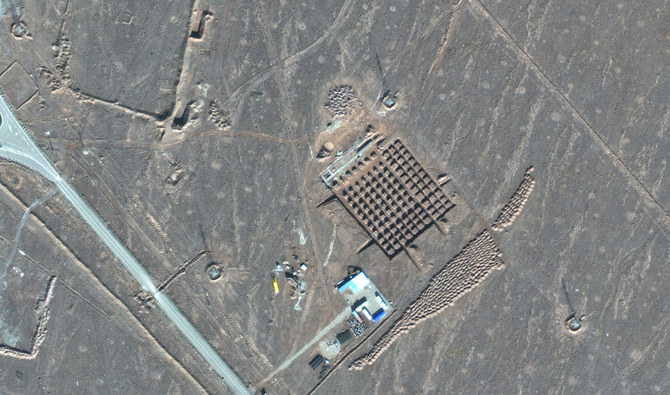
VIENNA: Iran is escalating its uranium enrichment further by preparing to use advanced IR-6 centrifuges at its underground Fordow site that can more easily switch between enrichment levels, a United Nations nuclear watchdog report seen by Reuters on Monday showed.
The move is the latest of several steps Iran had long threatened to take but held off carrying out until 30 of the 35 countries on the International Atomic Energy Agency’s Board of Governors backed a resolution this month criticizing it for failing to explain uranium traces found at undeclared sites.
With indirect US-Iran talks on reviving the 2015 Iran nuclear deal long stalled, any further escalation in Tehran’s standoff with the West risks killing off hopes of reining in the Islamic republic’s nuclear advances and lifting US sanctions against it.
IAEA inspectors verified on Saturday that Iran was ready to feed uranium hexafluoride (UF6) gas, the material centrifuges enrich, into the second of two cascades, or clusters, of IR-6 centrifuges installed at Fordow, a site dug into mountain, the confidential IAEA report to member states said.
Iran informed the IAEA on Monday that passivation of the cascade, a process that precedes enrichment and also involves feeding UF6 into the machines, had begun on Sunday.
Importantly, the 166-machine cascade is the only one to have so-called “modified sub-headers,” which make it easier to switch to enriching to other purity levels. Western diplomats have long pointed to that equipment as a source of concern since it could enable Iran to quickly enrich to higher levels.

AWAITING CLARIFICATION
Iran has also not told the agency clearly what purity the cascade will enrich to after passivation. Iran had previously informed the IAEA that the two IR-6 cascades could be used to enrich to 5 percent or 20 percent purity.
“The Agency has yet to receive clarification from Iran as to which mode of production it intends to implement for the aforementioned cascade, following the completion of passivation,” the report said, which the IAEA confirmed.
At a different site, Iran is already enriching to up to 60 percent, close to the roughly 90 percent of weapons-grade and far above the 2015 deal’s cap of 3.67 percent. Iran has breached many of the deal’s limits in response to the US withdrawal from the deal in 2018 and its reimposition of sanctions. Iran denies seeking nuclear weapons.
In response to the Board of Governors’ resolution, Iran has ordered the removal of IAEA cameras installed under the 2015 deal and pressed ahead with the installation of IR-6 centrifuges at an underground plant at Natanz where the deal lets it enrich but only with far less efficient IR-1 machines.
The 2015 deal does not allow uranium enrichment at Fordow.


Israeli-backed group kills a senior Hamas police officer in Gaza, threatens more attacks

Updated 3 sec ago
Follow

Israeli-backed group kills a senior Hamas police officer in Gaza, threatens more attacks

  • Hussam Al-Astal, leader of an anti-Hamas group based in an area under Israeli control east of Khan Younis, claimed responsibility for the killing
CAIRO: An Israeli-backed Palestinian militia said on Monday it had killed a senior Hamas police officer in the southern Gaza Strip, an incident which Hamas blamed on “Israeli collaborators.”
A statement from the Hamas-run interior ministry said gunmen opened fire from a passing car, ​killing Mahmoud Al-Astal, head of the criminal police unit in Khan Younis, in the south of the enclave. It described the attackers as “collaborators with the occupation.”
Hussam Al-Astal, leader of an anti-Hamas group based in an area under Israeli control east of Khan Younis, claimed responsibility for the killing in a video he posted on his Facebook page. The surname he shares with the dead man, Al-Astal, is common in that part of Gaza.
“To those who work with Hamas, your destiny is to be killed. Death is coming to you,” he ‌said, dressed in ‌a black military-style uniform and clutching an assault rifle.
Reuters could ‌not ⁠independently ​verify ‌the circumstances of the attack. An Israeli military official said the army was not aware of any operations in the area.
The emergence of armed anti-Hamas groups, though still small and localized, has added pressure on the Islamists and could complicate efforts to stabilize and unify a divided Gaza, shattered by two years of war.
These groups remain unpopular among the local population as they operate in areas under Israeli control, although they publicly deny they take Israeli orders. Hamas has held public executions ⁠of people it accuses of collaboration.
Under a ceasefire in place since October, Israel has withdrawn from nearly half of ‌the Gaza Strip, but its troops remain in control of ‍the other half, largely a wasteland ‍where virtually all buildings have been levelled.
Nearly all of the territory’s two million people ‍now live in Hamas-held areas, mostly in makeshift tents or damaged buildings, where the group has been reasserting its grip. Four Hamas sources said it continues to command thousands of fighters despite suffering heavy losses during the war.
Israel has been allowing rivals of Hamas to operate in areas it controls. In ​later phases, US President Donald Trump’s plan for Gaza calls for Israel to withdraw further and for Hamas to yield power to an internationally backed administration, ⁠but there has so far been no progress toward those steps.
Prime Minister Benjamin Netanyahu acknowledged Israeli backing for anti-Hamas groups in June, saying Israel had “activated” clans, but has given few details since then.
The ceasefire has ended major combat in Gaza over the past three months, but both sides have accused the other of regular violations. More than 440 Palestinians and three Israeli soldiers have been killed since the truce took effect.
Gaza health authorities said on Monday Israeli drone fire killed at least three people near the center of Khan Younis.
The Israeli military did not have an immediate comment on the drone incident.
The war erupted on October 7, 2023 when Gazan militants invaded Israel, killing about 1,200 people and taking some 250 hostages, according to ‌Israeli tallies.
Israel’s subsequent military assault on Gaza has killed more than 71,000 Palestinians, according to the enclave’s health ministry, and led to accusations of genocide and war crimes, which Israel denies.