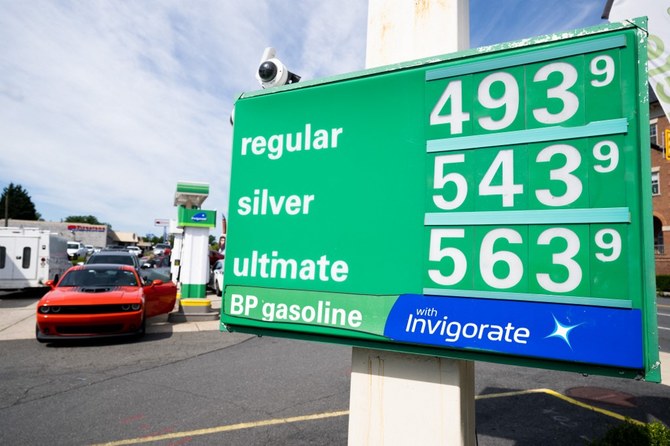
US gasoline average pump price tops $5 a gallon in historic first

The national average price for regular unleaded gas rose to $5.004 a gallon on June 11. (AFP)
Short Url
Updated 12 June 2022
Follow

US gasoline average pump price tops $5 a gallon in historic first

WASHINGTON: The price of US gasoline averaged more than $5 a gallon for the first time on Saturday, data from the AAA showed, extending a surge in fuel costs that is driving rising inflation.

The national average price for regular unleaded gas rose to $5.004 a gallon on June 11 from $4.986 a day earlier, AAA data showed.

High gasoline prices are a headache for President Joe Biden and congressional Democrats as they struggle to maintain their slim control of Congress with midterm elections coming up in November.

Biden has pulled on numerous levers to try to lower prices, including a record release of barrels from US strategic reserves, waivers on rules for producing summer gasoline, and leaning on major OPEC countries to boost output.

Yet fuel prices have been surging around the world due to a combination of rebounding demand, sanctions on oil producer Russia after its invasion of Ukraine and a squeeze on refining capacity.

Road travel, however, has remained relatively strong, just a couple of percentage points below pre-pandemic levels, even as prices have risen.

Still, economists expect demand may start to decline if prices remain above $5 a barrel for a sustained period.

“The $5 level is where we could see very heavy amounts of gasoline demand destruction,” said Reid L’Anson, senior economist at Kpler.

Adjusting for inflation, the US gasoline average is still approximately 8 percent below June 2008 highs around $5.41 a gallon, according to US Energy Department figures.

Consumer spending has so far remained resilient even with inflation running at its highest level in more than four decades, with household balance sheets shored up by pandemic relief programs and a tight job market that has fueled strong wage gains, especially for lower-income workers.

Gasoline product supplied, a proxy for demand, was 9.2 million barrels per day last week, according to the US Energy Information Administration, broadly in line with five-year seasonal averages.

The high prices for drivers come as major oil-and-gas companies post bumper profits. Shell reported a record quarter in May and Chevron Corp. and BP have posted their best numbers in a decade. 

Other majors, including Exxon Mobil and TotalEnergies, as well as US independent shale operators, reported strong figures that have spurred share repurchases and dividend investments. 

Numerous companies have said they will avoid excessive investment to boost output due to investors’ desires to hold the line on spending, rather than respond to $100-plus barrel prices that have persisted for months. Read full story

Refiners have been struggling to rebuild inventories that have dwindled, especially on the US East Coast, reflecting exports to Europe where buyers are weaning themselves off of Russian oil.

Currently, refiners are utilizing about 94 percent of their capacity, but overall US refining capacity has fallen, with at least five oil-processing plants shutting during the pandemic.

That has left the United States structurally short of refining capacity for the first time in decades, analysts said.


Saudi home ownership exceeds 66% in 2025: housing minister 

Updated 4 sec ago
Follow

Saudi home ownership exceeds 66% in 2025: housing minister 

RIYADH: Saudi Minister of Municipalities and Housing Majid Al-Hogail affirmed that the Kingdom has built a balanced real estate ecosystem, which raised the homeownership rate from 47 percent in 2016 to over 66 percent by 2025. 

This indicator reflects the effectiveness of housing policies and regulatory reforms the sector has witnessed in recent years. 

This came during Al-Hogail’s speech at the opening of the fifth edition of the Future of Real Estate Forum. He explained that the Kingdom has chosen the path of “real estate balance” as a strategic approach aimed at enhancing market stability, increasing its efficiency, and entrenching fairness within it.  

He pointed out that this path has been translated into precise regulatory tools whose effects have materialized in less than a year since the launch of its programs in 2025. 

He clarified that the entry into force of the system allowing non-Saudi ownership, within a disciplined regulatory framework, enhances the attractiveness and preserves the sustainability of the real estate market. He emphasized that balanced regulation represents a fundamental pillar in stimulating investment and raising the sector’s efficiency. 

In the context of land regulation and stimulating supply, the minister added that the White Land and Vacant Property Fees Law aims to mobilize unused land. He noted that more than 60,000 invoices have been issued since the beginning of 2026, in addition to the availability of over 100 million sq. meters of ready-to-develop land in Riyadh. This contributes to increasing supply and achieving a balance between supply and demand. 

Al-Hogail added that the ministry, in partnership with the private sector, is working to inject more than 300,000 housing units into Riyadh over the next three years. He also noted that more than 300,000 housing units had been delivered by the end of 2025 across 16 cities in various regions of the Kingdom. 

Furthermore, the number of beneficiaries of housing support programs has exceeded one million, a step that enhances the sustainability and diversity of housing solutions. 

Regarding financing and investment, he revealed that the total real estate financing portfolios in Saudi banks represent about 27 percent of their portfolios.  

He indicated that local sukuk worth over SR20 billion ($5.3 billion) and international issuances worth $4.5 billion have been issued. This is in addition to attracting global developers through an investment portfolio exceeding SR40 billion, reflecting the sector’s solidity and investor confidence in it. 

The minister pointed to the diversity of the housing solutions ecosystem through multiple tools, including rent-to-own, partial ownership and real estate coding, which expand options for beneficiaries and enhance market flexibility. 

Al-Hogail said the Kingdom now has an advanced digital real estate ecosystem considered among the world’s leading systems, with 13 digital platforms serving more than 35 million users. 

About 80 percent of real estate transactions are completed digitally, alongside the issuance of more than 1.3 million real estate records, enhancing governance and transparency and improving operational efficiency. 

On real estate coding, Al-Hogail explained that its regulatory journey spans seven stages, including the launch of a regulatory sandbox for the private sector involving nine companies. He said the future of coding will unfold across three main phases, aimed at building a more open and innovative real estate market. 

Al-Hogail concluded by emphasizing that the Saudi real estate sector is moving confidently toward a new stage of maturity and sustainability, supported by regulatory, financial and digital reforms that strengthen its role as a key driver of the national economy.