

Saudi home ownership exceeds 66% in 2025: housing minister 

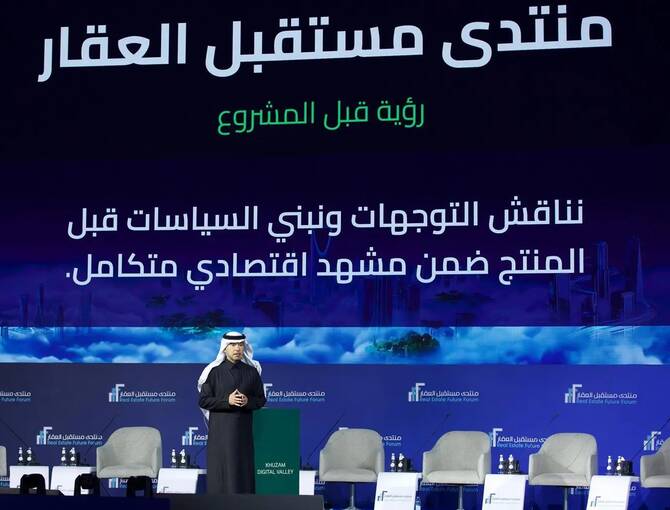
This came during Al-Hogail’s speech at the opening of the fifth edition of the Future of Real Estate Forum. SPA
Short Url
Updated 26 January 2026
Follow

Saudi home ownership exceeds 66% in 2025: housing minister 

RIYADH: Saudi Minister of Municipalities and Housing Majid Al-Hogail affirmed that the Kingdom has built a balanced real estate ecosystem, which raised the homeownership rate from 47 percent in 2016 to over 66 percent by 2025. 

This indicator reflects the effectiveness of housing policies and regulatory reforms the sector has witnessed in recent years. 

This came during Al-Hogail’s speech at the opening of the fifth edition of the Future of Real Estate Forum. He explained that the Kingdom has chosen the path of “real estate balance” as a strategic approach aimed at enhancing market stability, increasing its efficiency, and entrenching fairness within it.  

He pointed out that this path has been translated into precise regulatory tools whose effects have materialized in less than a year since the launch of its programs in 2025. 

He clarified that the entry into force of the system allowing non-Saudi ownership, within a disciplined regulatory framework, enhances the attractiveness and preserves the sustainability of the real estate market. He emphasized that balanced regulation represents a fundamental pillar in stimulating investment and raising the sector’s efficiency. 

In the context of land regulation and stimulating supply, the minister added that the White Land and Vacant Property Fees Law aims to mobilize unused land. He noted that more than 60,000 invoices have been issued since the beginning of 2026, in addition to the availability of over 100 million sq. meters of ready-to-develop land in Riyadh. This contributes to increasing supply and achieving a balance between supply and demand. 

Al-Hogail added that the ministry, in partnership with the private sector, is working to inject more than 300,000 housing units into Riyadh over the next three years. He also noted that more than 300,000 housing units had been delivered by the end of 2025 across 16 cities in various regions of the Kingdom. 

Furthermore, the number of beneficiaries of housing support programs has exceeded one million, a step that enhances the sustainability and diversity of housing solutions. 

Regarding financing and investment, he revealed that the total real estate financing portfolios in Saudi banks represent about 27 percent of their portfolios.  

He indicated that local sukuk worth over SR20 billion ($5.3 billion) and international issuances worth $4.5 billion have been issued. This is in addition to attracting global developers through an investment portfolio exceeding SR40 billion, reflecting the sector’s solidity and investor confidence in it. 

The minister pointed to the diversity of the housing solutions ecosystem through multiple tools, including rent-to-own, partial ownership and real estate coding, which expand options for beneficiaries and enhance market flexibility. 

Al-Hogail said the Kingdom now has an advanced digital real estate ecosystem considered among the world’s leading systems, with 13 digital platforms serving more than 35 million users. 

About 80 percent of real estate transactions are completed digitally, alongside the issuance of more than 1.3 million real estate records, enhancing governance and transparency and improving operational efficiency. 

On real estate coding, Al-Hogail explained that its regulatory journey spans seven stages, including the launch of a regulatory sandbox for the private sector involving nine companies. He said the future of coding will unfold across three main phases, aimed at building a more open and innovative real estate market. 

Al-Hogail concluded by emphasizing that the Saudi real estate sector is moving confidently toward a new stage of maturity and sustainability, supported by regulatory, financial and digital reforms that strengthen its role as a key driver of the national economy. 


Room cancelations at 80% and 1 million airline passengers affected - tourism feels impact of US-Iran war

Updated 4 sec ago
Follow

Room cancelations at 80% and 1 million airline passengers affected - tourism feels impact of US-Iran war

  • At least 11,000 flights into, out of, and within the Middle East

RIYADH: The Middle East’s tourism and hospitality sector faces severe disruption as the widening Iran war shuts down airspace and forces widespread flight cancelations, stranding travelers and upending travel plans across the region.

Industry figures have told Arab News of an 80 percent cancellation rate for hotel rooms as the impact of reduced and cancelled flights hits the sector.

Major Gulf hubs, including Dubai, remained closed for a fourth day on March 3, sharply reducing capacity on key routes such as Australia–Europe, where Emirates and Qatar Airways hold significant market share.

The conflict threatens the region’s hospitality sector as countries, including Saudi Arabia, push to become global tourism hubs and diversify away from oil.

Eti Bhasin, executive director Majestic Hotels UAE — which operates three hotels in Dubai with a combined 438 rooms — told Arab News the group has seen a surge in cancelations in recent days amid regional instability.

“Over 80 percent cancelations have come in for the next two weeks owing to the ongoing war situation. We only hope that we can bounce back sooner,” said Bhasin.

She added: “So far, I only see the next two weeks being impacted. Only time will tell how it goes for the upcoming months’ forecast. We would still like to be optimistic that the situation should hopefully get better by mid-June.” 

Shilpa Mahtani, co-founder of Dubai-based bnbme Holiday Homes, told Arab News that while tourism performance was exceptionally strong last year, the Iran war could weigh on the sector.

“What we are watching closely now is how the coming days and weeks unfold. The immediate impact is largely linked to flight disruptions and airspace constraints, which have resulted in last-minute cancelations for the coming days and short-notice postponements and slower forward bookings,” said Mahtani.

According to aviation analytics firm Cirium, at least 11,000 flights into, out of, and within the Middle East have been canceled, affecting more than 1 million passengers, since Feb. 28, after Israel and the US launched attacks on Iran.

Travel disruption is expected to persist after US President Donald Trump said on March 2 that the conflict could last four to five weeks, or longer.

“Flight cancelations impacts our group tremendously in terms of guests’ arrival patterns, especially from the Southeast Asian market that predominantly features as top 3 nationalities in our properties. We have had several extensions and so far have been at 80 percent occupancy, maintaining a healthy figure despite Ramadan,” said Bhasin.

A crisis for the entire region?

Mahtani added that the conflict’s impact extends beyond any single Gulf country to the wider region.

“At the moment, the entire Gulf region is impacted, not necessarily due to conditions within each country, but because regional airspace, flight schedules and traveler perception affect the Gulf as a whole. When connectivity is disrupted, it becomes a region-wide issue,” said Mahtani.

Rahul Singh, managing director of A.A. Al Moosa Enterprises’ Mobility Division, offered a different view, saying the crisis’s impact across the Gulf would be varied.

“If the conflict continues, the long-term impact on regional tourism is likely to be uneven. Some destinations may see softer international demand, while stable and well-connected hubs that are perceived as safe are likely to be more resilient,” Singh told Arab News.

The managing director added that the region is certainly witnessing a shift in travel patterns, which includes cancelations as customers adjust their plans in response to the situation.

“Additionally, instead of booking long, well-planned international holidays, many are choosing alternative transit hubs, shorter regional breaks, or making last-minute decisions,” said Singh.

He added: “On the ground, the biggest challenge is uncertainty. Flight diversions, temporary airport disruptions, and changing travel adviseries can quickly impact when and where customers arrive. That puts real pressure on fleet allocation and staffing across key airport and city locations.”

Meanwhile, the UAE and Qatar have ordered hotels in Dubai and Abu Dhabi to provide free accommodation and meals for over 20,000 tourists stranded by a regional airspace closure.

The authorities in both countries said that the states will bear full financial responsibility for the stranded travelers.

As tension escalates in the region, several tour operators have also paused some Middle East itineraries.

Tauck posted a travel update on its website, saying that it had canceled the March 2 departure date for its Jordan & Egypt: Petra to the Pyramids itinerary, citing uncertainty in the region and current flight disruptions.

Intrepid, on March 3, issued an update stating that it has canceled all departures of trips to Egypt, Jordan, Oman and Saudi Arabia from March 4.

Vijay Valecha, chief investment officer at Century Financial, told Arab News that tourism is among the sectors most exposed to the conflict, given the Middle East’s heavy reliance on hospitality as an economic pillar.

“The sector most sensitive to regional stability is tourism. It’s also a core pillar of Vision 2030. An increase in oil and energy prices affects the cost structure of companies like flynas. The flight routes are also longer, and insurance premiums also rise. Furthermore, fewer tourists visit the region, reducing overall revenue,” said Valecha.

Future optimism: A resilient Middle East

Tero Taskila, CEO of Beond, said that the tourism and travel sector in the Middle East region still remains resilient, and the ongoing tensions are not an indicator of a long-term structural decline.

“The Middle East has proven repeatedly that it is resilient. Temporary airspace adjustments may shift flows, but the region remains structurally strong in tourism. Infrastructure, hospitality standards and connectivity are world-class. In our view, this is a short-term recalibration, not a long-term structural decline,” said Taskila.

He added: “History shows that travel rebounds quickly once clarity returns. The luxury traveler, in particular, values experience and time. Demand may pause briefly, but it rarely disappears.”

According to Mahtani, the industry is expected to see sustained shorter booking cycles, more cautious traveler behavior and higher costs linked to rerouting if the instability continues in the region.

She added that hospitality businesses may need to adjust pricing dynamically and prioritize service to maintain confidence during uncertain times.

“Over time, destinations with strong governance, infrastructure and crisis management will continue to attract confidence, while others may take longer to stabilize. The key will be consistency, communication and operational readiness,” concluded Mahtani.