BANGKOK: Myanmar’s military government and its opponents traded accusations over a bomb that exploded Tuesday in the middle of the country’s largest city, Yangon, killing one and wounding nine others.
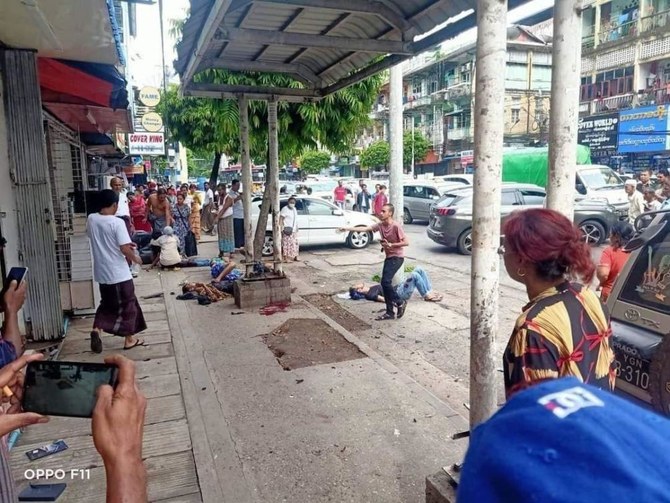
Photos and videos of Tuesday’s bombing that circulated on social media showing the bloodied victims sprawled on the sidewalk were a sharp reminder of the violence that has engulfed the country since the military seized power last year.
A story in Wednesday’s edition of The Global New Light of Myanmar, a state-run newspaper, blamed the People’s Defense Forces, the opposition movement’s armed wing, but did not supply any evidence linking them to the blast.
It said the attack was made with a “handmade bomb planted by PDF terrorists at a bus stop” roughly one block from the Sule Pagoda, a city landmark. The blast occurred at 3:20 p.m. and a 30-year-old man died of wounds in his chest and abdomen, state media said.
A spokesperson for the self-styled National Unity Government, the main opposition body that loosely commands the PDF and its various local units, pinned the blame on the military government.
“The brutal genocidal military has been carrying out senseless bombings and killings against its own civilian population across Myanmar,” said a statement by Sasa, the NUG’s Minister of International Cooperation.
Myanmar has been in turmoil since last year’s army takeover seized power from the elected government of Aung San Suu Kyi, sparking widespread nonviolent protests that were quashed with lethal force by the army and police. In turn, opponents of military rule took up arms and are now conducting an active insurgency in many parts of the country.
The Assistance Association for Political Prisoners says 1,876 civilians, mostly in cities and towns, have been killed by the security forces. Their figures do not generally include casualties of war in the countryside.
On Wednesday, the international human rights organization Amnesty International accused Myanmar’s military of carrying out widespread atrocities in the eastern part of the country that constitute war crimes and probably crimes against humanity.
It charges in a report that civilians from the Karen and Karenni ethnic minorities have been the targets of unlawful killing, arbitrary detention and forcible displacement.
“The world’s attention may have moved away from Myanmar since last year’s coup, but civilians continue to pay a high price,” Rawya Rageh, Amnesty’s senior crisis adviser, said in a news release.
The opposition NUG’s Defense Ministry in a Wednesday statement said the ruling military “have sought to place blame on ethnic resistance groups and revolutionary forces in similar incidents in the past.”
Urban guerrillas are part of the resistance movement, carrying out targeted killings of people associated with the military and bombings of establishments with official ties. But PDF-affiliated groups in Yangon posted statements on their Facebook pages denying involvement in Tuesday’s blast and accusing the military of staging a provocation.
The military government brands its opponents as terrorists in a bid to dent their widespread popularity. Wednesday’s newspaper report said the PDF received “financial assistance to launch bombing attacks.”
“They also committed bomb attacks using handmade bombs on public roads, streets, bus terminals and bus stops,” it added.
Another fatal bombing occurred Tuesday at an education office in Naung Cho township in Shan State in eastern Myanmar, for which state media likewise blamed the PDF and the NUG.
The Global New Light of Myanmar said a headmistress died and six educational personnel and a civil servant were injured. The blast occurred as state schools were preparing for their seasonal reopening.
The school system has been a battleground between the military government and its foes, who generally have pressed for a boycott as a sign of rejection of army rule.
The non-governmental organization Save the Children said in a statement issued Wednesday that there were at least 260 attacks on schools between May 2021 and April this year, and that explosions in and around school buildings accounted for almost three-quarters of that total.
“Attacks on schools, teachers, and students have surged over the past year due to the conflict, leaving many of them scared to return to the classroom and, in some cases, with no schools left to attend,” the group said.


![]()

Accusations fly after Myanmar bombing kills 1, injures 9
Accusations fly after Myanmar bombing kills 1, injures 9
- Sharp reminder of the violence that has engulfed the country since the military seized power last year
- Myanmar has been in turmoil since last year’s army takeover seized power from the elected government
Latest updates


Recommended


© 2026 SAUDI RESEARCH & PUBLISHING COMPANY, All Rights Reserved And subject to Terms of Use Agreement.