

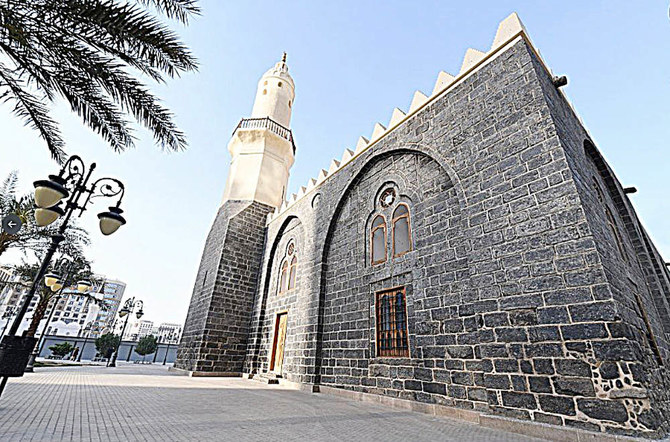
ThePlace: Al-Ghamama Mosque in Madinah, where Prophet Muhammad offered Eid and Rain prayers

Photo/Saudi Press Agency
Short Url
Updated 30 May 2022
Follow

ThePlace: Al-Ghamama Mosque in Madinah, where Prophet Muhammad offered Eid and Rain prayers

  • The mosque is covered from the outside with black basalt stones, and its domes and interior walls are painted white, while the arches are shaded in black to complete the mosque’s unique appearance

MADINAH: Al-Ghamama Mosque, located 500 meters southwest of the Prophet’s Mosque, is one of Madinah’s most prominent historical sites. It has been associated with the journey of Prophet Muhammad and is known as the last place where he performed Eid and rain prayers.

The mosque has undergone repair and restoration work several times since it was built during the era of Umar bin Abdulaziz, between the year 86 A.H. and 93 A.H. Sultan Hassan bin Muhammad bin Qalawun Al-Salihi renewed it before the year 761 A.H. and it was restored again during the reign of Sultan Inal in 861 A.H.

Al-Ghamama Mosque has also been taken care of and renovated during the era of King Salman, who showed great interest and care for its architectural style, to have people benefit from performing prayers in it and embracing many religious and cultural activities, and enhance its historical value related to the prophet’s journey.

The mosque is covered from the outside with black basalt stones, and its domes and interior walls are painted white, while the arches are shaded in black to complete the mosque's beautiful appearance.

A delightful green panel is placed at the entrance to the building upon which the words Al-Ghamama Mosque are written in beautiful calligraphy.

The mosque’s external arches are a rare architectural masterpiece, built with dark-colored stones and separated by white lines.

Inside, the beautiful arches suggest the splendor of the engineering art that designed them and the craftsmanship that executed them.


Foreign ministers chair Saudi-Omani coordination council meeting in Muscat

Updated 57 min 38 sec ago
Follow

Foreign ministers chair Saudi-Omani coordination council meeting in Muscat

MUSCAT: Saudi Foreign Minister Prince Faisal bin Farhan met with Oman’s Foreign Minister Sayyid Badr bin Hamad Al-Busaidi on Monday.

They reviewed bilateral relations between their nations and ways to enhance and develop them across various fields. Additionally, they discussed regional and international developments.

The ministers co-chaired the third meeting of the Saudi-Omani Coordination Council in the Omani capital, Muscat, with the participation of the heads of the Council’s subsidiary committees and the two heads of the Council’s General Secretariat teams.

The meeting comes as an affirmation of the keenness of Saudi and Omani leaders to strengthen ties and advance them toward greater prosperity for both nations.

In his remarks during the meeting, Prince Faisal affirmed that gathering builds on the previous council meeting, held last year in AlUla, and on its positive and fruitful outcomes within the framework of the approved recommendations and initiatives. 

He stressed the importance of continuing the work of the council’s subsidiary committees to complete the necessary procedures to implement the remaining initiatives, and of the General Secretariat’s role in follow-up and in addressing any challenges that may hinder implementation.

He also underscored the importance of developing and enhancing trade relations, stimulating investment, and strengthening cooperation between the public and private sectors.

He also praised the ongoing work to establish and launch the Coordination Council’s electronic platform, which aims to connect all committee work and initiatives to facilitate follow-up on the Council’s progress. 

Al-Busaidi affirmed in his remarks the qualitative progress in relations between the two countries and the notable development witnessed across numerous sectors toward achieving economic integration and enhancing intra-trade and joint investments. 

The Omani foreign minister also highlighted deeper cooperation in the security and judicial fields, as well as the cultural and tourism sectors, noting the advanced and continuous political cooperation, consultation, and coordination on regional and international issues.