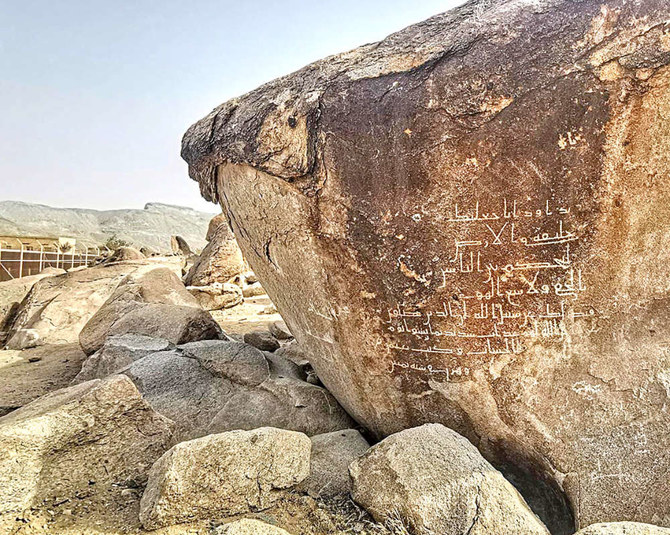
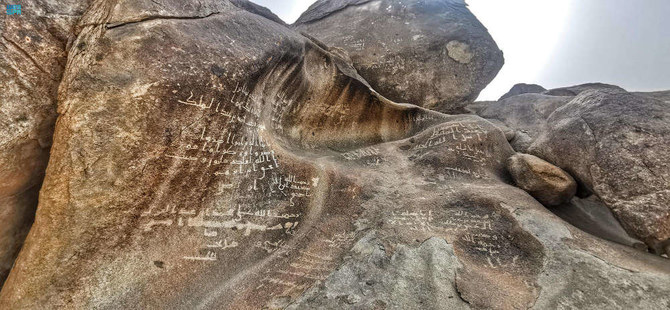
Wadi Al-Asilah contains 60 early Islamic inscriptions — material that is highly important in the study of Arabic calligraphy. The Al-Asilah Valley is one of the valleys to the northeast of Makkah. It borders the Grand Mosque from the Al-Ju’ranah side and is located between El-Baroud and Al-Abtah, to the northwest of the ritual sites. It is 2 kilometers wide and 6 kilometers long, and stretches between Rai’ Al-Nuqra and Rai’ Umm Al-Silm.
Dr. Fawaz Al-Dahas, director of the History Center of Makkah, said that the Al-Asilah region is known as the neighborhood of the descendants of Abdullah bin Khalid bin Usayd, who ruled Makkah during the caliphate of Caliph Uthman bin Affan.
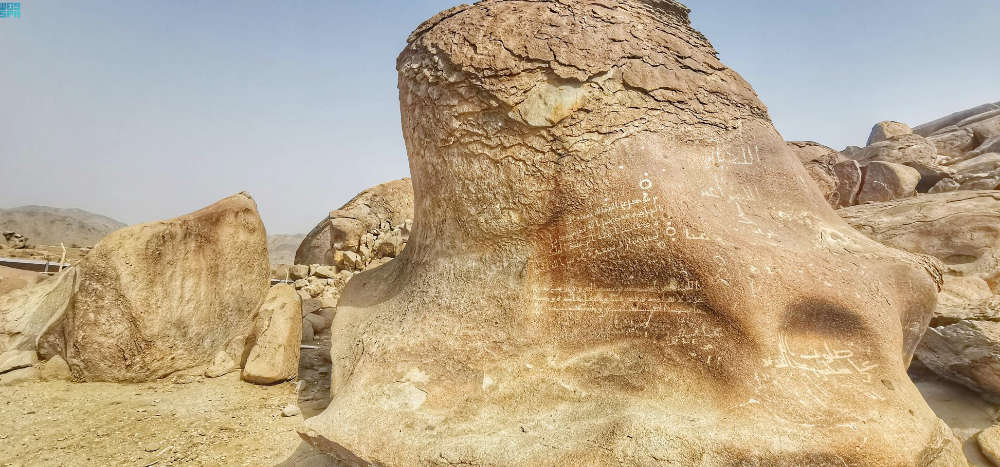
Wadi Al-Asilah is rich in early Islamic inscriptions, especially on the Al-Wajrah Mountains and on Al-Qimmah rock. The former contains three peaks: Al-Wajrah Al-Kabir (The Grand Wajrah), Al-Wajrah Al-Saghir (Little Wajrah) and Abu Sirrah Mountain.
The total number of inscriptions is about 60, including one in the name of Safiyyah bint Shiba bint Uthman, and another in the name of Mohammed bin Abdul Rahman bin Hashim from the first century.
The neighborhood saw keen interest throughout the ages from Muslim caliphs and sultans, as well as rulers of Makkah. They were keen to provide drinking water for pilgrims. The area was located on the path of Iraqi pilgrimage caravans. Wells became clustered near the location of the inscriptions, with small distances of about 200 meters separating them.

ThePlace: Wadi Al-Asilah in Makkah
https://arab.news/cvs2h
ThePlace: Wadi Al-Asilah in Makkah
- The total number of inscriptions is about 60, including one in the name of Safiyyah bint Shiba bint Uthman, and another in the name of Mohammed bin Abdul Rahman bin Hashim from the first century
Al Akaria signs SR1.2bn agreement lease with Amsa Hospitality
- Project, located in Riyadh Diplomatic Quarters, spans approximately 40,000 sq. meters and includes 240 modern residential units, comprising 176 apartments and 64 villas and townhouses
- CEO of Amsa Hospitality Muin Serhan: We have a certain commitment to deliver to the community and to the project in particular
RIYADH: The Saudi Real Estate Co., also known as Al Akaria, recently announced the signing of a lease agreement for the Amsa Vue Residential Compound in Riyadh with Amsa Hospitality, with the total value of the project estimated at around SR1.2 billion ($320 million).
Spread across 20 years, the cost reflects the long-term nature of the investment and its focus on value, sustainability, and operational quality.
The project, located in Riyadh Diplomatic Quarters, spans approximately 40,000 sq. meters and includes 240 modern residential units, comprising 176 apartments and 64 villas and townhouses.
Acting CEO of Al Akaria Khalid Al-Sehaibany stated that the project embodies the company’s approach to developing residential communities that focus on an integrated experience built on quality planning and comprehensive facilities, elevating the standard of living in Riyadh.
CEO of Amsa Hospitality Muin Serhan told Arab News that the core philosophy behind the project is to create a space that focuses both on individuals and community values.
Serhan pointed out that this strategy is central to a broader ambition to redefine hospitality in Saudi Arabia by embedding the hallmark of Arabian hospitality into the brand’s identity.
“We have a certain commitment to deliver to the community and to the project in particular. Year on year, we're adding value to the landlord and the owners of the assets,” he said.
He outlined a clear vision for the company’s legacy, aiming to set a new standard for hospitality management in the region. The goal, he said, is to be the go-to partner for developers and asset owners seeking to integrate hospitality elements into their projects.
Serhan confirmed that this vision is currently being brought to life through close collaboration with contractors and designers.
He emphasized that the process is a “moving journey,” where the designer, the brand, and the location converge to create a product that truly reflects the local narrative.