LAGOS: When the flight carrying hundreds of Nigerians fleeing South Africa landed in Lagos last week, the first feeling of passenger Iniebong James was one of relief. Then came worry.
Nearly two weeks after his return to his homeland, James, 52, is trying to settle back into the life he left 10 years ago when he packed his suitcases and headed for South Africa on a six-month visitor’s visa. He overstayed his visa and, despite lacking permission to stay, built a life as a car mechanic in the country’s Eastern Cape Province.
He was coping until he was attacked by anti-immigrant protesters in May, leaving him with a head wound, he told The Associated Press.
The attack on James came in the midst of a sharp rise in anti-migrant sentiment in South Africa in recent months, when there have been marches calling for immigrants in the country illegally to leave and reports of violence against some foreign nationals.
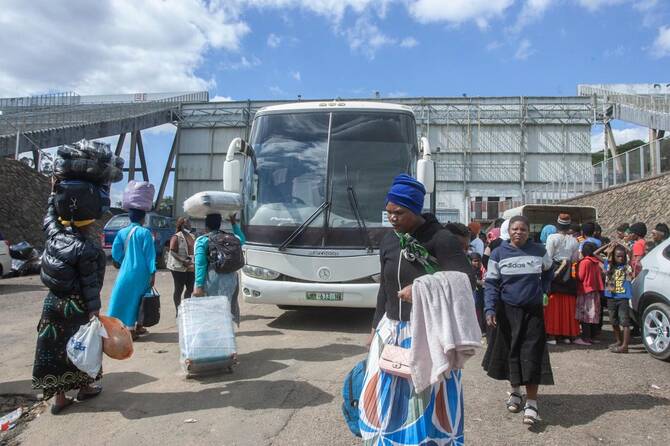
Hundreds of migrants from Nigeria and several other African countries have been repatriated from South Africa recently by their governments, citing threats of violence against them and a growing sense of tension.
South Africa has for years attracted foreign nationals from across Africa, including many from Nigeria, because of its relative wealth and opportunity. But outbursts of xenophobic violence against foreigners also have accompanied that sporadically. South Africans sometimes blame foreigners for high levels of unemployment and poverty, putting a strain on public services and for being involved in crime.
Before moving to South Africa, James worked as a truck driver for a haulage company in Lagos, but the company closed in 2016 when Nigeria’s economy entered its first recession in two decades. Unemployment worried him, but it was the dayslong power outages that pushed him to finally leave.
To survive with an expired visa in South Africa, James said he had to bribe community police officers 200 rands ($12.14) a week to operate his shop. Twice, he paid immigration officers when he had been arrested. The AP could not verify this claim.
James said he is happy to be home as he now has his “freedom,” but the economy that made him leave is much worse and he is worried that getting a job will be harder.
“I would submit my CV if anybody can accept me, but I am still hoping for the government to help me (with a job),” he said.
Starting over again is very difficult
When Nigeria’s government announced a repatriation flight last month to bring back its nationals, James thought he should come back home and try again.
He was one of the first group of Nigerians repatriated from South Africa on June 11.
Over the past decade, the economy has fallen, leading to far-reaching economic reforms by President Bola Tinubu in 2023. Those reforms included the removal of decades-long fuel subsidies that kept fuel prices low, influencing retail prices of nearly every good and service in the West African nation and allowing the value of the naira to be dictated by market forces.
The reforms have sparked skyrocketing inflation, which was compounded by the US-Iran war, bringing fuel prices to nearly $1 per liter. When James left in 2016, fuel cost 85 naira a liter ($0.1), and on the day he returned it was selling for 1,400 naira ($1.03).
“Everything is too expensive,” he said.
The government said the returnees will “receive the appropriate assistance and support before being reunited” with their families.
The Ministry of Foreign Affairs did not respond to questions about long-term plans for the repatriated citizens.
“Reparation is not transformation,” said Margaret Monyani, founder of OLAM Africa Research Institute, a Johannesburg-based migration think-tank. “Returning is not always as straightforward as it sounds. People just think, go back home and start again. No, what is home?”
’We don’t want to employ foreigners’
Omotola Adeniyi, another Nigerian migrant, joined her mother in South Africa in 2015 when she was 8 years old. Her mother enrolled her and her sister in high school, but after that, she was unable to find a job and proceed to university.
“After I finished high school, that’s when I saw real life because everywhere I looked for a job, all I could get was, ‘No, we don’t want to employ foreigners,’” Adeniyi said.
She started saving for a flight back to Nigeria last year, but the fare was too high. So she accepted Nigeria’s offer of an airline ticket home. But having been away for 11 years, Adeniyi said home feels foreign now.
The latest protests have sparked diplomatic reactions from governments across the continent, including Nigeria, Ghana, Malawi and others who have repatriated hundreds of their citizens from the country. Nigeria and Ghana summoned South Africa’s diplomatic officials and issued strong public statements.
“The price of your peace, and the safety of your children, is worth any sacrifices you have to make, or any assets you have to leave behind when fleeing a conflict zone or hate-infested environment. Survival is the noblest form of vengeance,” Nigeria’s Minister of Foreign Affairs, Bianca Odumegwu-Ojukwu, told James and others when they arrived in a statement delivered by her representatives.
Despite the attacks on foreigners, experts say South Africa still remains a destination of choice for most African migrants due to its more advanced economy and infrastructural development.
“It doesn’t mean South Africa has the perfect institutions, but they’re working to a large extent,” Monyani said.


![]()

Nigerian migrants returning from South Africa face the same economic issues they left behind
Short Url
https://arab.news/r99em
Nigerian migrants returning from South Africa face the same economic issues they left behind
- Nigerians repatriated from South Africa following a series of anti-migrant marches and reported attacks on some foreign nationals are struggling to settle into a new life back home
Latest updates


© 2026 SAUDI RESEARCH & PUBLISHING COMPANY, All Rights Reserved And subject to Terms of Use Agreement.