Russian ex-president Medvedev calls for tougher ‘foreign agent’ law

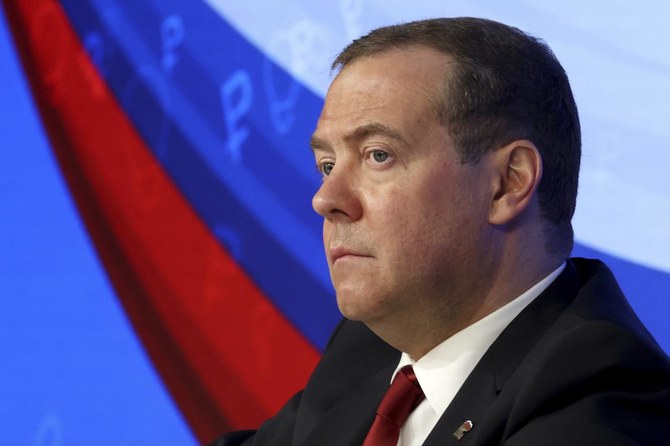
Russian Security Council Deputy Chairman and the head of the United Russia party Dmitry Medvedev attends a session of the Entrepreneurship in the New Economic Reality forum in Moscow on Thursday. (AP)
Short Url
Updated 28 May 2022
Follow

Russian ex-president Medvedev calls for tougher ‘foreign agent’ law

  • Russia has legislation that labels groups and individuals as foreign agents if they receive foreign funding to engage in political activity
  • Dozens of Kremlin critics have been listed as foreign agents

DUBAI: Former president Dmitry Medvedev on Saturday called for Russia to toughen its laws on “foreign agents” and prosecute individuals working for the interests of foreign states.
Russia has legislation that labels groups and individuals as foreign agents — a term that carries Soviet-era connotations of spying — if they receive foreign funding to engage in what the authorities say is political activity.
Dozens of Kremlin critics have been listed as foreign agents, including journalists and rights activists, and many have fled abroad.
Medvedev, who now serves as deputy head of Russia’s security council, said the enforcement of the “foreign agents” legislation needed to be stepped up as Moscow carries out its military intervention in Ukraine and finds itself under unprecedented sanctions from the West.
“If they (foreign agents) are carrying out activities aimed against our country — especially during this tough period — and receive money for it from our enemies, our response must be quick and harsh,” Medvedev wrote on the Telegram messaging app.
He added that the legislation should more precisely classify “foreign agents” and impose stricter consequences for their offenses.
At present, those listed are subject to stringent financial reporting requirements and have to preface anything they publish, including social media posts, with a disclaimer stating that they are foreign agents.
Lawmakers said last month they planned to submit amendments to the law to add more restrictions, including on investing in strategic industries and working with children.
Medvedev also said he supported legislative initiatives to criminally prosecute “people working in the interest of a foreign state.”
His post began and ended with a reference to a 1960s Soviet television series set during the Russian Civil War of the 1920s, in which Medvedev noted that the hero was shot as a spy.


‘New progress’ on North Korea possible in coming days, Seoul official says

Updated 3 sec ago
Follow

‘New progress’ on North Korea possible in coming days, Seoul official says

  • Senior official says Seoul has made considerable efforts to bring North Korea to dialogue
  • Trump administration has decided to lift sanctions for humanitarian aid projects to North Korea
SEOUL: A senior South Korean official said Friday “new progress” on North Korea could come within days, with a local report saying the Trump administration has decided to approve humanitarian sanctions exemptions for Pyongyang.
In a meeting with reporters in the United States, the senior official said Seoul has made considerable efforts to bring North Korea to dialogue.
“There could be some new progress in the coming days” on North Korea, the government official said on condition of anonymity.
Washington has long demanded that Pyongyang give up its banned nuclear weapons program, with the country under successive rounds of UN sanctions over it.
The South Korean senior official’s comments came while addressing US President Donald Trump’s scheduled trip to China in April.
Trump last year made repeated overtures to Pyongyang’s leader Kim Jong Un during his barnstorming tour of Asia, saying he was “100 percent” open to a meeting and even bucking decades of US policy by conceding that North Korea was “sort of a nuclear power.”
North Korea did not respond to Trump’s offer, and has repeatedly said it will never give up its nuclear weapons.
South Korea’s daily Dong-A Ilbo reported on Friday, citing Seoul’s unnamed government sources, that the Trump administration has decided to lift sanctions for humanitarian aid projects to North Korea, at the UN Security Council’s 1718 Committee.
Analysts say the move would allow South Korea’s NGOs to provide humanitarian assistance — such as nutritional supplements, medical equipment and water purification systems — to North Korea, an improverished state that has struggled to provide for its people.
Trump met North Korea’s Kim three times. The US leader once famously declared they were “in love” during his first term, in efforts to reach a denuclearization deal.
But since a summit in Hanoi in 2019 fell through over differences about what Pyongyang would get in return for giving up its nuclear weapons, no progress has been made between the two countries.
Seoul and Washington earlier this week reaffirmed their commitment to North Korea’s “complete denuclearization” and cooperation on Seoul’s nuclear-powered submarine plan, a move that has previously drawn an angry response from Pyongyang.
North Korea is set to hold a landmark congress of its ruling party soon, its first in five years.
Ahead of that conclave, Kim ordered the “expansion” and modernization of the country’s missile production.