

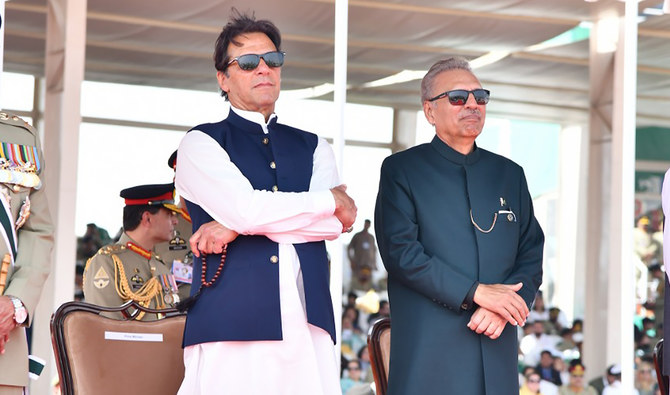

ISLAMABAD: President Dr Arif Alvi has written a letter to Prime Minister Shehbaz Sharif and the Chief Justice of Pakistan asking that a high-powered judicial commission be formed to probe allegations by ex-premier Imran Khan that he had been removed from office last month as part of a "foreign conspiracy."
The letter by Alvi, a longtime Khan ally, brings deep political divisions to the fore and is seen as a direct challenge to Sharif, formerly an opposition leader, whom Khan has variously accused as being part of a foreign conspiracy orchestrated by the United States through local politicians, including Sharif.
On Monday, Alvi had said he "strongly" rejected Sharif's recommendation to remove Khan ally Omar Sarfaraz Cheema from the post of governor Punjab, unleashing a debate on the constitutional question of whether the governor could be removed without the president's approval.
Cheema, a member of Khan’s Pakistan Tehreek-e-Insaf (PTI) party since 1996, was appointed governor Punjab last month amid a no-confidence motion filed against Khan in parliament, which saw many of his allies, including then governor Chaudhry Mohammad Sarwar, jumping ship and joining the opposition. Khan was subsequently ousted from office in the no-trust vote and Sharif appointed the new PM by parliament. Khan blames the “regime change” on the US, which has denied the charge.
“[Alvi] was sending his letter to the Prime Minister of Pakistan as well as to the Honorable Chief Justice of Pakistan, with the request that the latter may constitute an empowered Judicial Commission to conduct open hearings in this regard [regime change conspiracy],” Alvi’s office said on Twitter.
Alvi’s post came as Cheema on Tuesday refused to accept a government notification removing him as governor of the province of Punjab, saying it was unconstitutional and had also been rejected by the president of Pakistan.
A governor in Pakistan is appointed by the president on the advice of the prime minister and can serve for a tenure that lasts up to five years.
“Despite the President's rejection of the summary in view of the extraordinary circumstances, the Cabinet Division issued an unconstitutional notification which I reject,” Cheema said on Twitter. “Consultations with constitutional experts are underway. I will announce the next course of action soon.”
In a notification by the cabinet division dated May 10, the government said Cheema “ceases to hold the office of the Governor of the Punjab, with immediate effect,” adding that the speaker of the Punjab provincial assembly would perform the functions of governor until a permanent appointment was made.
Presenting the opinion of the federal government, interior minister Rana Sanaullah said the president was bound to follow the prime minister's advice on the issue, adding that Alvi's office did not have any "inherent" or "residual" powers according to a Supreme Court ruling.
On Monday, Alvi tweeted: “President Dr. Arif Alvi strongly rejects Prime Minister’s advice to remove Governor Punjab. The President has conveyed to the Prime Minister of Pakistan that Governor Punjab cannot be removed without his approval.”
The president said Cheema could not be removed since there was neither an allegation of misconduct against him, nor had he committed any act contrary to the constitution.
Cheema earlier this month also refused to administer oath to new Punjab chief minister Hamza Shehbaz Sharif, who belongs to PTI's rival Pakistan Muslim League-Nawaz (PML-N) party, despite a ruling issued by the Lahore High Court. His presence in the office of governor also stalled the process of provincial cabinet formation since there were concerns he would also stall the oath-taking process of provincial ministers.


