

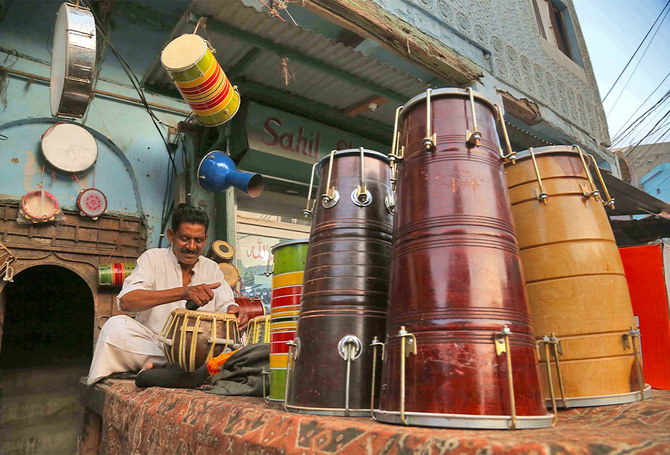
Fading art of tabla-making gets unlikely lifeline from the faithful in Pakistan’s Karachi

Tanveer Hussain is busy making a tabla at his shop in Karachi, Pakistan, on May 7, 2022. (AN Photo/S.A.Babar)
Short Url
Updated 09 May 2022
Follow

Fading art of tabla-making gets unlikely lifeline from the faithful in Pakistan’s Karachi

  • Once a thriving red-light district, Karachi’s Napier Road offered livelihood to tabla-makers for decades
  • After losing traditional clientele, tabla-makers started selling musical instruments to religious devotees

KARACHI: Surrounded by pieces of sandpaper, rolled cardboard stands and hand drums, Tanveer Hussain sits in a small store in a defunct red-light district of Pakistan’s southern port city of Karachi.
Napier Road, which once nurtured dance and music, wears a deserted look, though Hussain’s business has survived due to the devotees of various faiths.
As he sandpapers the top of a hand drum called tabla, which is used in the subcontinental classical music, Hussain points at buildings across the road while recalling times when they attracted dance enthusiasts.
The dwellers of Napier Road were forced to migrate to other parts of the city after Pakistan’s former military ruler General Ziaul Haq declared wine, prostitution and dance illegal in the 1980s.
In the following decades, escalating gang violence in the city put an end to whatever entertainment activity was left in the neighborhood.

Hussain’s business managed to survive since he found new customers among the devotees of various faiths who started buying tablas to perform religious rituals.
“If our business still runs and helps us earn a little for food, it is because of people associated with different religions,” Hussain’s son, Saddam, told Arab News.
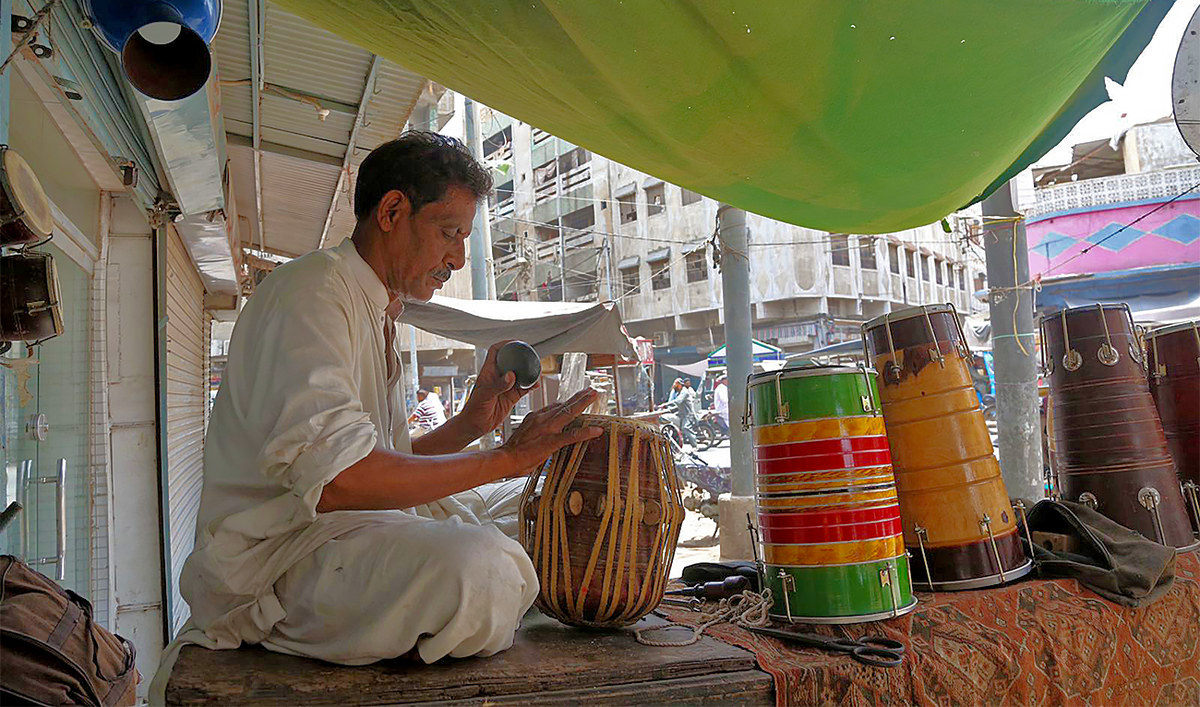


Tanveer Hussain is busy making a tabla at his shop in Karachi, Pakistan, on May 7, 2022. (AN Photo/S.A.Babar)

Proponents of Islamic Sufism in the Subcontinent sing qawwalis, a musical performance of poetry that aims to lead listeners to a state of religious ecstasy, which requires tabla beat. Similarly, Sikhs, Hindus, and Christians also purchase the musical instrument from Hussain for religious rituals.
One of his clients, Sardar Gurmeet Singh, told Arab News he buys tablas to recite kirtan, a Sikh hymn, in gurdwaras.
Tapping his new musical instrument, Singh said the handmade drums by Hussain and his son had no competition.
“This is the best place to find tabla,” he said. “This is why I have purchased a new one and brought the old ones for repair. This, along with harmonium, is mandatory for reciting kirtan.”
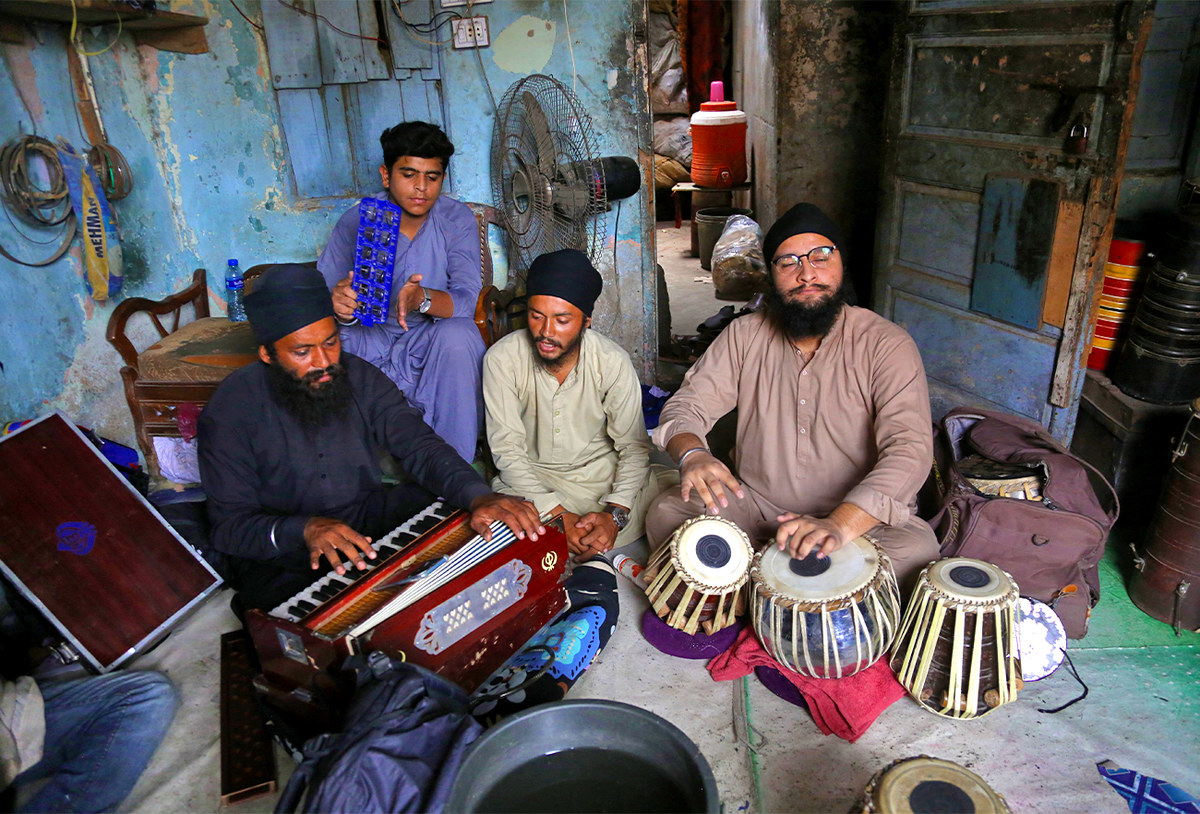


Sardar Gurmeet Singh (right) beats a pair of tabla to check its quality as his friends Sardar Mool Singh and Sardar Ramesh Singh recite kirtan at a store located on Napier Road in Karachi, Pakistan, on May 7, 2022. (AN Photo/S.A.Babar)

Today, most of the buildings on Napier Road look dilapidated.

“These [buildings] … were once home to women dancers,” Hussain told Arab News.
He recalled that his store was once among 18 tabla shops in the neighborhood. Back in the day, workers remained busy round the clock to meet customer demand for valuable percussion instruments. Now only three shops remain in the area, he said.
“Our business is going extinct and may not survive for more than five to six years,” he added.
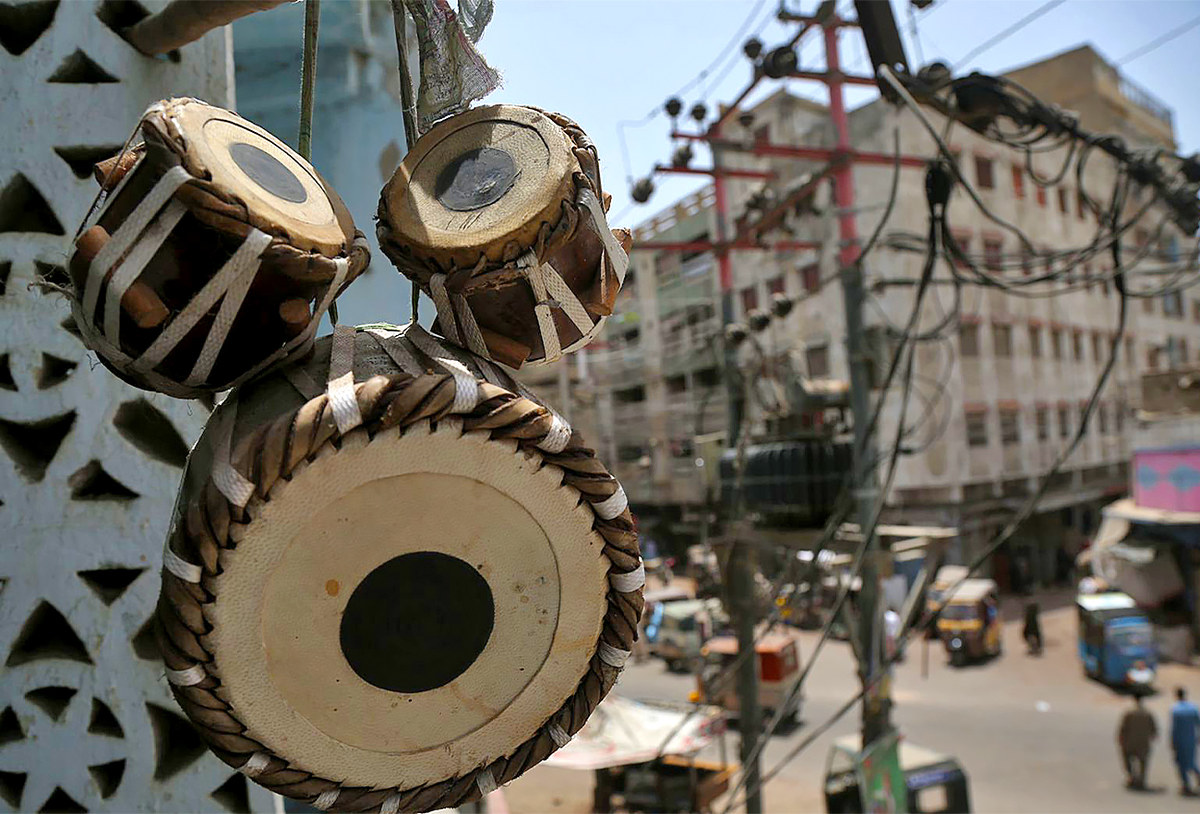


Tablas hang outside a store on Napier Road in Karachi, Pakistan, on May 7, 2022. (AN Photo/S.A.Babar)

Rubina Chaudhry, who is in her 60s, briefly worked as a teenaged dancer in the area just a few years before the ban imposed in the 1980s.
She said there was hardly a building in the neighborhood that did not have mujra, a traditional Mughal-era dance form in which a woman moves as her male colleagues play tabla and harmonium.

“There are over one hundred apartments in these buildings and each one of them used to have guests from across the city,” Chaudhry told Arab News. “It was also a cultural center, which it is no more.”


Workers are busy making tablas at a workshop in Karachi, Pakistan, on May 7, 2022. (AN Photo/S.A.Babar)

Saddam said mujra continued in the area until 2002 despite the new rules introduced by Haq’s regime.
“Our work as tabla-makers still continues, though it is not the same as it used to be in the past,” he said. “We came to the workshop at 9am and went home after midnight since we still had customers.”
The period was then followed by worsening security situation due to violence involving gangs based in nearby neighborhoods of Lyari and Shershah. They extorted money and harassed dancers, forcing them to leave Napier Road.
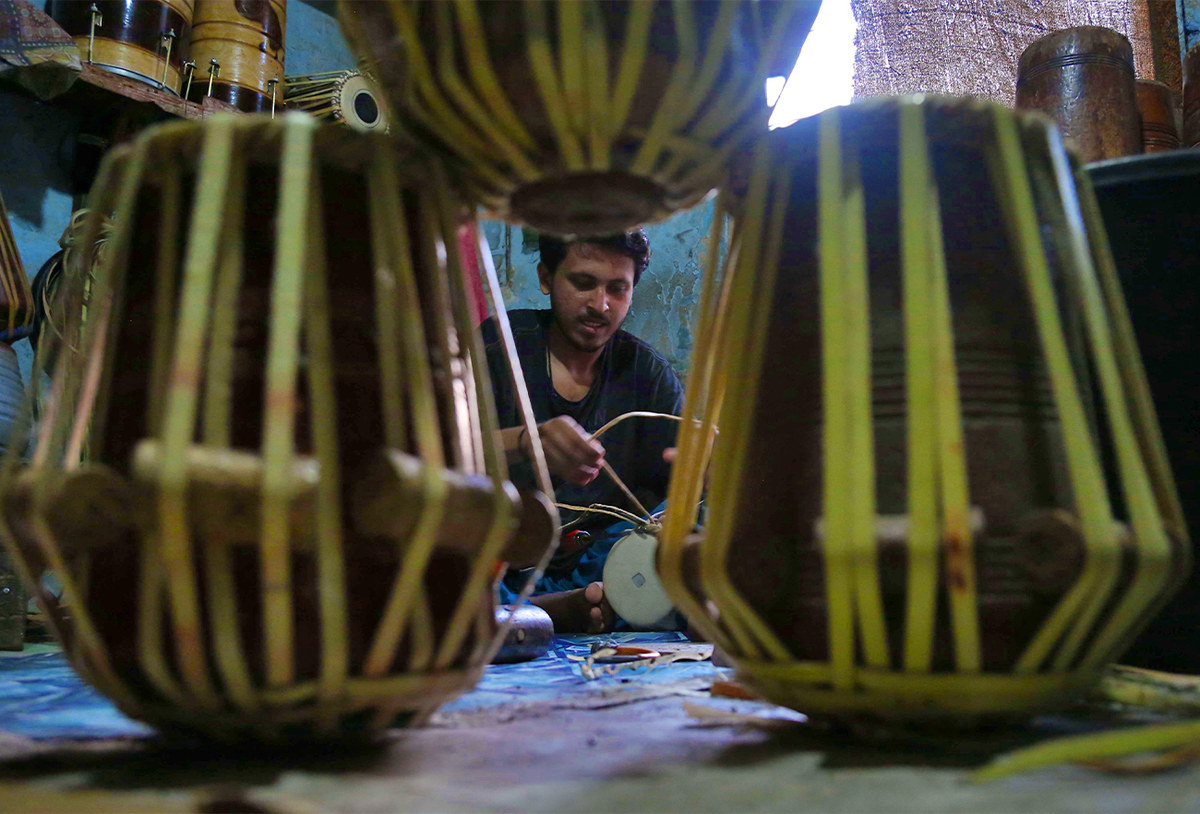


A worker is busy making tablas at a workshop in Karachi, Pakistan, on May 7, 2022. (AN Photo/S.A.Babar)

“Gangsters put the last nail in the coffin of this place and completely shut down whatever activity was left,” Saddam said while recalling how he tried to make time to watch dance performances after work.
Today, Hussain and his son depend on religious devotees to help keep their craft alive for a few more years. “If people of these faiths were not there, our work would have ended long ago,” he said.
Saddam maintained the art of tabla-making would go extinct if it were not institutionalized.

“If this situation persists, our children may not continue this profession for meager earning and we may soon lose our ancestral skill,” he added.


Pakistan, China call for more ‘visible, verifiable’ actions to dismantle ‘terrorist’ groups in Afghanistan 

Updated 5 sec ago
Follow

Pakistan, China call for more ‘visible, verifiable’ actions to dismantle ‘terrorist’ groups in Afghanistan 

  • Foreign ministers of China, Pakistan co-chair seventh round of strategic dialogue in Beijing to review bilateral cooperation, regional situation
  • Pakistan accuses Kabul of facilitating attacks launched by militant outfits from Afghanistan’s soil, a charge Kabul has repeatedly denied

ISLAMABAD: Pakistan and China on Monday urged Afghanistan to take more visible actions to dismantle “terrorist organizations” based in its country, vowing to work with world powers to encourage Kabul to adopt moderate policies and integrate into the international community. 

Ties between Pakistan and Afghanistan remain strained as Islamabad alleges militant outfits, mainly the Tehreek-e-Taliban Pakistan (TTP) group, uses Afghan soil to launch attacks against Pakistan. Islamabad accuses the Afghan Taliban government of facilitating these attacks against Pakistan, charges Kabul have repeatedly denied. 

The joint statement by China and Pakistan was released after a meeting of both countries’ foreign ministers, Ishaq Dar and Wang Yi, in Beijing. Dar and his Chinese counterpart co-chaired the Seventh Round of China-Pakistan Foreign Ministers’ Strategic Dialogue in Beijing on Jan. 4 where they reviewed cooperation in trade, investment, economic sectors, counterterrorism, defense and regional matters. 

“The two sides called for more visible and verifiable actions to dismantle and eliminate all terrorist organizations based in Afghanistan which continue to pose serious threats to regional and global security, and prevent terrorist organizations from using the Afghan territory for terrorism against any other country and to endanger any other country,” the statement read. 

The joint statement said the two countries will work with world powers to encourage Kabul to adopt an inclusive political framework, moderate policies, and pursue good neighborliness. 

On bilateral cooperation, China and Pakistan said they had agreed to focus on industry, agriculture and mining, and also promote the building and operation of the Gwadar Port in southwestern Pakistan. 

“The two sides will deepen cooperation in areas such as trade and investment, information technology, science and technology, cybersecurity, technical and vocational training and education, and people-to-people and cultural exchanges,” the statement said. 

“The two sides agreed to further strengthen cooperation in the financial and banking sectors, including extending mutual support at regional and international multilateral financial forums. Pakistan appreciated China for providing support for its fiscal and financial sectors.”

The joint statement said China commended Pakistan’s “comprehensive measures” to combat “terrorism” and protect Chinese personnel, projects and institutions in the country.

“The two sides reiterated their commitment to combating terrorism in all its forms and manifestations with zero tolerance, and agreed to further deepen all-round cooperation on counter-terrorism and security, and make concerted efforts to ensure that the China-Pakistan Belt and Road cooperation advance in a secure and smooth manner,” the statement said. 

Pakistan and China expressed their willingness to conduct a transboundary water resources cooperation, stressing the importance of fulfilling international legal obligations. The statement comes as Pakistan frequently accuses India of violating a water-sharing agreement between the two neighbors, claiming New Delhi purposefully diverts the flow of water away from its territory. 

Islamabad has warned that any move by New Delhi to stop or divert the flow of Indus rivers to Pakistan will be considered an “act of war.”

Pakistan and China also demanded an unconditional, comprehensive and permanent ceasefire in Gaza in their joint statement, reaffirming their support for the Palestinian people’s right to self-determination and for the implementation of a two-state solution in the Middle East. 

“The two sides also expressed their concern at the situation in the occupied West Bank, and urged the need for urgently addressing it,” the statement said.