BERLIN/BELGRADE: Germany said on Tuesday it noted reports that Serbia was receiving Chinese surface-to-air missiles, warning it expected the Balkan country to align its foreign policy with the European Union if it wanted to become a member.
Media reports said Chinese military cargo planes last week delivered to Belgrade the FK-3 surface-to-air defense system, similar to Russia’s S-300 or the United States’ Patriot.
Serbian authorities did not confirm the delivery took place.
Belgrade paid for the FK-3 missiles and China’s CH-92A combat drones in 2019, making Serbia their first operator in Europe.
“As a matter of principle, the Federal Government’s expectation of all EU accession candidates is that they join the European Union’s Common Foreign and Security Policy and thereby moves increasingly closer to the EU,” Germany’s Federal Press Office said.
Serbia’s President Aleksandar Vucic, speaking at a military drill at the weekend, acknowledged he plans to present “the newest pride” of its army this week, without elaborating.
Serbia is balancing its European aspirations, and partnership with NATO, with its centuries-old religious, ethnic and political alliance with Russia.
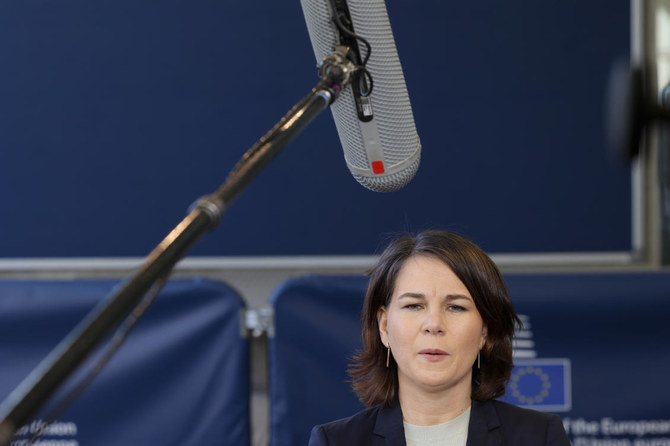
German Foreign Minister Annalena Baerbock on Monday renewed calls for Serbia to join the EU, the United States and other countries in imposing sanctions on Russia for its invasion of Ukraine.
Belgrade has voted against Russia three times at the United Nations but stopped short of imposing sanctions against it.
“If you want to become a member of the EU, which Serbia does want, then it is central that at such moments you join EU foreign policy, and sanctions that go along with it,” Baerbrock said.
Serbia’s military is loosely based on ex-Soviet technology and Russia is one of its main suppliers. Belgrade is also dependent on gas and oil supplies from Russia.
The West fears that weapons purchases from China and Russia could contribute to their influence in the tense Balkan region which is still recovering from the devastating wars in the 1990s.
On Monday, Vucic told Reuters Serbia plans to purchase a dozen Dassault Rafale fighter jets, a move seen by experts as a sign of Belgrade distancing from Russia.
China has invested billions of euros in Serbia, mainly in soft loans, infrastructure and energy projects.


Germany says Serbia should align with EU policies if it wants to join bloc
https://arab.news/rptvs
Germany says Serbia should align with EU policies if it wants to join bloc

- Media reports said Chinese military cargo planes last week delivered to Belgrade the FK-3 surface-to-air defense system
- Serbian authorities did not confirm the delivery took place


‘Don’t let Pari Island sink’: Indonesian fishers seek climate reparations from Swiss cement giant
- Holcim emitted more than 7bn tonnes of carbon dioxide between 1950 and 2021, research shows
- With about 11 percent of Pari submerged, most of the island might be underwater by 2050
JAKARTA: When Asmania began aquafarming on Indonesia’s Pari Island more than 20 years ago, harvest time brought her abundant seaweed and grouper fish to sustain livelihood, at times yielding more than enough good quality produce to supply export markets.
But as oceans grew warmer and extreme weather became more common as a result of climate change, seaweed and fish farming on the island are increasingly unsustainable, forcing her and other women on the island to look elsewhere to make a living.
“The seaweed we plant is not as good as it used to be. I also used to harvest grouper every nine months, but in the face of the climate crisis, the fish die way earlier,” the 42-year-old mother of three told Arab News.
The low-lying island of Pari, part of the famed Thousand Islands that lie off Java’s northwestern coast just under two hours from the Indonesian capital of Jakarta, is on the forefront of the climate crisis.
With rising global temperatures driving up sea levels, the island of about 1,000 people has suffered more frequent coastal erosion and tidal flooding that is driving away tourists — a traditionally steady source of income — while chaotic weather devastated fishing hauls.
The direct impacts of climate change pushed Asmania and three other Pari islanders to sue Swiss-based Holcim, the world’s largest cement maker, joining a growing number of lawsuits aimed at holding corporations responsible for their contributions to climate change.
“We feel the shift caused by climate change and suffer from the subsequent environmental damage. This is why we were encouraged to file a lawsuit,” Asmania said.
“Large corporations responsible for emissions, like Holcim, must be held accountable. It’s not fair that people who live on the coast must bear all the burden, it’s not fair that small fishermen like us must live awaiting the risks of climate change.”
Research by the US-based Climate Accountability Institute shows that Holcim emitted more than 7 billion tonnes of carbon dioxide between 1950 and 2021, while the Global Cement and Concrete Association said cement production accounts for about 7 percent of global carbon dioxide emissions.
With support from the Indonesian Forum for the Environment, or Walhi, the Swiss Church Aid group HEKS and the European Center for Constitutional and Human Rights, the four Indonesians from Pari filed a complaint against Holcim in Zug, Switzerland — where Holcim has its headquarters — in 2023.
In December, the Swiss court agreed to hear the complaint, which accuses Holcim of failing to do enough to cut carbon emissions and demands the global manufacturer to reduce its carbon dioxide emissions by 43 percent by 2030, co-finance adaptation measures on Pari and pay “loss and damage” compensation.
It was the first time a Swiss court has admitted climate litigation brought against a big corporation, according to HEKS.
“I was so happy when I heard the news, after what has been a very long process,” Asmania said.
“Why am I fighting for this? Because it’s not just for me, it’s also for my kids and future grandkids, they deserve and need a good environment.”
Holcim did not immediately respond to Arab News’s request for comment but has reportedly appealed the Swiss court decision.
Eleven percent of Pari Island has been submerged over the past decade due to rising sea levels, and most of it will probably be underwater by 2050, according to Walhi.
“Pari Island was around 40 to 43 hectares, but this is no longer the case. There’s been so much more coastal abrasion so we’re losing more of our land,” Mustaghfirin, a Pari fisherman and one of the plaintiffs in the case, told Arab News.
The 54-year-old father of three has been fishing for three decades. While his catch could reach more than 100kg in the past, nowadays he considers himself lucky to return home with 30kg. Some species, such as tuna and lobster, are increasingly difficult to find.
“There have been about seven generations who lived on this island, and these days we are truly feeling the impacts of climate change, which is threatening our home, our livelihoods,” he said.
“Don’t wait until we sink to save us. Don’t let Pari Island sink.”