JAKARTA, Indonesia: Enormous swathes of pristine forest are being cut down across Indonesia to supply the rapidly rising international demand for biomass material seen as critical to many countries’ transitions to cleaner forms of energy.
Nearly all of the biomass from forests destroyed for wood pellet production since 2021 has been shipped to South Korea and Japan, The Associated Press found in an examination of satellite images, company records and Indonesian export data. Both countries have provided millions of dollars to support the development of biomass production and use in Indonesia.
Indonesia’s state-run utility also has plans to dramatically increase the amount of biomass it burns to make electricity.
Experts and environmentalists fear the rising international and domestic demand, coupled with weak domestic regulation, will accelerate deforestation at the same time it prolongs the use of highly polluting fossil fuels. Biomass is organic material like plants, wood and waste, and many coal-fired power plants can be easily modified to burn it alongside coal to make energy.
“Biomass production — which is only recently starting to be seen on an industrial scale in Indonesia — is a dire new threat to the country’s forests,” said Timer Manurung, director of Auriga Nusantara, an environmental and conservation organization in Indonesia.
As countries accelerate their energy transitions, demand for biomass is growing: The use of bioenergy has increased an average of about 3 percent per year between 2010 and 2022, the International Energy Agency said.
Experts including the IEA say it’s important for that demand to happen in a sustainable way, such as using waste and crop residue rather than converting forest land to grow bioenergy crops. Deforestation contributes to erosion, damages biodiverse areas, threatens wildlife and humans who rely on the forest and intensifies disasters from extreme weather.
And many scientists and environmentalists have rejected the use of biomass altogether. They say burning wood-based biomass can emit more carbon than coal and tree-cutting greatly reduces forests’ ability to remove carbon from the atmosphere. Critics also say that using biomass to co-fire, instead of transitioning directly to clean energy, simply prolongs the use of coal.
In Indonesia, biomass production is causing deforestation across the archipelago.
Auriga Nusantara reports that more than 9,740 hectares (24,070 acres) of forest have been cleared in areas where biomass production is permitted since 2020. Permits have been issued for over 1.4 million hectares (3,459,475 acres) of energy plantation forests in Indonesia, with over one-third of that land being undisturbed forest. Over half of these concession areas are the habitat of flagship species such as sumatran rhino, elephants, orangutans and tigers, said Manurung.
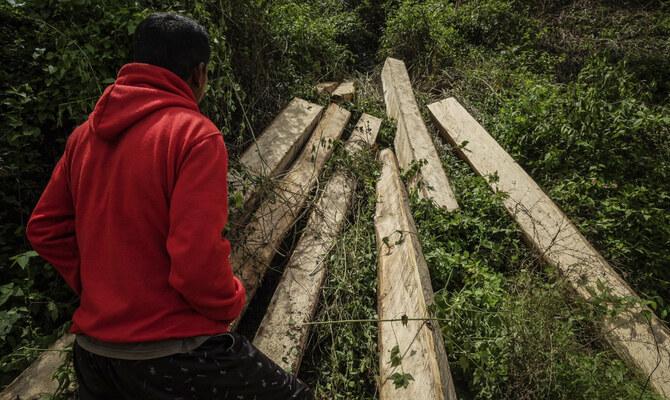
In the carbon-rich forests of Gorontalo, Sulawesi, the felling, shredding and shipping of old trees to make energy-dense wood pellets has been streamlined. Over 3,000 hectares (7,410 acres) of forest have been razed in a concession owned by Banyan Tumbuh Lestari, from 2021 to 2024, according to satellite analysis shared with AP by international environmental organization Mighty Earth. An additional 2,850 hectares (7,040 acres) were cleared for logging roads.
After trees are cut down, they’re turned into wood pellets at a facility near the concessions owned by Biomasa Jaya Abadi, the largest exporter of wood pellets from Indonesia from 2021-2023, according to data Auriga Nusantara compiled from the Indonesian Ministry of Environment and Forestry database. The database has no records of wood pellet exports prior to 2020.
Biomasa Jaya Abadi did not respond to repeated requests for interviews or comment. Banyan Tumbuh Lestari do not have contact information publicly available; AP contacted their main shareholders seeking comment but got no response. Indonesia’s ministries of Environment and Forestry; Energy and Mineral Resources and Maritime Affairs and Investment did not respond to requests for comment.
Nearly all of Indonesia’s wood pellet production is shipped overseas to meet international demand, said Alloysius Joko Purwanto, an energy economist at the Economic Research Institute for ASEAN and East Asia.
Most of Indonesia’s wood pellets went to South Korea (61 percent) and Japan (38 percent) from 2021-2023, according to government data.
“It’s clear that Japan and South Korea’s governments are trying to buy more biomass from Indonesia to lower their own domestic emissions,” said Bhima Yudhistira, executive director of the Indonesia-based Center of Economic and Law Studies.
Both countries have provided millions of dollars of financial support toward the development of biomass in Indonesia through research, policy, construction and other support, according to a review of publicly available business and government agreements by AP.
South Korea’s Forest Service, which drives South Korea’s biomass expansion and policy, did not reply to requests for comment. Japan’s Ministry of Agriculture, Forestry and Fisheries also did not respond to a request for comment.
The promotion of biomass production and use has coincided with the ramping-up of Indonesia’s domestic biomass use.
The country’s state electricity company, Perusahaan Listrik Negara (PLN), plans to implement 10 percent biomass co-firing for 52 coal plants across the country. PLN estimates that would take 8 million tons of biomass a year — far greater than the wood pellet industry’s capacity at the end of 2023 of less than 1 million tons, according to Indonesian civil society organization Trend Asia.
To achieve PLN’s ambitions, a 66 percent increase in forest plantation land would be needed — “which would likely come at the expense of intact, carbon-rich and carbon-absorbing forests,” according to a report by Mighty Earth.
PLN spokesperson Gregorius Adi Trianto told AP that the company’s plan relied on biomass from “organic waste such as tree branches, rice waste, and wood industry waste ... rather than from actively logged forests.”
With Indonesia lacking clear regulations and oversight of its expanding biomass industry, experts fear deforestation is likely to spike for years to come.
“We’re already far behind when it comes to monitoring and regulating issues around biomass production in Indonesia,” said Yudhistira. “There’s definitely a lack of due diligence, and forests are suffering.”


![]()

Indonesian forests pay the price for the growing global biomass energy demand
Short Url
https://arab.news/pn6zd
Indonesian forests pay the price for the growing global biomass energy demand
- Biomass is organic material like plants, wood and waste, and many coal-fired power plants can be easily modified to burn it alongside coal to make energy


Latest updates




© 2026 SAUDI RESEARCH & PUBLISHING COMPANY, All Rights Reserved And subject to Terms of Use Agreement.