

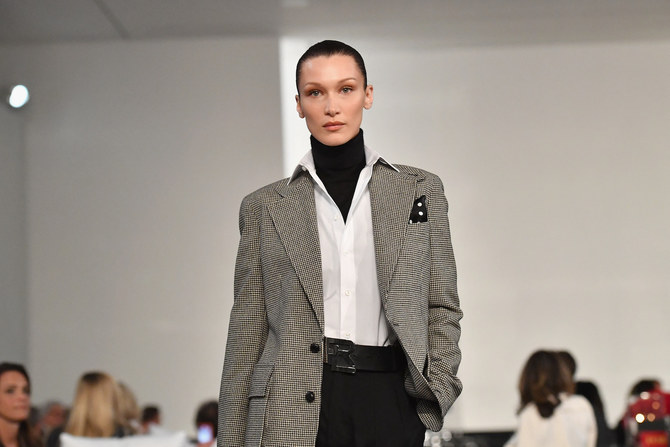
Part-Palestinian model Bella Hadid gets acting role in third season of ‘Ramy’
Updated 02 April 2022
Arab News
DUBAI: Palestinian-Dutch supermodel Bella Hadid is getting a starring role in the third season of Hulu’s “Ramy” in what will be the catwalk star’s television series acting debut.
The details about Hadid’s character in the show are yet to be revealed.
“Ramy,” starring comedian Ramy Youssef, is about an Egyptian-American living in New Jersey who is determined to become a better Muslim as he grows into an adult, often stumbling along the way.
The show also stars British-Syrian actor Laith Nakli, Palestinian star Hiam Abbass, Egyptian actor Amr Waked, “Moon Knight” actress May Calamawy, Canadian-Lebanese comedian Dave Merheje, Palestinian-American talent Mohammed Amer and US actor Steve Way.
Season One of the series was an outsized success, netting Youssef — who is the writer, director, creator and executive producer of the show — a Golden Globe for Best Actor and an international following.
In the second season, Ramy digs deeper into his Muslim faith, introducing a charismatic new imam named Sheik Ali, played by Oscar-winner Mahershala Ali, with whom Ramy quickly bonds.
Hadid has walked for some of the top fashion brands in the world, including Burberry, Off-White, Fendi, Versace, Givenchy, Max Mara, Moschino and many more.
She has fronted multiple covers in France, Italy, UK, Japan, China and other countries.
She also hops on various business ventures. In September 2021, she joined Kin Euphorics, a tonic and wellness drink brand, as co-founder and partner.
Kin Euphorics, founded by Saudi Arabia-raised Jen Batchelor, is a non-alcoholic tonic that was “made to transform the world’s oldest social ritual, drinking, into a conscious act of better being,” as per the beverage brand’s official website.
In a 2017 interview with Porter magazine, Hadid talked about her father, Mohamed Hadid, and her faith.
“He was always religious, and he always prayed with us. I am proud to be a Muslim,” she said.
Lina Gazzaz traces growth, memory and resilience at Art Basel Qatar
The Saudi artist presents ‘Tracing Lines of Growth’ at the fair’s inaugural edition
Updated 7 sec ago
Shyama Krishna Kumar
DUBAI: Saudi artist Lina Gazzaz will present a major solo exhibition via Hafez Gallery at the inaugural edition of Art Basel Qatar, which runs Feb. 3 to 7. “Tracing Lines of Growth” is a body of work that transmutes botanical fragments into meditations on resilience, memory and becoming.
Hafez Gallery, which was founded in Jeddah, frames the show as part of its mission to elevate underrepresented regional practices within global conversations. Gazzaz’s biography reinforces that reach. Based in Jeddah and trained in the United States, she works across sculpture, installation, painting and video, and has exhibited in Saudi Arabia, the US, Lebanon, the UK, Germany, the UAEand Brazil. Her experimental practice bridges organic material and conceptual inquiry to probe ecological kinship, cultural memory and temporal rhythm.
Saudi artist Lina Gazzaz. (Supplied)
“Tracing Lines of Growth” is a collection rooted in long-term inquiry. “I started to think about it in 2014,” Gazzaz told Arab News, describing a project that has evolved from her initial simple line drawings through research, experimentation and material interrogation.
What began as tracing the lines of Royal Palm crown shafts became an extended engagement with the palm’s physiology, its cultural significance and its symbolic afterlives. During the COVID-19 pandemic, she went deeper into that exploration, translating weathered crown shafts into “lyrical instruments of time.”
Each fragment of “Tracing Lines of Growth” is treated as a cache of human and ecological narratives. Gazzaz describes a feeling of working with materials that “have witnessed civilization,”attributing to them a deep collective memory.
Hafez Gallery’s presentation text frames the palm as a cipher — its vascular routes once pulsing with sap transformed into calligraphic marks that summon the bodies of ouds, desert dunes and scripted traces rooted in Qur’anic and biblical lore.
Detail of Gazzaz's work. (Supplied)
“Today, the palm has evolved into a symbol of the land and its people. Throughout the Arabian Peninsula, it is still one of the few agricultural exports; and plays an integral role in the livelihood of agrarian communities,” said Gazzaz.
The sculptures’ rippling ribs and vaulted folds, stitched with red thread, evoke what the artist hears and sees in the wood. “Each individual line represents a story, and it’s narrating humanity’s story,” she said.
The works’ stitching is described in the gallery’s materials as “meticulous.” It emphasizes linear pathways and punctuates the sculptures with the “suggestion of life’s energy moving through the dormant material.”
“(I used) fine red thread — the color of life and energy — to narrate the longevity of growth, embodying themes of balance, fragility, music, transformation and movement. The collection is about the continuous existence in different forms and interaction; within the concept of time,” Gazzaz explained.
Hand-stitching, in Gazzaz’s practice, highlights her insistence on care and repair, and the human labor that converts cast-off organic forms into carriers of narratives.
Gazzaz describes her practice as a marriage between rigorous research and intuitive making. “I am a search-based artist... Sometimes I cannot stop searching,” she said. “During the search and finding more and more, and diving more and more, the subconscious starts to collaborate with you too, because of your intention. After all the research, I go with the flow. I don’t plan... I go with the flow, and I listen to it.”
The artist is far from done with this particular project. “I am now beginning to explore the piece with glass,” she noted.
Art Basel Qatar’s curatorial theme for its inaugural year is “Becoming.” For Gazzaz, ‘becoming’ is evident in the material and conceptual transformations she stages: discarded palm fragments reconstituted into scores of lived time, stitched lines reactivated as narratives.
“It’s about balance. It’s about fragility. It’s about resilience,” she said.