

Top Pakistani commanders concerned over Indian missile misfire, say could have led to ‘major disaster’

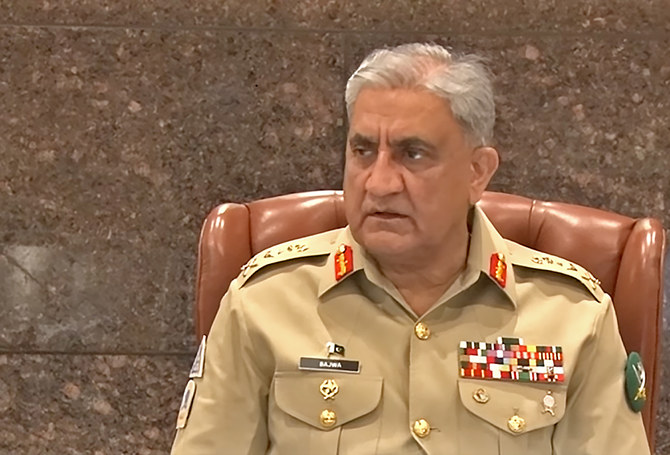
Pakistan’s Army Chief General Qamar Javed Bajwa presides over a corps commanders’ conference at GHQ in Rawalpinidi, Pakistan, on March 15, 2022. (ISPR)
Short Url
Updated 15 March 2022
Follow

Top Pakistani commanders concerned over Indian missile misfire, say could have led to ‘major disaster’

  • India says conducting review of procedures for operations, maintenance and inspection of weapons systems
  • Islamabad rejects Indian statement, Foreign Minister Shah Mahmood Qureshi writes to UN Security Council

ISLAMABAD: Top Pakistan army commanders on Tuesday reviewed with concern the Indian missile misfire into Pakistan and maintained it could have resulted in a “major disaster” and endangered “regional peace and strategic stability,” the Pakistani military said. 
Pakistan’s military last Thursday said an unarmed surface-to-surface missile launched from neighboring India violated Pakistan’s airspace and ended up in eastern Punjab province on Wednesday, damaging a wall in a residential area but causing no casualties. 
Major General Babar Iftikhar, the head of the military’s media wing, demanded an explanation from India over the “flagrant violation,” while the foreign office summoned the Indian charge d’affaires in Islamabad the same day to convey Pakistan’s ‘strong protest.’ 
On Tuesday, Pakistan’s Army Chief General Qamar Javed Bajwa presided over a corps commanders’ conference to review key global and regional developments, internal security situation and progress on the Western Border Management Regime. 
“The forum reviewed with concern, the recent incident of missile firing, claimed as accidental by India, which could have resulted in a major disaster,” the Inter-Services Public Relations (ISPR), the Pakistani military’s media wing, said in a statement. 
“It was emphasized that despite Indian acknowledgment of the mistake, relevant international forums must take a serious view of the incident and subject the safety and security protocols of Indian strategic assets to deliberate oversight.” 
Such dangerous incidents could act as a “trigger and seriously endanger regional peace and strategic stability,” the ISPR added. 
Islamabad also rejected a statement by India’s defense minister on the missile ‘accidentally’ fired from India into Pakistan last week, Pakistan’s foreign minister Shah Mahmood Qureshi said on Tuesday. 


Pakistani Foreign Minister Shah Mahmood Qureshi shows the letter sent to the U.N. Security Council regarding the accidental missile fired by India during a briefing in Islamabad, Pakistan, on March 15, 2022. (AP)

India said on Tuesday it was conducting a review of its procedures for operations, maintenance and inspection of weapons systems following the accidental firing. 
“We attach the highest priority to the safety and security of our weapon systems. If any shortcoming is found, it would be immediately rectified,” Indian Defense Minister Rajnath Singh told parliament. “While this incident is regretted, we are relieved that nobody was hurt due to the accident.” 
Pakistan’s Qureshi told journalists the Indian statement was “incomplete” and he had written to the UN Security Council on the matter and asked the international community to take the matter up. 
Last Friday, New Delhi responded that in the course of a routine maintenance, a technical malfunction led to the accidental firing of the missile, saying it was relieved there was no loss of life due to the accident. 
During a briefing on Monday, Ned Price, the US state department spokesperson, said the Americans had “no indication” that a missile fired from India into Pakistan last week was anything but an accident. 
“We have no indication, as you also heard from our Indian partners, that this incident was anything other than an accident,” Price told reporters on Monday. 
“We refer you, of course, to the Indian Ministry of Defense for any follow-up. They issued a statement on March 9th to explain precisely what had happened. We don’t have a comment beyond that.” 


Pakistan seeks wider access to Canadian market as both sides want deeper agricultural cooperation

Updated 4 sec ago
Follow

Pakistan seeks wider access to Canadian market as both sides want deeper agricultural cooperation

  • Islamabad urges faster certification for canola and halal products in a bid to expand agricultural exports
  • Canada pledges collaboration on pest management, invites Pakistan to the Canada Crops Convention

ISLAMABAD: Pakistan on Wednesday pressed for improved access to Canadian agricultural markets and faster certification procedures for key exports as Islamabad looks to modernize its climate-strained farm sector and resolve long-standing barriers to trade, according to an official statement.

The push comes as Pakistan, a largely agricultural economy, faces mounting challenges from erratic weather patterns, including floods, droughts and heatwaves, which have hurt crop yields and raised food security concerns. Islamabad has increasingly sought foreign partnerships and training to upgrade farm technology, while pursuing export-oriented growth to diversify markets for mangoes, rice, kinnow, dates and halal meat.

Federal Minister for National Food Security Rana Tanveer Hussain and Canadian High Commissioner Tarik Ali Khan met to discuss “strengthening bilateral collaboration in agriculture, enhancing market access for key commodities, and advancing ongoing phytosanitary and technical cooperation,” according to the statement.

“Minister Rana Tanveer Hussain stressed the importance of resolving market access challenges to ensure uninterrupted trade in priority commodities, particularly canola, which constitutes Pakistan’s major agricultural import from Canada," it continued. "He highlighted that Pakistan seeks robust and timely certification and registration processes to facilitate predictable canola imports."

"The Minister emphasized that Pakistan is eager to strengthen its halal export footprint in Canada and sought CFIA’s [Canadian Food Inspection Agency’s] support in accelerating certification procedures for halal gelatin, casings, and value-added poultry," it added.

High Commissioner Khan  acknowledged Pakistan’s concerns, the statement said, and assured Hussain of Ottawa’s readiness to deepen technical collaboration.

He also briefed the minister on Canada’s pest management systems and grain supply chain controls, adding that his country looked forward to facilitating Pakistan’s plant protection team during an upcoming systems-verification visit.

Khan also invited Pakistani officials to the Canada Crops Convention in April 2026 and confirmed participation in the Pakistan Edible Oil Conference, reaffirming that “Canada views Pakistan as a priority partner in the region.”

Hussain proposed forming a joint working group to maintain momentum on technical discussions and regulatory issues as both officials agreed to strengthen agricultural cooperation.