

Saudi artist finds inspiration in the past for Founding Day

1 / 3
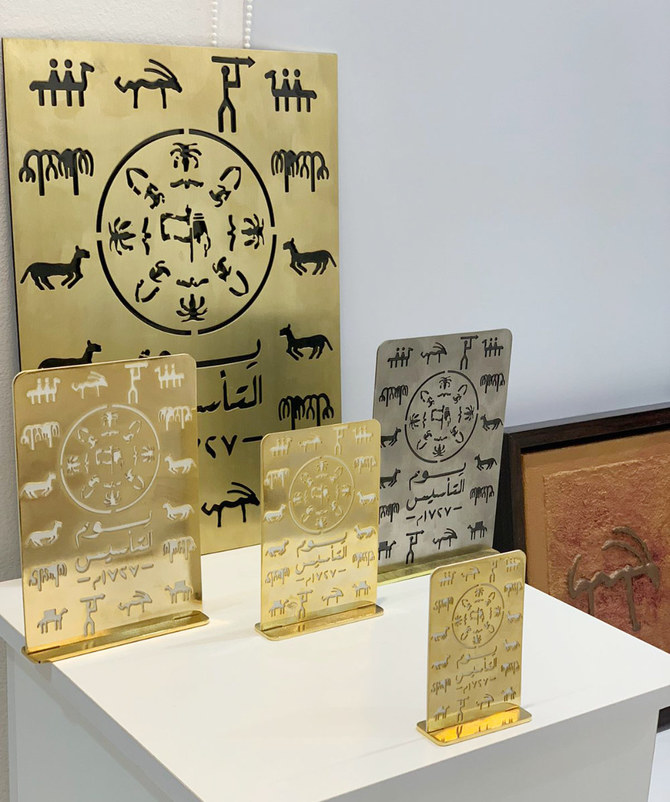
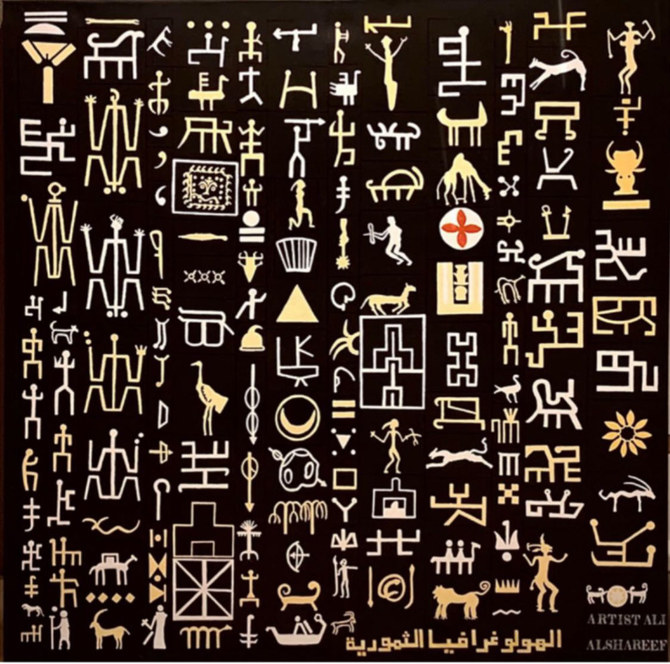
‘The Founding Heliography’ is an emblem of the three centuries since the founding of the state. (Supplied)
2 / 3
Photo/Supplied
3 / 3
Photo/Supplied
Short Url
Updated 27 February 2022
Follow

Saudi artist finds inspiration in the past for Founding Day

  • ‘My work is a message for present, future generations to preserve heritage of their parents, grandparents in a way that reflects national belonging’

MAKKAH: A Saudi artist has attracted attention on social media presented with a work of art called “The Founding Heliography,” made to mark Saudi Arabia’s Founding Day. The piece was inspired by the rock writings and archaeological inscriptions found in various Saudi cities.

Ali Al-Sharif said that Saudi Arabia is the cradle of the civilizations that have been built in the Arabian Peninsula and the Kingdom’s territory was the recipient of the divine messengers who left a legacy that echoed the life of the ages in which they lived. He also said that this legacy wasn’t documented on leather nor on paper, but instead it was carved on rocks.
“I have two hobbies,” he said. “The first one is my love for archeology and the second is my love for fine arts of different schools, such as realism, abstract art and graffiti from an early age.

HIGHLIGHT

In his work ‘The Founding Heliography,’ Saudi artist Ali Al-Sharif used symbols found on the rocks in the Kingdom that referred to the prehistoric civilizations that lived in the Arabian Peninsula.

“The rock paintings and carvings of those civilizations are a reason why I am developing my skills and hobbies to travel outside the Kingdom.”
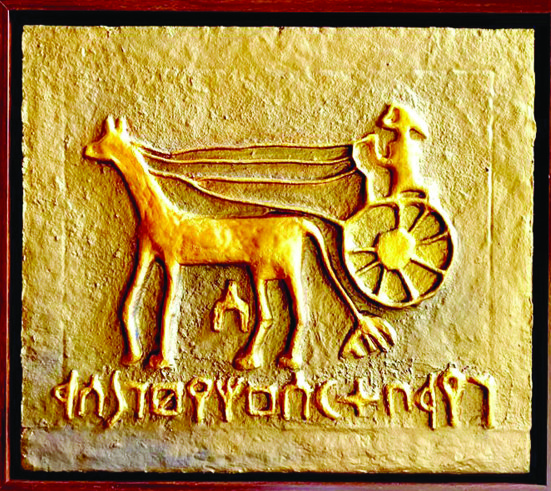
He said he was self-taught and uses advanced archaeological techniques to preserve the drawings and carvings. He said that this new art is called the “3D Graffiti School.”


Saudi Arabia is the cradle of the civilizations
that have been built in the Arabian Peninsula.
Ali Al-Sharif, Saudi artist

“I transferred more than 123 paintings and rock inscriptions in a three-dimensional manner to be visible and prominent outside the rock painting,” he said.
In his work “The Founding Heliography” he used symbols found on the rocks in the Kingdom that referred to the prehistoric civilizations that lived in the Arabian Peninsula.
He said that these represent the ancient ages in which ancient Arabs lived and which contributed to the formation of the personality of the founder King Abdulaziz.
“This allowed us to learn about their lives, the strength of their personalities and the way the rulers of the Saudi state navigated life despite its difficulties, as their life became a legacy later on,” he said.
He also stated that the early rulers were leaders in all fields, and they strived to achieve prosperity for their peoples and their successors who have immortalized the history of the Kingdom.
“My work is a message for present and future generations to preserve the heritage of their parents and grandparents in a way that reflects national belonging,” he said.
He said that “The Founding Heliography” is an emblem of the three centuries since the founding of the state.


Group of women retrace sacred Hijrah route to Madinah 

Updated 7 sec ago
Follow

Group of women retrace sacred Hijrah route to Madinah 

  • Kingdom’s supportive environment for women made the 500 km journey on foot possible, says Soul Al-Hijrah founder  

JEDDAH: Embarking on a spiritual journey, a group of women retraced the sacred steps of the Prophet Muhammad from Makkah to Madinah.

The 22 women — adventurists, managers, doctors, nurses, teachers, mothers ranging in age from their 30s to their 50s — are believed to be the first known women-only group to have performed the journey closest to the exact original route.

The women walked on foot, nearly 500 km from Makkah to Madinah, to experience what the Prophet Muhammad and his companions might have gone through more than 1400 years ago.

“Yes, it is the first ever women-only Hijrah walk and they all came from all over the world to walk together on an unforgettable journey. They completed a week-long journey, experiencing the route’s historical and spiritual significance,” Salma Abdulrahman, the director of Soul Al-Hijrah, told Arab News.

The 22 participants from around the world visited key locations along the route in an immersive experience of the historical and spiritual significance of the Hijrah.

Abdulrahman was among the first to embark on the path.

“I found my soul on this path, and felt as if I were born a new. This journey revived my heart and changed the course of my life. It was (also) the beginning of my tourism company Soul Al-Hijrah.”

She accompanied the participants from the beginning of the trip and said: “It was an honor to serve them and the guests of our beloved Prophet Muhammad, peace and blessings be upon him, ensuring their comfort throughout the journey. 

“It is an honor I cherish deeply, and my joy in it and in them is indescribable.”

She said that they have undertaken more than 20 journeys on the Hijrah route to date, all of which were carried out for groups from various countries around the world, reflecting the growing global interest in this type of spiritual and historical tourism.

“It must be said that this type of initiative would not have been possible without the supportive environment provided by the beloved Kingdom for Saudi women. It has granted them complete confidence to be at the forefront of the tourism sector,” Abdulrahman added.

Dr. Dina Altayeb, a periodontist and implantologist, and one of the members of the women-only Hijrah walk, described the journey as the most intense and profound of the walks or adventures she had completed.

“I wish more people could have this opportunity because it offers countless benefits for the soul, body and mind,” she added.

Altayeb, who is the first Saudi woman to qualify and compete in the Ironman World Championship,  told Arab News that this is a totally different experience. “For me it was not as difficult as my usual adventures but spiritually was a great experience because it was an indescribable emotional experience … (and) it was also a learning experience.”

She was overjoyed to enter Madinah. “We walked through mountains, valleys and deserts just as the Prophet did. It was a great feeling when we reached Madinah after eight days.”

Ghadeer Sultan, a human resources manager, joined the group with no prior planning. “To be honest, I did not plan to join the Prophet’s migration journey; it was just a coincidence, an invitation that came my way, and a little curiosity to have the experience,” she said.

“When we entered the shaded garden in Madinah, I felt as if peace and light had penetrated the depths of my soul. I sensed the joy of the Ansar upon the arrival of the Prophet, peace and blessings be upon him, and my heart felt all those historic moments. I was experiencing the true great values that the city of the Prophet embodies: values of love and tolerance.”

Upon reaching Madinah after the challenging journey which started on Dec. 22 and ended on Dec. 29, the participants were warmly welcomed with roses and prayers.

Their first stop in Madinah was the Quba Mosque, where the Prophet stayed during his migration. 

As the first mosque in Islamic history and partially built by the Prophet himself, it holds profound spiritual significance.