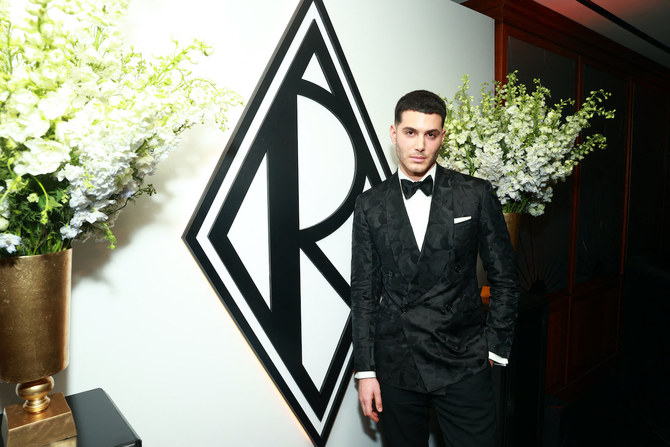

DUBAI: US-Palestinian model and artist Fai Khadra jetted to Dubai this week to celebrate the launch of US label Ralph Lauren’s Club Eau de Parfum, in which he stars.
Khadra appeared in the campaign video, set in a swanky nightclub of the same name as the fragrance, alongside Palestinian-Dutch model Gigi Hadid, model and musician Lucky Blue Smith and artist and actor Luka Sabbat.
In an interview with Arab News, Khadra said he enjoyed filming the campaign, his first post-pandemic.
“Ralph Lauren is such an iconic American heritage brand, and their concept for this fragrance was really to bring together a community that felt authentic to Ralph’s club, and that felt like a real club of a group of friends,” he said.
“I think they did that so beautifully because all the cast members who were in the campaign are really friends in real life. We hang out and we see each other all the time.”
Besides the friendly atmosphere on set, Khadra said that one of his favorite memories was spending time with Hadid.
“Gigi had just had her baby and I didn’t get a chance to meet her. So I got a chance to, you know, at least see photos of the baby and hear about how she’s doing. It was just great to be all together again,” he explained.
Khadra has had a lot on his plate, recently partnering with heritage eyewear brand Oliver Peoples on a capsule collection of handcrafted sunglasses.
“They really are the perfect everyday shape. I designed them to be ‘every day,’ ‘looks great on everyone’ and can just seamlessly fit into your lifestyle,” he said.
Turning back to his art, Khadra also recently displayed a sculpture at a show called “Vessels” in Los Angeles.
“It was really an interesting idea. A friend of mine, Alex — who curates these shows — comes up with a concept for each show. The last one he did was chairs,” he said. “My idea was to carve a vessel out of the ground, which I thought was an interesting kind of take on the concept of his show.”
Some of Khadra’s favorite artists that he is inspired by are Bruce Nauman, Richard Prince and Andy Warhol.
He spent the lockdown period caused by COVID-19 in Los Angeles. “I was with my family for most of the time. We honestly cooked a lot. I know it was a very difficult time for everybody including myself, but I think something positive that came out of it was really being able to spend time with loved ones and kind of take a break from a very tricky life that we all live.”
Besides modeling, sculptures, DJ’ing and set design, Khadra is interested in exploring the tech world.
“I’ve actually been really interested in different tech companies and this new NFT (non-fungible token) space, and how art and technology are coming in together. I think that is definitely going to be the future,” he said.
“I’m very interested in learning more about the different tech spaces and how we can optimize the experience and create an experience that maybe you can’t achieve in the physical world.”