

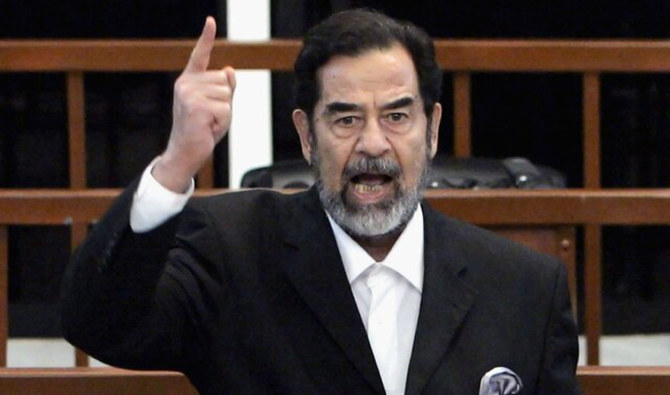
Iraq struggles to make use of Saddam Hussein’s crumbling palaces

Iraq has a total of 166 Saddam-era residences, villas and other complexes.
Short Url
Updated 09 February 2022
Follow

Iraq struggles to make use of Saddam Hussein’s crumbling palaces

BAGHDAD: Scattered across Iraq lie more than 100 opulent palaces and villas built by former dictator Saddam Hussein — some in use, many in ruins like much of the war-scarred country.

With their marble columns, ornate carvings and gaudy furniture, they reflected the megalomania and delusions of grandeur of Saddam, who visited some of them only once or twice.

In his Babylon residence, the feared strongman’s profile is engraved in bas-relief like that of the Mesopotamian emperor he idolized, Chaldean dynasty King Nebuchadnezzar II.

In many places, the initials “S.H.” are still visible as reminders of the despot who was toppled by the 2003 US-led invasion, captured later that year and executed in 2006.

Most of his palaces were looted during the chaos of the invasion, when thieves scavenged all they could carry, even ripping electric cables out of walls.

Since then, only a handful of the palatial residences have been given a second lease on life, often as military bases or public administrations, more rarely as museums.

Most lie empty, in part because the cost of renovating them is prohibitive. “We can turn palaces into museums, at least in Baghdad — a tapestry museum, for example, or on the royal family or Islamic art,” said Laith Majid Hussein, director of the Iraqi State Board of Antiquities and Heritage.

But he conceded that rehabilitating many of Iraq’s “gigantic castles” would require “astronomical sums.”

Red tape and entrenched graft spell other hurdles, said a senior government official, speaking on condition of anonymity.

“Bureaucracy and corruption hinder the restoration of these palaces to turn them into tourist complexes or heritage centers,” he said.

Saddam, during his more than two decades in power in the oil-rich country, had many monuments and palaces built while cheerfully defying the Western embargo of the 1990s.

In the turmoil of war, many were damaged in fighting or used as bases by US and other foreign forces.

In Baghdad, three palaces now house the presidency and the prime minister’s offices.

The sumptuous Al-Faw complex — encircled by an artificial lake — has since 2021 housed the private American University, built by an Iraqi investor.

Al-Faw, situated near the airport for Saddam’s VIP guests, once served as an American base. Now its stone and marble buildings house auditoriums, amphitheaters and a food court.

The university’s president Michael Mulnix voiced pride about the project which saw “the palace of a former dictator and a fairly ruthless man” become an institution of higher learning.

While the main palace had survived relatively intact, he said, “all of the other buildings ... were really destroyed.

“The windows were all broken out, there were birds flying around, snakes on the floor, literally. So it was very messed up. We had to go in and do substantial renovation.”


First responders enter devastated Aleppo neighborhood after days of deadly fighting

Updated 12 January 2026
Follow

First responders enter devastated Aleppo neighborhood after days of deadly fighting

  • The US-backed SDF, which have played a key role in combating the Daesh group in large swaths of eastern Syria, are the largest force yet to be absorbed into Syria’s national army

ALEPPO, Syria: First responders on Sunday entered a contested neighborhood in Syria’ s northern city of Aleppo after days of deadly clashes between government forces and Kurdish-led forces. Syrian state media said the military was deployed in large numbers.
The clashes broke out Tuesday in the predominantly Kurdish neighborhoods of Sheikh Maqsoud, Achrafieh and Bani Zaid after the government and the Syrian Democratic Forces, the main Kurdish-led force in the country, failed to make progress on how to merge the SDF into the national army. Security forces captured Achrafieh and Bani Zaid.
The fighting between the two sides was the most intense since the fall of then-President Bashar Assad to insurgents in December 2024. At least 23 people were killed in five days of clashes and more than 140,000 were displaced amid shelling and drone strikes.
The US-backed SDF, which have played a key role in combating the Daesh group in large swaths of eastern Syria, are the largest force yet to be absorbed into Syria’s national army. Some of the factions that make up the army, however, were previously Turkish-backed insurgent groups that have a long history of clashing with Kurdish forces.
The Kurdish fighters have now evacuated from the Sheikh Maqsoud neighborhood to northeastern Syria, which is under the control of the SDF. However, they said in a statement they will continue to fight now that the wounded and civilians have been evacuated, in what they called a “partial ceasefire.”
The neighborhood appeared calm Sunday. The United Nations said it was trying to dispatch more convoys to the neighborhoods with food, fuel, blankets and other urgent supplies.
Government security forces brought journalists to tour the devastated area, showing them the damaged Khalid Al-Fajer Hospital and a military position belonging to the SDF’s security forces that government forces had targeted.
The SDF statement accused the government of targeting the hospital “dozens of times” before patients were evacuated. Damascus accused the Kurdish-led group of using the hospital and other civilian facilities as military positions.
On one street, Syrian Red Crescent first responders spoke to a resident surrounded by charred cars and badly damaged residential buildings.
Some residents told The Associated Press that SDF forces did not allow their cars through checkpoints to leave.
“We lived a night of horror. I still cannot believe that I am right here standing on my own two feet,” said Ahmad Shaikho. “So far the situation has been calm. There hasn’t been any gunfire.”
Syrian Civil Defense first responders have been disarming improvised mines that they say were left by the Kurdish forces as booby traps.
Residents who fled are not being allowed back into the neighborhood until all the mines are cleared. Some were reminded of the displacement during Syria’s long civil war.
“I want to go back to my home, I beg you,” said Hoda Alnasiri.