

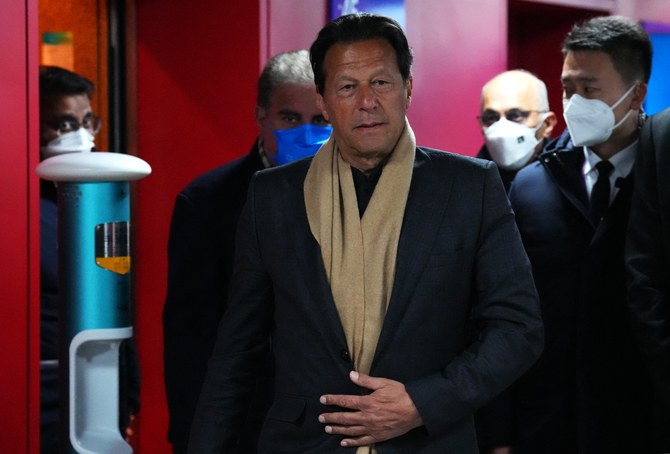

ISLAMABAD: Pakistani Prime Minister Imran Khan on Friday joined world leaders at Beijing's National Stadium to take part in the inaugural ceremony of Beijing Winter Olympics on his four-day official visit to China.
The prime minister arrived in Beijing on Thursday to attend the colourful event, besides holding meetings with Chinese leaders to seek investment in Pakistan's different sectors.
The athletes participating in the opening ceremony parade included Muhammad Karim from Gilgit-Baltistan who would represent Pakistan in Alpine Skiing.
Besides Karim, the four-member Pakistani delegation included Syed Noman Ali as the chef de mission, Nadeem Ajmal Khan as the team leader and Mirza Mohammad Qamar as the COVID-19 liaison and the coach.
Prime Minister Khan and his delegation rose from their seats to join other spectators in welcoming Pakistan's squad marching past through the venue and waving the national flag.
The games will continue till February 20, with around 3,000 athletes from 91 nations competing across 109 medal events.
Earlier in the day, China’s leading state-owned and private firms assured Pakistani Prime Minister Imran Khan of their "full support" for expeditious development of all projects under the China-Pakistan Economic Corridor, one of his top aides said.
The $60 billion corridor, comprising infrastructure, trade and energy projects, is designed to give China a shorter, more secure trading route via Pakistan to the Middle East and beyond, while also boosting Pakistan’s economy.
But media reports in recent months suggested many CPEC projects had been suspended or stalled because of the coronavirus pandemic and financing disputes. The costliest project under the CPEC agreement, the upgradation of Pakistan Railways' Mainline-1 (ML-1) at a cost of $6.8 billion, has reportedly hit the snag, with Beijing reluctant to fund it at the one percent rate demanded by Islamabad. Of the $19 billion worth of energy projects in Pakistan to produce 11,648 megawatts of electricity, only four have so far been completed.
The delay in getting 116 acres of land in the southern port city of Gwadar vacated by law enforcement agencies has also slowed down work on the Gwadar Free Zone and Gwadar Eastbay Expressway. The projects are seen as critical for full functioning of the Gwadar Port, the crown jewel of China’s Belt and Road Initiative (BRI) projects in Pakistan.
“Chinese leaders [during their meeting with the prime minister] have assured full support and full commitment to CPEC projects in Phase-2 and they'll develop all these projects expeditiously,” said Khalid Mansoor, who advises the prime minister on CPEC projects.
Chinese companies would provide technology and financial support for these projects, he said. A consortium of three companies is planning to construct a park to reprocess metal and paper in Gwadar with an investment of $3.5 billion in the next two to three years, according to the PM's aide.
Mansoor said three major agricultural companies and one leading textile mill also expressed their desire to invest in Pakistan. “The textile company will be investing $250 million to manufacture high-quality, export-oriented apparel and create at least 20,000 jobs,” he said.
Other executives who met the prime minister included officials of the China Communication Construction Company (CCCC), Huazhong Technology, Zhejiang Seaport Group, Challenge Apparel, Hunan Sunwalk Group, Royal Group, China Road and Bridge Corporation (CRBC), Zhengbang Group and the China Machinery Engineering Corporation (CMEC).
They briefed the prime minister on the progress of their ongoing projects in Pakistan, expressing a keen interest in projects relating to recycling of metals and paper, energy, textile, fibre-optics networks, housing, dairy and water management.
In his remarks, the prime minister appreciated Chinese firms and highlighted growing economic and trade ties between the two countries. He informed them about his government's measures to create a conducive environment for Chinese investment in Pakistan and encouraged them to benefit from business-friendly policies for investment in CPEC special economic zones.
“We are hopeful to secure commitments in a variety of sectors by the end of this trip,” Mansoor said.
PM Khan also held an exclusive session with heads and representatives of leading Chinese think tanks, universities and Pakistan Study Centers. He emphasized the importance of Pakistan-China relationship and ensuring regional stability and prosperity.
The Pakistani premier highlighted the united stance of both countries on multilateral forums, reaffirming Islamabad’s commitment to One-China Policy and other issues of core interests.
“The prime minister also thanked China for its unwavering support on Jammu and Kashmir dispute,” read a statement issued after the meeting.
Reaffirming Pakistan’s all-weather strategic partnership with China, the prime minister highlighted the importance of CPEC as a flagship project of President Xi Jinping’s Belt and Road Initiative.
He emphasized while Phase-I of CPEC was focused on infrastructure development and connectivity, the next phase would focus on industrialization, cooperation in information technology (IT) and agricultural transformation.
PM Khan highlighted that Pakistan was offering incentives for investment that were at par with or better than other investment destinations.
“In view of myriad global challenges, the world did not need another cold war,” he highlighted, adding that divisions could result in mounting sufferings and prevent common benefits.
“Pakistan was, therefore, of the belief that the key driver in international politics should be cooperation, rather than confrontation,” the prime minister said.


