



RAWALPINDI: Pakistan’s first female general, Nigar Johar, hailed Saudi Arabia for introducing “commendable” reforms for the welfare and well-being of women in an exclusive interview with Arab News earlier this week.
Lt. Gen. Johar belongs to Swabi, a small settlement in the conservative Khyber Pakhtunkhwa province in the country’s northwest, though the childhood environment of her town did not prevent her from dreaming of a professional career.
She joined the Army Medical College in 1981 and graduated four years later. Subsequently, she became the only woman in the history of Pakistan Army who reached the rank of a three-star general and was asked to lead a corps.
The three-star Pakistan Army general asked Muslim women to have self-belief since they were capable of exceling in any field.
“I am very happy that female residents of Saudi Arabia can now drive around due to the commendable steps taken by the king,” she told Arab News on Monday. “I was recently there for umrah and saw female drivers which made me very happy.”
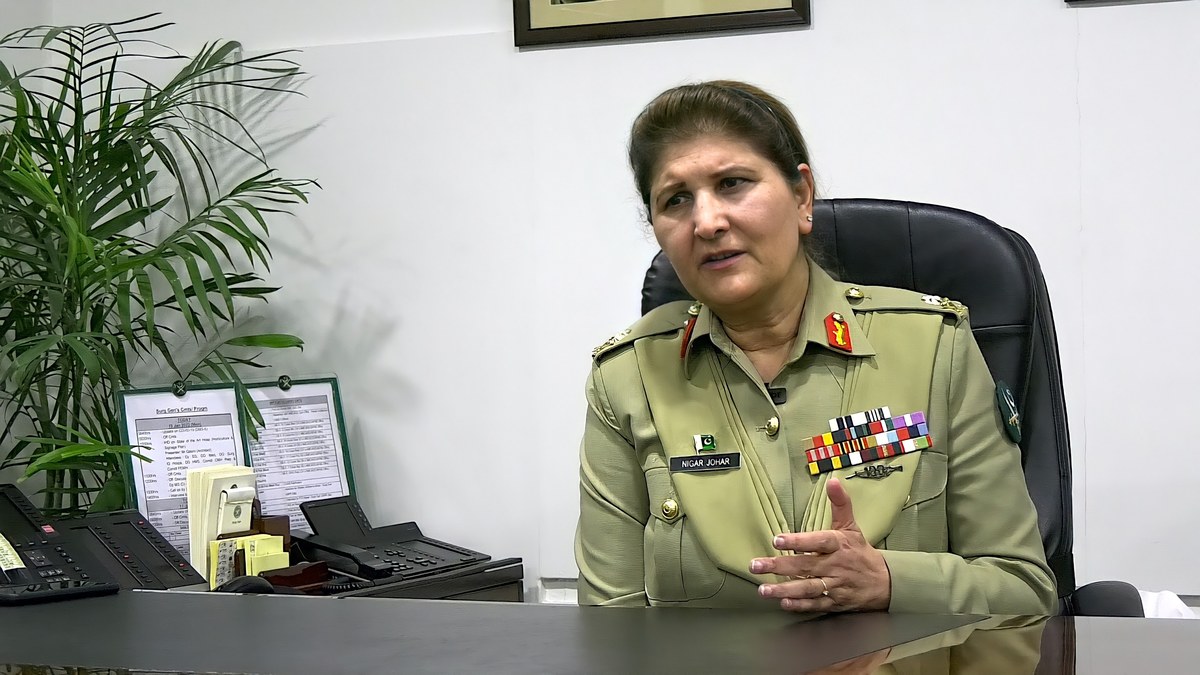
Pakistan’s first female general, Lieutenant General Nigar Johar Nigar Johar (right), speaks to Arab News Pakistan in Islamabad, Pakistan on January 10, 2022. (AN Photo)
Women’s rights are one of the issues that has benefited most from Saudi Arabia’s reform push in recent years. Some of the most important reforms in the kingdom included changes to laws designed to enhance rights of women in a number of fields and promote gender equality.
As a result, Saudi women have been appointed to high-ranking positions in the public and private sectors, as well as diplomatic missions. In addition, more Saudi women are working in the legal profession and have opportunities to represent clients in court and work in public prosecution offices.
Lt Gen Johar, who is the first female colonel commandant of the Army Medical Corps (AMC), also applauded the Gulf countries for providing assistance to Pakistan during the COVID-19 pandemic.
“Saudi Arabia, Bahrain, UAE and Qatar have really helped us,” she acknowledged. “We got ventilators, oxygen generation plants and oxygen concentrators [from them].”
The top AMC official attributed her professional success to a clear sense of purpose along with a system of meritocracy in the Pakistani armed forces.
“If you know your job and work hard with clear direction and sincerity, there is no reason why you would be left behind,” she said. “The army system is merit-based. This is also exemplified by my presence here.”
Explaining her passion for the armed forces, she said her father was an artillery officer who inspired her in many ways.
“He was my ideal,” she said. “I had seen him in uniform from the beginning which influenced my decision to become a doctor and join the army.”
Johar’s dedication and professional excellence captured the attention of her superiors who gave her positions of command and authority, making her feel she was facing “the biggest challenge” of her life.
She said that her first leadership role arrived when she was asked to command a hospital as a brigadier.
“That was definitely a huge challenge since you have to prove yourself,” she continued. “Then you feel a burden of responsibility because you know that you are there to make it or break it for females coming there after you.”
She added that her performance was acknowledged by everyone, increasing her institution’s expectations further. With the outbreak of the coronavirus pandemic, Johar was asked to convert the Military Hospital Rawalpindi into a fully equipped COVID-19 center within a week.
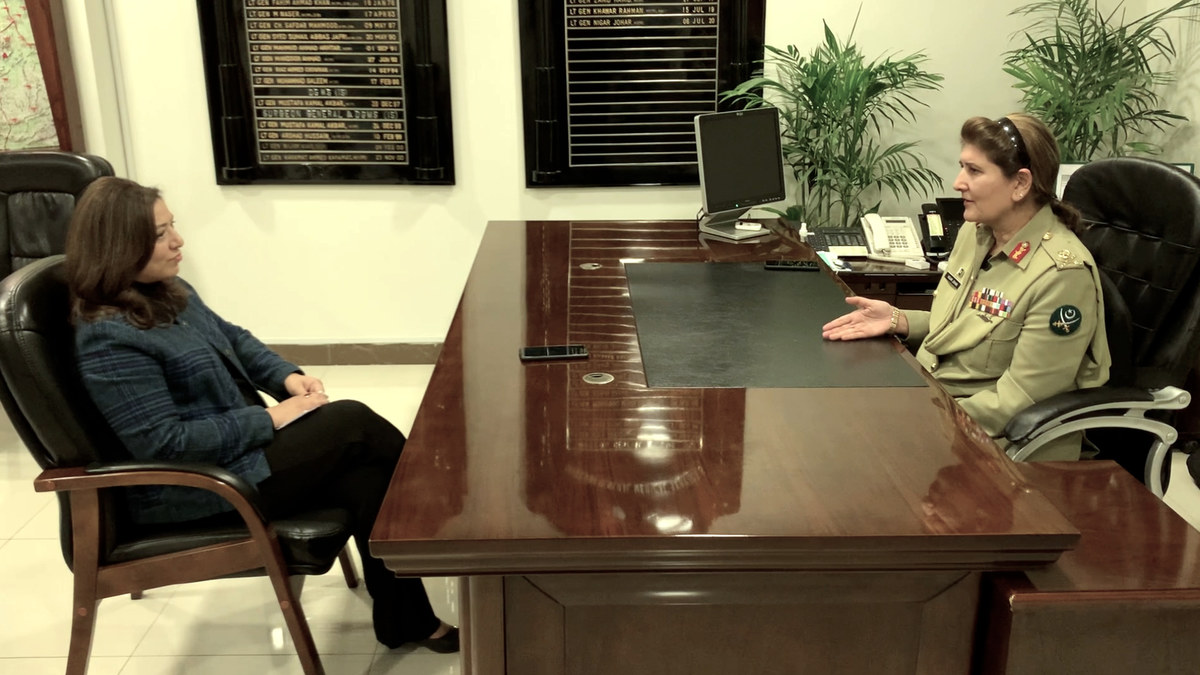
Pakistan’s first female general, Lieutenant General Nigar Johar Nigar Johar (right), speaks to Arab News Pakistan in Islamabad, Pakistan on January 10, 2022. (AN Photo)
She recalled the daunting challenge, saying: “We converted it into a COVID hospital by spreading oxygen services to over 100 beds and expanding its Intensive Care Unit from one to four within days.”
As the disease started spreading in the country, she took the initiative to further add 3,000 beds by taking over the building of an Army Public School.
“We worked day and night with our team to manage the emergency situation,” she continued, “and now I can proudly say that we did quite well because our mortality ratio was very low.”
Asked if she ever faced gender discrimination, Johar said it was a global issue which was present in every field across the world.
She remembered that female doctors were initially not allowed any specialty other than gynecology in the army, but maintained things had changed and female officers were now present everywhere in the military setup.
“I wanted to be a cardiologist but I couldn’t,” she said, adding: “I feel that my destiny turned out to be better than what I had planned for myself because I could not become a cardiologist but I am sitting here now which is better for me.”
Johar said women had more options in the military now.
“We have females in so many areas in the army. They are there in education, computer sciences, information technology, engineering and architecture,” she said.
“Though many of them are still in the initial stages of their careers and are captains and majors.”


