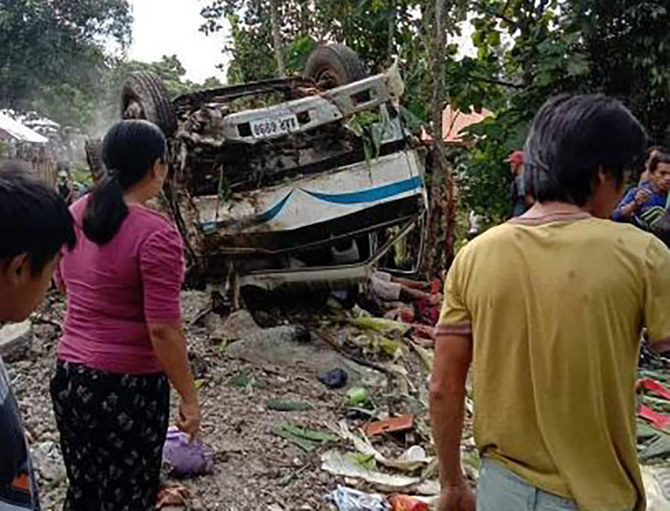
MANILA: At least 11 people were killed after a small truck packed with partygoers, including children, overturned in the southern Philippines, police said Thursday.
The vehicle was traveling to a beachside resort on Mindanao island for a postponed Christmas party on Wednesday when the driver lost control after the brakes apparently failed on a downhill section of road.
Around 50 people were crammed into the truck, most of them in the open tray, when it veered off the road and into a tree.
The vehicle then flipped over onto a pile of rocks, Balingasag municipal police chief Major Teodoro De Oro said.
Eleven people were killed, including a three-year-old child, De Oro said, adding police were seeking to confirm another three deaths.
Scores of other passengers were injured, including a dozen children. The driver, who was also hurt and tried to hide after receiving medical treatment, was arrested and will face charges.
The vehicle was part of a convoy of three trucks but the other two were not involved in the accident, De Oro said.
Deadly road mishaps are common in the Philippines, where drivers frequently flout the rules and vehicles are often poorly maintained or overloaded.
In 2019, 19 farmers were killed in the mountainous northern Philippines when a truck carrying them and sacks of rice seeds plunged backwards down a deep ravine.

11 killed in Philippine truck crash
https://arab.news/n7bxm
11 killed in Philippine truck crash
- Around 50 people were crammed into the truck, most of them in the open tray, when it veered off the road and into a tree
Philippines eyes closer cooperation on advanced defense tech with UAE
- Philippine-UAE defense agreement is Manila’s first with a Gulf country
- Philippines says new deal will also help modernize the Philippine military
MANILA: The Philippines is seeking stronger cooperation with the UAE on advanced defense technologies under their new defense pact — its first such deal with a Gulf country — the Department of National Defense said on Friday.
The Memorandum of Understanding on Defense Cooperation was signed during President Ferdinand Marcos Jr.’s visit to Abu Dhabi earlier this week, which also saw the Philippines and the UAE signing a comprehensive economic partnership agreement, marking Manila’s first free trade pact with a Middle Eastern nation.
The Philippines-UAE defense agreement “seeks to deepen cooperation on advanced defense technologies and strengthen the security relations” between the two countries, DND spokesperson Assistant Secretary Arsenio Andolong said in a statement.
The MoU “will serve as a platform for collaboration on unmanned aerial systems, electronic warfare, and naval systems, in line with the ongoing capability development and modernization of the Armed Forces of the Philippines,” he added.
It is also expected to further military relations through education and training, intelligence and security sharing, and cooperation in the fields of anti-terrorism, maritime security, and peacekeeping operations.
The UAE’s Ministry of Foreign Affairs has described security and defense as “very promising fields” in Philippine-UAE ties, pointing to Abu Dhabi being the location of Manila’s first defense attache office in the Middle East.
The UAE is the latest in a growing list of countries with defense and security deals with the Philippines, which also signed a new defense pact with Japan this week.
“I would argue that this is more significant than it looks on first read, precisely because it’s the Philippines’ first formal defense cooperation agreement with a Gulf state. It signals diversification,” Rikard Jalkebro, associate professor at the Anwar Gargash Diplomatic Academy in Abu Dhabi, told Arab News.
“Manila is widening its security partnerships beyond its traditional circles at a time when strategic pressure is rising in the South China Sea, and the global security environment is (volatile) across regions.”
Though the MoU is not an alliance and does not create mutual defense obligations, it provides a “framework for the practical stuff that matters,” including access, training pathways, procurement discussions and structured channels” for security cooperation, he added.
“For the UAE, the timing also makes sense, seeing that Abu Dhabi is no longer only a defense buyer; it’s increasingly a producer and exporter, particularly in areas like UAS (unmanned aerial systems) and enabling technologies. That opens a new lane for Manila to explore capability-building, technology transfer, and industry-to-industry links,” Jalkebro said.
The defense deal also matters geopolitically, as events in the Middle East and the Indo-Pacific region have ripple effects on global stability and commerce.
“So, a Philippines–UAE defense framework can be read as a pragmatic hedge, strengthening resilience and options without formally taking sides,” Jalkebro said.