

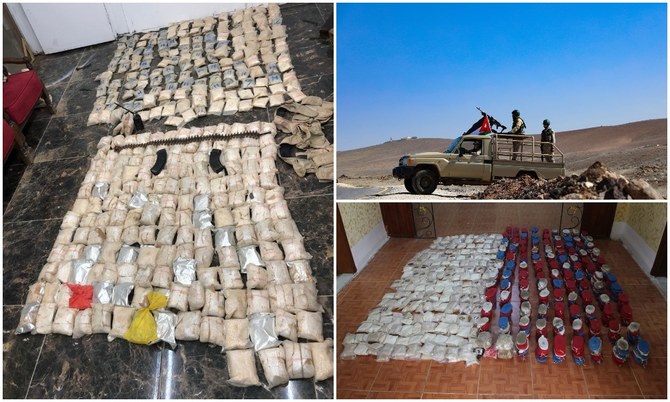

AMMAN: With the latest figures from the Jordanian Armed Forces revealing a “dramatic” increase in drug smuggling attempts from Syria, experts have warned of the war-torn country becoming a narco-state, posing cross-border threats to nearby Jordan, the region and the rest of the world.
The Jordanian army said in a recent statement it had thwarted 361 infiltration and smuggling attempts from Syria into the kingdom, and seized about 15.5 million pills of narcotics of different types, including Captagon and tramadol, more than 16,000 sheets of hashish weighing 760 kg and almost 2 kilograms of heroin.
Jordan’s Customs Department said on Jan. 12 that working with anti-narcotics teams its personnel foiled an attempt to smuggle 2.7 million Captagon pills in two trucks traveling from Syria at the Jaber-Nasib border crossing.
A military source, who requested anonymity, told Arab News the figures were “dramatically high.”
“Illicit drug cultivation and manufacture has become a growing industry in Syria,” the person said.
The Jordanian army said it foiled more than 130 infiltration and smuggling attempts from Syria in 2020 that resulted in the seizure of about 132 million Captagon pills and more than 15,000 sheets of hashish.
Drugs smugglers go to extreme lengths to avoid Jordan’s surveillance of its borders with Syria, which stretch more than 360 km, but several have been shot or killed by border guards in their efforts to cross.
In October, the Jordanian army said it shot down a drone carrying a large quantity of drugs as it flew over the border.
Another Jordanian security source, who also spoke on condition of anonymity, said that traffickers from Syria used secret routes and tunnels to smuggle their illicit products into the kingdom.
“Having all these routes spotted by the Jordanian army, smugglers resort to other methods, including drones and even animals,” the person said.
According to the Syrian news website Enab Baladi, drug smuggling operations are most active in Syria’s southern regions of Daraa and Al-Suwayda. Most of the smuggling routes are controlled by armed Bedouin tribes that have affiliations inside Jordan, it quoted sources as saying.
It added that traffickers used sewer pipes and tunnels to smuggle drugs into Jordan.
In November 2018, the Jordanian army said it thwarted a “large terrorist scheme” to infiltrate the kingdom via the Trans-Arabian Pipeline.
Experts say the strong presence of Lebanon’s Shiite militant organization Hezbollah in Syria and the expansion of its drug trafficking operations are the main reasons for the war-torn country becoming a narco-state, and the increase of drug smuggling into Jordan, Arab Gulf states and Europe.
In remarks to Arab News, Fayez Dweiri, a retired major general and military analyst, said Hezbollah had resorted to the narcotics trade to secure funding after the US sanctions on Iran.
“There is an established illicit drugs industry for Hezbollah in Beirut’s Dahieh Al-Janubiya in the Shiite stronghold of Baalbek. Hezbollah has relocated some of its drug factories to Aleppo and other Syrian government-controlled regions,” he said.
Dweiri said Hezbollah had always used its money laundering and drug trafficking networks to finance its military arsenal and operations, and to fund the social services for its constituents.
“The US sanctions on Iran have hit Hezbollah hard, obliging Tehran’s most funded proxy to look for other sources of revenues,” he said.
Asked whether the Syrian government was involved in illicit drug trafficking, Dweiri said: “I don’t have any documents proving that but to let Hezbollah operate such massive illicit activities in the country is alone a big crime.”
Enab Baladi claimed that drugs were being smuggled from Lebanon to Syria in vehicles backed by the armed forces, meaning they could pass through military checkpoints without being inspected.
According to a report by the Washington Institute for Near East Policy, Hezbollah has significantly expanded and institutionalized its drug trafficking enterprises, which now generate more money than its other funding streams. The think tank claimed that Hezbollah’s global narcotics industry began in Lebanon’s Bekaa Valley in the 1970s, using well-established smuggling routes across the Israel-Lebanon border.

keywords


