

Philippines warns jail time for quarantine violators amid omicron wave

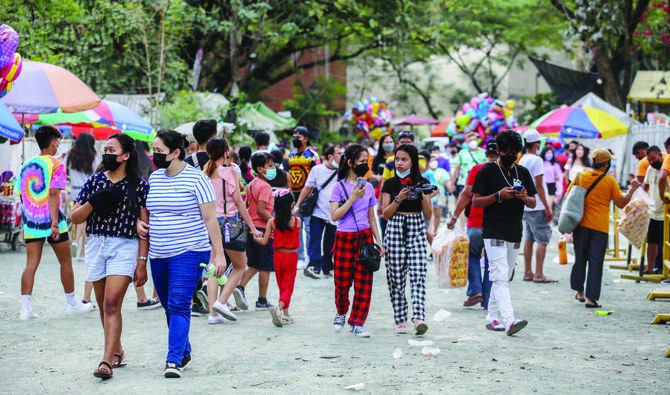
The Philippines will now tighten COVID-19 restrictions in Manila over fears of an ‘exponential growth’ in cases due to the highly contagious omicron variant. (AFP)
Short Url
Updated 04 January 2022
Follow

Philippines warns jail time for quarantine violators amid omicron wave

  • Officials to enforce applicable laws, including $1k fines
  • High-profile case saw US traveler infect 7 others post party

MANILA: Philippine officials warned incoming travelers against violating COVID-19 quarantine protocols on Monday, as the country gears up to face the highly transmissible omicron variant amid a sharp rise in COVID-19 cases.

The warning comes after a Filipino traveler returning from the US allegedly breached quarantine rules to attend a party in Makati City — part of the Metro Manila region and the country’s financial hub — in December, later testing positive for COVID-19 along with seven of her 15 close contacts. Authorities have since launched an investigation into the case.

In a televised interview, presidential spokesperson Karlos Nograles said that violators will be subject to fines of up to 50,000 Philippine pesos ($1,000) or up to six months’ imprisonment.

“If you’re thinking of violating protocols, please don’t even attempt that because we will run after you, including the hotels,” Nograles said.

“Because of what happened, we will ensure that whatever applicable laws that can be enforced, will be enforced. Whatever can be prosecuted and whoever — we will prosecute.

“And it’s not just civil cases to be filed, but also criminal charges will be filed against those responsible, whether it’s the violator or the establishment. We will do what is necessary to serve as an example to all,” he added.

The government has also tracked down another traveler from the US who allegedly skipped quarantine after arriving in the country.

Police will now “conduct random visits in different quarantine hotels across the country,” the Department of Interior and Local Government said on Monday, as part of efforts to ensure strict compliance with existing quarantine protocols.

The quarantine breaches occurred as the Philippines recorded a sharp increase in COVID-19 cases. Health Undersecretary Maria Rosario Vergeire said during a virtual press conference that the country is again deemed “high risk.”

She said: “Nationally, we are now at high-risk case classification from low-risk case class in the previous week, showing a positive two-week growth rate at 222 percent and a moderate risk average daily attack rate at 1.07 cases for every 100,000 individuals.”

A daily rate less than one typically means a low COVID-19 threat level. The Philippines was last placed under high-risk case classification between August and October, when the archipelago experienced a major case spike driven by the highly contagious delta variant.

Health Undersecretary Leopold Vega said that the delta variant still makes up the majority of cases, though the omicron variant, which experts said is the most transmissible strain, is predicted to overtake it in the next few weeks.

The Philippines has so far detected three local cases and 11 imported cases of the omicron variant, while officials noted that healthcare utilization rate remains low. The country’s Department of Health reported 4,600 additional infections on Sunday, raising the number of active cases to more than 21,000.

“It looks like the omicron wave is upon us. We’ve seen this globally across South Africa and Europe and there has been a steady increase in our landscape here in the Philippines in terms of omicron,” Vega said in a televised interview.

He added: “Our numbers have doubled and this is the start. We are very sure that this will peak. When it will press down and decelerate, we don’t know. But what is very important is that we are prepared for omicron.”


‘Peace and stability are ultimate prerequisites for growth and prosperity,’ Indonesia’s president tells WEF

Updated 9 sec ago
Follow

‘Peace and stability are ultimate prerequisites for growth and prosperity,’ Indonesia’s president tells WEF

  • While world faces tightening financial conditions, trade tensions, political uncertainty, ‘Indonesia continues to grow,’ says Prabowo Subianto
  • He says country does not fear economic integration

BEIRUT: History teaches us that “peace and stability are our most valuable assets” and the “ultimate prerequisites for growth and prosperity” as there will be no prosperity without peace, Indonesia’s president said on Thursday.
Prabowo Subianto, in his special address before the World Economic Forum, said: “We gather here in Davos at a time of great uncertainty; a time when wars continue to break out … a time when trust between nations, between institutions, between peoples is fragile.”
According to Subianto, the International Monetary Fund recently described Indonesia as “a global bright spot with strong economic growth amid a challenging external environment.”
While the world faced tightening financial conditions, trade tensions and political uncertainty, “Indonesia continues to grow,” Subianto said, adding that his country’s economy had grown by more than 5 percent every year over the last decade.
“I am confident that this year our growth will be higher,” he said, noting that inflation remained at about 2 percent, while the government deficit had been kept below 3 percent of gross domestic product.
He said that international institutions did not praise Indonesia because of unfounded optimism, but because of evidence. “They recognized that Indonesia’s economy is resilient,” he said, emphasizing that “peace and stability in Indonesia over the years” did not happen by chance.
He added that his country had always chosen unity over fragmentation, and friendship and collaboration over confrontation. He stressed “friendship over enmity.”
Subianto explained that his country had never defaulted on paying its debts and “succeeding regimes always pay the debts of the preceding regime.”
Regarding the economy, the Indonesian president said his country did not fear economic integration, adding: “We have been a trading nation for hundreds of years, and we now conclude trade agreements, not because it is fashionable but we consider it necessary.
“We believe in the concept of win-win. Last year we signed free trade agreements and comprehensive economic partnership agreements with Europe, the EU, Canada (and) Peru, and I have just visited the UK to sign our new strategic partnership and also an economic growth agreement.” He hopes that by 2027 Indonesia has in place a comprehensive economic partnership agreement with the UK.
Its policy is part of the country’s strategy to deepen productivity, reduce barriers and unlock private sector growth for Indonesia, ASEAN (the Association of Southeast Asian Nations) and the Global South, he said.
Subianto added in a session chaired by Borge Brende, WEF’s president and CEO: “We believe that trade integration, when done fairly, is not a threat to sovereignty. We believe trade is a tool for prosperity.
“Indonesia has a clear vision, as we are determined to become a modern country integrated with the global economy (while) providing (a) good quality of life for its citizens, living free of poverty and hunger.”
He further highlighted the importance of political and economic stability as a prerequisite for investments.
Toward the end of his address, the Indonesian president reiterated that “peace and stability is a long and arduous program.”
He added: “Indonesia chooses peace versus chaos. We want to be a friend to all, and an enemy to none. We want to be a good neighbor and a good, responsible citizen of the world, protecting the environment and protecting nature. We must not destroy nature, and live with it.
“Let us build the world we want to live in together. Let us continue the journey to improve the quality of life for all to live in peace, freedom, friendship, tolerance, coexistence, and (with) cooperation for all races, ethnicities, and religions.
“Let us continue our pursuit of justice for all, and security and freedom for all.”