France to ban non-essential UK travel over omicron surge

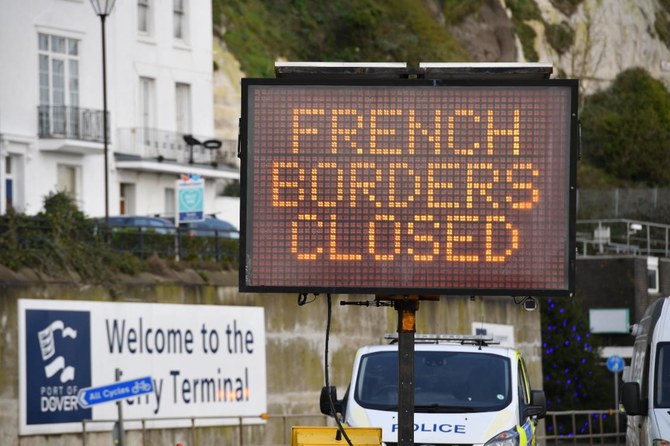
A sign informs drivers that the French border crossing is closed at the cordoned entrance to the ferry terminal at the Port of Dover in Kent, south east England. (File/AFP)
Short Url
Updated 16 December 2021
Follow

France to ban non-essential UK travel over omicron surge

  • French citizens and EU nationals could still return to France from the UK
  • Britain on Wednesday recorded a record 78,610 laboratory-confirmed COVID-19 cases

PARIS: France will ban non-essential travel to and from Britain from the weekend to slow the spread of the omicron Covid-19 variant that is causing record numbers of cases on the other side of the Channel, the government said Thursday.
From midnight Saturday (2300 GMT Friday) there will be a “requirement to have an essential reason to travel to, or come from, the UK, both for the unvaccinated and vaccinated... People cannot travel for touristic or professional reasons,” the government said in a statement.
“Faced with the extremely rapid spread of the omicron variant in the UK, the government has chosen to reinstate the need for an essential reason for travel from and to the UK,” the statement said.
It added that French citizens and EU nationals could still return to France from the UK.
“We will put in place a system of controls drastically tighter than the one we have already,” government spokesman Gabriel Attal told BFMTV channel.
Attal said the policy was aimed at “tightening the net” to slow down the arrival of omicron cases in France and give time for the French vaccination booster campaign to make more ground.
“Our strategy is to delay as much as we can the development of omicron in our country and take advantage to push ahead with the booster drive,” he said.
In addition, returning travelers will need a negative test less than 24 hours old, and a blanket quarantine would be enforced on return to France.
“People (coming back) will have to register on an app and will have to self-isolate in a place of their choosing for seven days — controlled by the security forces — but this can be shortened to 48 hours if a negative test is carried out in France,” he said.
Britain on Wednesday recorded a record 78,610 laboratory-confirmed Covid cases, with scientists predicting even higher rates as omicron is believed to spread much faster than the currently dominant Delta variant.
The tight travel restrictions are also being imposed during what analysts see as a breakdown of trust between the British and French governments in the wake of Brexit over a host of issues from migrants to fishing.
French President Emmanuel Macron last week accused UK Prime Minister Boris Johnson’s government of failing to keep its word on Brexit, saying “the problem with the British government is that it does not do what it says.”


Bangladesh sets February date for first vote since 2024 mass uprising

Updated 59 min 23 sec ago
Follow

Bangladesh sets February date for first vote since 2024 mass uprising

  • At least 1,400 protesters were killed in violent crackdown under ex-PM Hasina’s rule
  • Interim government promises ‘all necessary support’ for upcoming elections

DHAKA: Bangladesh will hold national elections on Feb. 12, its chief election commissioner has announced, setting the timeline for the nation’s first vote since a student-led uprising that ousted long-serving Prime Minister Sheikh Hasina.

Hasina, whose Awami League party-led government was marred by allegations of human rights violations, rigged elections and corruption, was removed from office in August last year after 15 uninterrupted years in power.

Bangladesh has since been led by interim leader Muhammad Yunus, a Nobel Prize-winning economist, who took over governance after Hasina fled to India, where she is now in self-exile.

In a televised address on Thursday, chief election commissioner A.M.M. Nasir Uddin confirmed the voting date to elect 300 lawmakers and said a national referendum on political reforms would also be held on the same day.

“It’s a relief for the voters; it’s a relief for the country. It’s a relief for the investors, it’s a relief for the development partners and for the political parties and the people who did a massive job in July 2024 by sacrificing their lives and limbs to oust a tyranny,” said Prof. A.S.M. Amanullah, political analyst and vice chancellor of the National University in Dhaka.

Mass protests that broke out in 2024 began in early July as peaceful demonstrations, triggered by the reinstatement of a quota system for the allocation of civil service positions.

Two weeks later, they were met with a communications blackout and a violent crackdown by security forces.

A special tribunal in Dhaka found Hasina guilty of allowing lethal force to be used against the protesters, at least 1,400 people of whom died, according to estimates from the UN’s human rights office.

After a months-long trial, she was sentenced to death in November for crimes against humanity.

The February elections will take place in the aftermath of Hasina’s reign, with the Yunus-led administration banning all activities of Awami League, meaning the former ruling party would not be able to join the race next year.

Minor political tensions now revolve around the more than 40 million voters of the Awami League, as the public speculate “how they would move, in which party they would support or whether they would remain silent,” Amanullah said.

“(But) if you consider other than Awami League, if we consider the other political parties, I think the other political parties are sufficient, you know, to make the next poll participatory, and free and fair.”

Bangladesh last held elections in January 2024, which saw Hasina return to office for a fourth consecutive term. That vote was boycotted by the country’s main opposition parties, which accused her administration of rigging the polls.

“There is a growing demand within the society and in the community that they would cast their first vote after almost 15, 16 years. And that would be an (occasion) of big national celebration,” Amanullah said.

In February, more than 127.6 million Bangladeshis will be eligible to cast their vote. It will be Bangladesh’s 13th election since the country gained independence in 1971.

The long-awaited election process now begins with the filing of nominations from Dec. 12 to 29, which will then be reviewed over the following six days. The last date for withdrawing nominations is Jan. 20.

After the voting date was announced, Yunus pledged to “provide all necessary support” to encourage festivity, participation and fairness in the upcoming polls.

“After the historic mass uprising (last year), the country is now moving toward a new path,” he said in a statement. “This election and referendum will consolidate that trajectory, prioritize the will of the people and further strengthen the foundation of a new Bangladesh.”

For Malaika Nur, a 24-year-old Dhaka University student who took part in the 2024 protests, the elections are an opportunity for young people to formally take part in politics.

“Young people have been showing much interest in politics since July 2024. They showed us how the youth can reshape a country’s political condition. If they have a few seats in the parliament, it can be a game-changer for the future of politics in Bangladesh,” she said.

“I hope this election will be different from the last three elections held in the previous regime. There will be a festive mood, people will cast their valuable votes and will get to choose their representative … I hope the elected government will ensure safety and basic rights of every citizen, and will hold fair elections in the future and will not become another fascist.”