MELBOURNE: Australia will introduce legislation to make social media giants provide details of users who post defamatory comments, Prime Minister Scott Morrison said on Sunday.
The government has been looking at the extent of the responsibility of platforms, such as Twitter and Facebook, for defamatory material published on their sites and comes after the country’s highest court ruled that publishers can be held liable for public comments on online forums.
The ruling caused some news companies like CNN to deny Australians access to their Facebook pages.
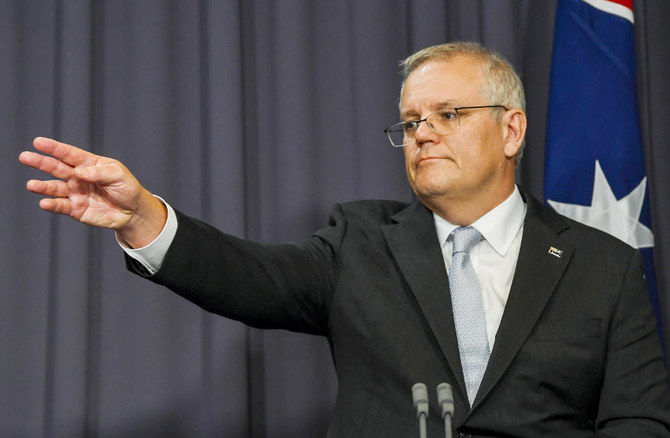
“The online world should not be a wild west where bots and bigots and trolls and others are anonymously going around and can harm people,” Morrison said at a televised press briefing. “That is not what can happen in the real world, and there is no case for it to be able to be happening in the digital world.”
The new legislation will introduce a complaints mechanism, so that if somebody thinks they are being defamed, bullied or attacked on social media, they will be able to require the platform to take the material down.
If the content is not withdrawn, a court process could force a social media platform to provide details of the commenter.
“Digital platforms — these online companies — must have proper processes to enable the takedown of this content,” Morrison said.
“They have created the space and they need to make it safe, and if they won’t, we will make them (through) laws such as this.”

Australia to introduce new laws to force media platforms to unmask online trolls
https://arab.news/rsqn5
Australia to introduce new laws to force media platforms to unmask online trolls
- The new legislation will introduce a complaints mechanism, so that if somebody thinks they are being defamed, bullied or attacked on social media, they will be able to require the platform to take the material down
UAE outlines approach to AI governance amid regulation debate at World Economic Forum
- Minister of State Maryam Al-Hammadi highlights importance of a robust regulatory framework to complement implementation of AI technology
- Other experts in panel discussion say regulators should address problems as they arise, rather than trying to solve problems that do not yet exist
DUBAI: The UAE has made changes to 90 percent of its laws in the past four years, Maryam Al-Hammadi, minister of state and the secretary-general of the Emirati Cabinet, told the World Economic Forum in Davos on Wednesday.
Speaking during a panel discussion titled “Regulating at the Speed of Code,” she highlighted the importance of having a robust regulatory framework in place to complement the implementation of artificial intelligence technology in the public and private sectors.
The process of this updating and repealing of laws has driven the UAE’s efforts to develop an AI model that can assist in the drafting of legislation, along with collecting feedback from stakeholders on proposed laws and suggesting improvements, she said.
Although AI might be more agile at shaping regulation, “there are some principles that we put in the model that we are developing that we cannot compromise,” Al-Hammadi added. These include rules for human accountability, transparency, privacy and data protection, along with constitutional safeguards and a thorough understanding of the law.
At this stage, “we believe AI can advise but still (the) human is in command,” she said.
Authorities in the UAE are aiming to develop, within a two-year timeline, a shareable model to help other nations learn and benefit from its experiences, Al-Hammadi added.
Argentina’s minister of deregulation and state transformation, Federico Sturzenegger, warned against overregulation at the cost of innovation.
Politicians often react to a “salient event” by overreacting, he said, describing most regulators as “very imaginative of all the terrible things that will happen to people if they’re free.”
He said that “we have to take more risk,” and regulators should wait to address problems as they arise rather than trying to create solutions for problems that do not yet exist.
This sentiment was echoed by Joel Kaplan, Meta’s chief global affairs officer, who said “imaginative policymakers” often focus more on risks and potential harms than on the economic and growth benefits of innovation.
He pointed to Europe as an example of this, arguing that an excessive focus on “all the possible harms” of new technologies has, over time, reduced competitiveness and risks leaving the region behind in what he described as a “new technological revolution.”


