CANBERRA: Australian police began taking control of the Solomon Islands capital Honiara on Friday after days of violent protests in the South Pacific island nation, witnesses said.
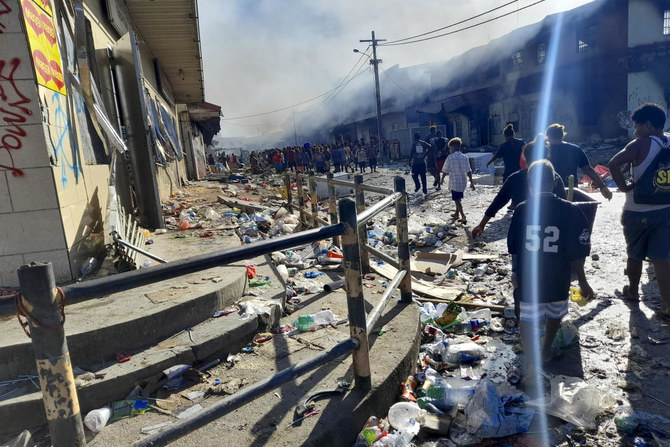
Tear gas was deployed in Chinatown where looting and the burning of buildings continued on Friday morning and a new curfew was expected to be imposed later in the day, a resident told Reuters.
Prime Minister Manasseh Sogavare, who requested help from Australia, on Friday blamed foreign countries for stoking the violent protests, but did not name any.
Many of the protesters come from the most populous province Malaita and feel overlooked by the government in Guadalcanal province and oppose its 2019 decision to end diplomatic ties with Taiwan and establish formal links with China.
“I feel sorry for my people in Malaita because they are fed with false and deliberate lies about the switch,” Sogavare told the Australian Broadcasting Corporation.
“These very countries that are now influencing Malaita are the countries that don’t want ties with the People’s Republic of China, and they are discouraging Solomon Islands to enter into diplomatic relations and to comply with international law and the United Nations resolution.”
China and Taiwan have been rivals in the South Pacific for decades with some island nations switching allegiances.
China views Taiwan as a wayward province with no right to state-to-state ties, which the government in Taipei hotly disputes. Only 15 countries maintain formal diplomatic ties with Taiwan. The last two to ditch Taipei in favor of Beijing were the Solomon Islands and Kiribati in September 2019.
Taiwan Foreign Ministry spokeswoman Joanne Ou said in a statement: “We have nothing to do with the unrest”.
Solomon Island resident Transform Aqorau said more than a hundred people were on Friday looting shops, before Australian Federal Police officers arrived.
“The scenes here are really chaotic. It is like a war zone,” Aqorau told Reuters by telephone on Friday morning.
“There is no public transport and it is a struggle with the heat and the smoke. Buildings are still burning.”
He said later Australian police were “taking control of Chinatown.”
A statement on the Solomon Islands government website said public servants with the exception of essential workers should stay at home “due to the current unrest in Honiara City.”
Australian Foreign Minister Marise Payne said Australia was sending 100 police personnel and was “clearly focused on stability in our region.”
Australian police were previously deployed to the Solomon Islands in 2003 under a peace keeping mission authorized by a Pacific Island Forum declaration and stayed for a decade.
Severe internal unrest and armed conflict from 1998 to 2003 involved militant groups from Guadalcanal and the neighboring island of Malaita, and fighting on the outskirts of Honiara.


![]()

Australian police take control of Solomon Islands capital after days of unrest
Short Url
https://arab.news/m57ut
Australian police take control of Solomon Islands capital after days of unrest
- Tear gas was deployed in Chinatown where looting and the burning of buildings continued on Friday morning
Related

Latest updates




© 2026 SAUDI RESEARCH & PUBLISHING COMPANY, All Rights Reserved And subject to Terms of Use Agreement.