DUBAI: Ever since she was a little girl, Salma Hayek — actress, producer, philanthropist, and all-around global superstar — has felt a strong connection to her Arab roots. Though she grew up in Mexico, far from the small village of Baabdat, Lebanon, which her family left years earlier, her father and grandparents never let her forget where they came from, and the values that entails.
“I was raised and I was educated, like all Lebanese people are educated, to give back to Lebanon, to be a brotherhood. We are raised so that when we encounter a Lebanese person in life, we immediately come together,” says Hayek.
In her house growing up, she was raised on Arabic food, handed the writings of Khalil Gibran by her grandfather, and taught about what her Arab identity meant.

Salma Hayek with husband Francois-Henri Pinault and their daughter Valentina Paloma Pinault in France. (Getty)
“I probably had Kibbeh before I had tacos,” she jokes.
Her background was diverse, and she embraced the richness of what that meant, both in her Latin roots and her Middle Eastern ones, even as she moved to the US from Mexico to pursue a career in entertainment, eventually becoming a naturalized citizen. As much as the richness of her heritage made her who she was, that identity led her down a hard road in a town such as Hollywood, a town in which the faces that were most easily embraced were the ones that conformed to a different standard.
“You have to understand, I am Mexican-Arab in America. It’s a tough one. I’m not British. I’m not Spanish. I’m Mexican-Arab,” she tells Arab News.
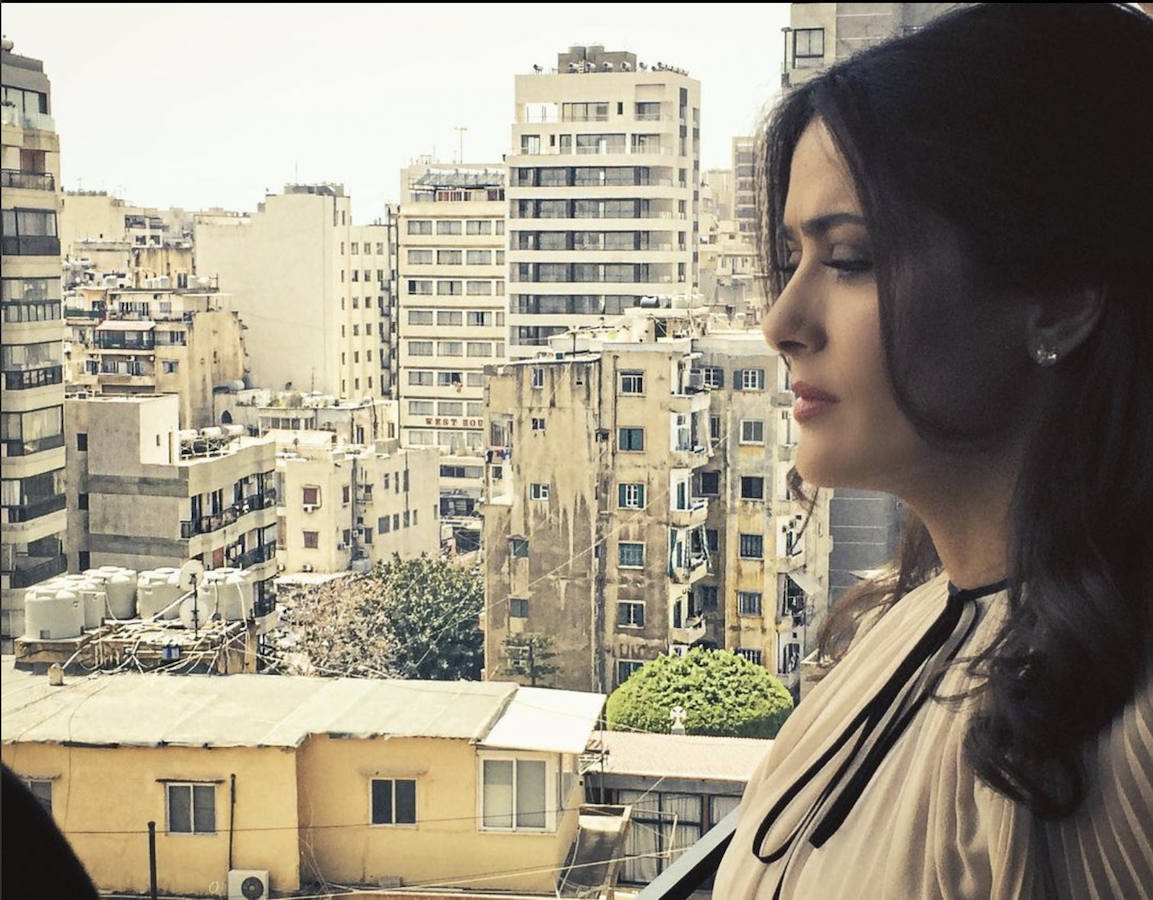
In her house growing up, she was raised on Arabic food, handed the writings of Khalil Gibran by her grandfather, and taught about what her Arab identity meant. (Supplied)
She has persevered, however, and made a significant contribution to a wider acceptance not only of ethnic diversity, but of women in roles traditionally held by men in the industry. Take her 2015 passion project “The Prophet,” an animation based on the famous work by Gibran that Hayek produced (as well as voicing one of the characters).
“It’s not a religious book, it’s poetic and philosophical. It’s a book written by an Arabic man, which unites all religions,” Hayek told the Guardian of the film. “That itself I think is important.”
“Through this book I got to know my grandfather, through this book I got to have my grandfather teaching me about life,” she told Reuters at the film’s premiere in Beirut. “For me, this is a love letter to my heritage. Between all the connections of our ancestors and the memories of the ones that are no longer with us, I hope they are proud of this film, because I did it also for them.” Hayek’s father went to Beirut with her for the premiere, and together they went on an “emotional journey” to Baabdat — their ancestral village.
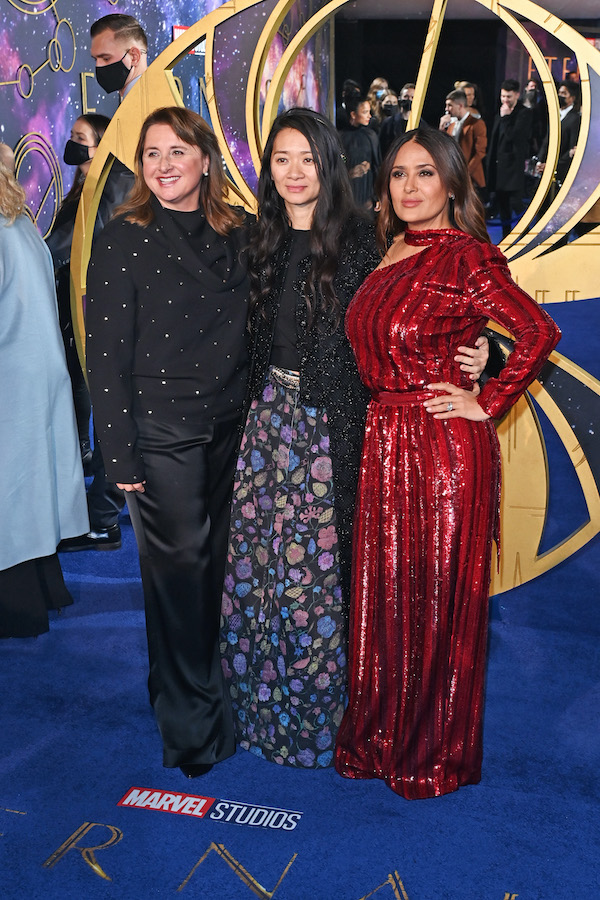
Hayek at the premiere of the latest Marvel movie with director Chloe Zhao and producer Victoria Alonso. (Supplied)
As much as ‘diversity’ has become the buzzword in the new Hollywood, and as much as every studio pushes for diverse hires both in front of and behind the camera, this is something that Hayek remains skeptical of. Why? Because often, she feels, these sorts of moves are made to fill quotas without substance, which don’t represent real change.
“When diversity is done out of political correctness, you feel an interrogation and you don’t feel welcome the same way [as you do when it’s done right]. They’re nervous and speak carefully just so that they don’t make a mistake in anything they say. They’re not seeing you as a human being and celebrating just who you are,” says Hayek.
Her latest film does not fall into that category, she stresses. It is her first venture into the Marvel Cinematic Universe, and she has become the MCU’s first Arab lead.

Hayek with the Gibran statue. (Supplied)
Hayek was particularly excited about the fact that director Chloe Zhao, who won Oscars earlier this year for Best Director and Best Picture for her film “Nomadland,” approached her not to fill a quota, but out of something deeper.
“It’s diversity, but it’s not done out of political correctness, but out of conviction. It didn’t feel contrived and forced. It’s not like, ‘I need one from this country, one from that,’” says Hayek.
Hayek had never been in a superhero movie before — and she’s happy about that. If she had, she says, she probably would have never been cast in this one, as the leader of a group of ancient heroes from another galaxy. For her, having a cast that represents people of so many different backgrounds in such a film is a big moment not only for her, but for Hollywood at large. The message of the film, she says, is that “we can all be superheroes.”
“Before, I was one of those people who, every time something appeared on screen, larger than life, were never included. I’m so happy that they didn’t call me before. Thank you very much. There’s some really bad ones, by the way; this was worth waiting for,” says Hayek. “It’s like my husband (French business mogul Francois-Henri Pinault). I waited a long time, and I got a good one.”
When she first spoke about the film with Marvel Studios head Kevin Feige and Zhao, she was surprised to hear that the reason that they wanted to cast her as the leader of the group was for the personal qualities she embodied, above all else.
“I thought I was going to play someone’s mother, frankly. But Chloe said, ‘You’re actually going to be the leader. In the comic books, it’s a man, but we wanted you, so we changed it to a woman.’ You can imagine my shock, right? I thought it was a prank. I asked, ‘Why did you want me?’ She said, ‘The quality I see for this leader is in you. You have a type of strength that I want for this character. You are extremely strong, but there’s a warmth to your strength.’ (The character has a) motherly instinct. And I really liked that. She’s a healer, and if you think about it, the best leaders in the world should be healers. They are followed by the people, and they should heal their pains and their problems, and they should fix what’s broken,” says Hayek.
Because they understood each other so well, Hayek and Zhao’s immediate bond from that first meeting continued throughout filming, lasting until today.
“She’s such a good director. Because of that, there was no preparation required from me, there was just, like, presence, and trust in the director,” says Hayek.
That welcoming spirit continued throughout filming, and as a result, the cast bonded in a way that Hayek hadn’t seen in years.
“We all interacted a lot in the moments when you’re waiting in between takes. That doesn’t really happen anymore. Before it did; actors used to talk about the characters all the time and read lines together and have fights about the meaning of the scene, but now everybody’s on their phone. They’ll come out of the trailers when it’s time to roll. Here, that didn’t happen,” says Hayek.
What was important to Hayek as well is that it wasn’t just her Arab and Mexican identity, or her identity as a strong woman, that was embraced on set. She felt she could wear all aspects of herself proudly.
“I’m a 55-year-old, so that’s a different kind of diversity,” says Hayek, alluding to the fact that older woman rarely get cast as anything other than mothers and grandmothers after their 30s.
She was also able to be comfortable with her dyslexia, she explains. “During our first table read, I had to read it off the paper. I thought I was going to stink, but I knew I could do it alright by the end. And Barry Keoghan (who plays Druig) is dyslexic too. It was nice that we could all sit there and hold hands and be heroes, even then. We all just got to be a family — a proper family — and embrace everything about each other,” says Hayek.
More than anyone else, Hayek has Zhao to thank for that.
“It was very clear from day one, 10 seconds in, that this was different. She’s a brave, strong woman with a lot of clarity and she kept that consistently throughout the film. The way she moved the camera, the smoothness, the curvature, the epic moments that found intimacy at the same time. It was a very clear, specific vision,” says Hayek. “It was a beautiful experience.”