

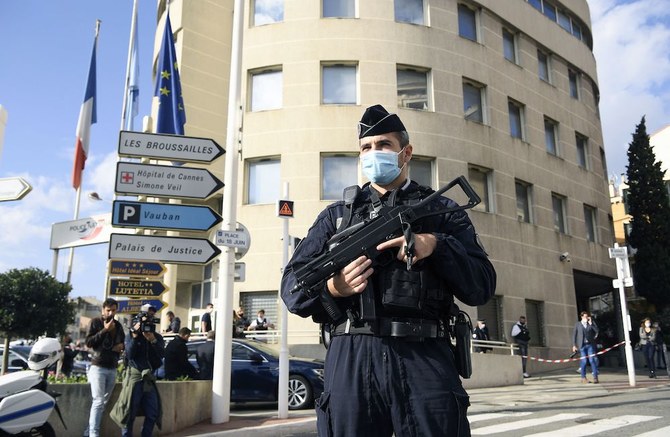
Policeman survives knife attack in French Riviera city of Cannes

The attack in Cannes comes as worries over violent crime and terrorism feature among voters’ main concerns. (AFP)
Short Url
Updated 08 November 2021
Follow

Policeman survives knife attack in French Riviera city of Cannes

  • The attack in Cannes comes as worries over violent crime and terrorism feature among voters’ main concerns

PARIS: A policeman survived a knife attack in the French Riviera city of Cannes on Monday, with media quoting a police source as saying the assailant had said he was acting “in the name of the Prophet.”

The policeman emerged from the attack unscathed, saved from serious injury or worse by his bulletproof vest, Interior Minister Gerald Darmanin said.

The assailant suffered life-threatening injuries after he was shot by other officers.

The Algerian national held an Italian residency permit, was in France legally and was not on a French watchlist of individuals thought to have Islamist sympathies, the minister said.

“I think that we can today sigh with relief that, although they have been hit hard psychologically, no police officer has been injured,” Darmanin told reporters in Cannes.

The attack comes as President Emmanuel Macron tries to persuade voters that his government is in control of security and violent crime, six months before elections in which the far right and conservatives pose the biggest threat to his re-election hopes.

Eric Ciotti, a conservative lawmaker from southeastern France, who is challenging for the mainstream center-right presidential ticket, called the incident a terrorist attack though he did not offer any evidence for that.

The investigation is in the hands of the local prosecutor for now and not the national anti-terrorism prosecutor.

Darmanin said it was too early to know the suspect’s motive.

Cannes Mayor David Lisnard said the incident was “sickening.”

Cannes is a glitzy Mediterranean resort popular with celebrities and tycoons, and which hosts the annual Cannes Film Festival.

The attacker opened the door of a police car parked in front of a police station and stabbed the officer at the wheel.

He then tried to attack a second policeman in the vehicle but a third opened fire, seriously wounding the assailant.

BFM TV and Nice Matin newspaper cited a police source as saying the suspect said he had carried out the attack “in the name of the Prophet” Mohammad, hinting at possible Islamist militant links.

The attack coincides with the trial of Salah Abdeslam, the only surviving member of a Daesh cell that carried out gun-and-bomb attacks on entertainment venues in Paris in November 2015, killing 130 people.


China positions itself as force for global stability at its annual Congress

Updated 3 sec ago
Follow

China positions itself as force for global stability at its annual Congress

BEIJING: While much of the world’s attention is on the Iran war, that hasn’t stopped China from moving ahead with national priorities with global repercussions.
Not that China doesn’t care about the war and its impact on energy supplies and geopolitics. But for the world’s second largest economy, its growing rivalry with the United States revolves around a different battle: the development of the cutting-edge technologies shaping the 21st century.
That message came through in a five-year plan formally endorsed Thursday by the National People’s Congress at the end of its annual meeting, the nation’s biggest political event of the year. If anything, China is doubling down on a push to transform its economy and be at the forefront of technology. State media described China’s determination to stay the course on economic development as a force for stability in an uncertain world.
“A stable and developing China injects more stability and certainty into a world fraught with change and turbulence,” the official People’s Daily newspaper said in a front-page column on Wednesday. Other state-media echoed that view.
The commentaries and official statements didn’t mention US President Donald Trump, whose tariffs and use of military force from Venezuela to Iran are shaking up the global order that has governed international relations in the post-World War II era. China publicly defends that system, while calling for making it more equitable to reflect the interests of developing countries as well as rich ones.
Trump is due to visit Beijing in three weeks to hold talks with his counterpart, Chinese leader Xi Jinping.
The National People’s Congress also rubber-stamped three laws, including one governing ethnic minorities, at its closing session. The votes are ceremonial and nearly unanimous, designed to show unity behind the ruling Communist Party’s vision for the nation. The five-year plan was approved with 2,758 votes in favor, one against, and two abstentions.
“We are forging ahead at full speed in building a great country,” Foreign Minister Wang Yi said at an annual news conference during the Congress.
Banking on tech for growth
Many economists believe that China needs to do more to put more money into the hands of consumers to boost domestic spending and reduce its dependence on export-led growth.
China’s leaders agree in concept, but the five-year plan puts technology front and center, confirming it remains the top priority. Analysts expect any steps to boost consumption to happen only gradually, such as expanding social security and health care benefits, while government funds are poured into artificial intelligence, robotics and other areas.
Chinese Premier Li Qiang announced an economic growth target of 4.5 percent to 5 percent for 2026 at the start of the Congress, a level that gives the government more leeway to focus on the longer-term goals of the five-year plan rather than meeting a higher target this year.
Staying conservative on climate
The five-year plan doesn’t pledge to reduce carbon emissions overall, but only to reduce “emissions intensity” — how much pollutants are emitted relative to the size of the economy. That means emissions could still grow as the economy does.
The target for a reduction in intensity was set at 17 percent, a level that could allow emissions to rise 3 percent or more, analysts said. “International good practice is to move away from intensity targets toward absolute emission reduction targets,” said Niklas Hohne of the NewClimate Institute in Germany.
China has a history of setting conservative targets and its rapid expansion in solar and other clean energies may drive emissions down anyway. The country is the world’s No. 1 emitter of greenhouse gases, but leaders have long argued that the size of its population and economy must be considered when evaluating its pollution levels.
Regulating ethnic groups
A sweeping ethnic minorities law endorsed by the Congress solidifies what critics say is a government policy of assimilation, emphasizing the creation of “a common consciousness of the Chinese nation.”
The government said it is meant to foster a stronger sense of community and shared economic development among its ethnic groups. The law encapsulates an approach under Xi that has promoted unity over ethnic cultures and their languages.
“It puts a death nail in the party’s original promise of meaningful autonomy,” said James Leibold, a professor at Australia’s LaTrobe University who has studied China’s changing policies toward its ethnic minorities.
Seeking a “right to rest” for workers
Formal proposals and other suggestions to reduce work hours in a variety of ways were among those that got the most attention on social media during this year’s Congress.
Many focused on a “right to rest,” including calls to give employees the right not to respond to work messages after hours. Many Chinese workers get only five days of paid vacation a year. Yu Miaojie, an economist and deputy to the Congress, proposed raising the minimum statutory annual leave from five to 10 days.
The popularity of the proposals reflects concern about the intense workplace competition in China. Giving workers more leisure time is also seen as a way to boost consumption by giving them more free time to spend.