
LONDON: While the technical particulars and political conditions of the nuclear agreement between Saudi Arabia and the US are yet to be fully revealed, there has been an overwhelmingly positive reaction to the news among experts and commentators in both countries.
And, as a statement on Wednesday from the Saudi Ministry of Energy noted, the deal has not come out of the blue. The Agreement for Cooperation on the Peaceful Uses of Nuclear Energy, it said, “builds on the historic strategic partnership between the two friendly countries.”
Most immediately, it follows the announcement made during the visit of Crown Prince Mohammed bin Salman to the US last year, “on the conclusion of negotiations on bilateral cooperation in the peaceful uses of nuclear energy.”
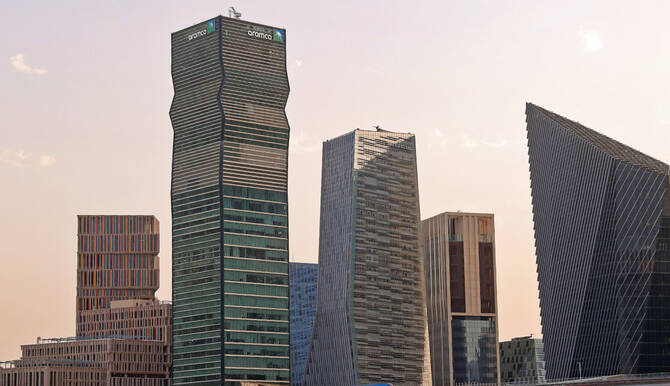
Historically, US-Saudi energy cooperation has led to momentous developments. The seeds of what would become Aramco, the world’s largest oil company, were sown in 1933, when Saudi Arabia signed a concession agreement with the Standard Oil Company of California.
Furthermore, the ministry added, the deal “reflects the shared vision of both countries to expand cooperation in energy and future technologies while supporting sustainable development.” But just how far back that vision extends will come as something of a surprise to many people.

An oil well of Ain Dar, Saudi Arabia, in 1952. (Photo by: Touring Club Italiano/Marka/Universal Images Group via Getty Images)
In April 1986, two scientists from the Department of Nuclear Engineering at Jeddah’s King Abdulaziz University flew in to Pittsburgh International Airport for a conference on the theory and application of computer modeling and simulation in a range of disciplines.
The title of the paper presented by A.F. Abdul-Fattah and W.H. Abulfaraj to the two-day conference at the University of Pittsburgh was “Technological evaluation of nuclear research reactors for Saudi Arabia.”
Forty years on, that paper serves as a reminder that, far from being the product of a rush to obtain nuclear power, the newly announced deal with the US is merely the latest piece in an energy jigsaw the Kingdom has been patiently assembling for at least four decades.
Michael Ratney, former US ambassador to Riyadh and a senior adviser at the Center for Strategic and International Studies in Washington, DC, told Arab News the US-Saudi nuclear deal was without doubt “a historic agreement.”
“The Saudis have been thinking about this for a long time,” he said. “It accelerated with Vision 2030 because of its economic diversification component, and a desire to create a viable post-fossil-fuel economy.
“And that doesn’t just mean an economy that doesn’t depend on oil exports. It means an economy that doesn’t depend upon oil use for its own power needs.”
Nuclear, he said, would be a logical part of a wider mix of renewables being developed in the Kingdom.
“Saudi Arabia has been developing solar energy and wind, and nuclear energy is a part of a non-fossil-fuel mix, and that’s the same discussion that’s going on in Europe and in the US right now.
“The Saudis have long sought nuclear power as an alternative to fossil fuels, and this is their opportunity to do it.”
The US, he added, had much to gain from the new arrangement.
“I’m not in the middle of the deal,” he said. “But my assumption would be that for us to pursue this right now, part of it would have to be an expectation that they work with US companies to produce the reactor.”
In a post on X, Saudi businessman and commentator Turki Al-Faisal Al-Rasheed agreed that both sides had a lot to gain.
The partnership, he wrote, “aims to meet Saudi Arabia’s peaceful nuclear energy needs while offering Washington leverage to steer Riyadh away from China, its leading partner in many Vision 2030 projects.”

Crown Prince Mohammed bin Salman launches project to build Saudi Arabia’s first nuclear research reactor. (SPA photo)
While American technology and expertise would “help maintain high safeguards and non-proliferation standards,” at the same time “Saudi Arabia possesses substantial resources and multiple international options (and) winning these contracts would generate jobs, technological leadership, and export revenues for US companies.”
But in an interview with Arab News, Al-Rasheed cautioned that while “it is essential — vital even — for Saudi Arabia to renew and diversify its sources of energy,” it could choose to do so with America, or with alternatives, such as France, China or Russia.
“America should be our first priority, but not our only priority,” he said. “Do not forget: China is our number-one trading partner. America is our military and political partner. Russia is our main partner in oil and energy. We have to maintain all of those relationships.”
America’s confidence in its Saudi partnership was reflected not only in the agreement itself signed on Wednesday, but also in the warm relationship that has developed between senior officials in Washington and Riyadh.
Speaking at the US Department of Energy headquarters where the agreement was signed, US Energy Secretary Chris Wright praised Prince Abdulaziz bin Salman as “one of the truly thoughtful commentators on global energy markets,” saying he had admired his willingness to speak candidly on global energy issues long before they met.

US Energy Secretary Chris Wright. (Supplied)
Since then, he said, the two had developed a friendship built on trust that extended well beyond discussions of oil, gas and civil nuclear cooperation.
Wright also credited the Saudi energy minister’s “strong, principled leadership” with helping to transform the Kingdom’s energy sector. The personal rapport, he suggested, reflected a broader confidence in Saudi Arabia as a long-term strategic partner.
Some commentators have expressed concern that if Saudi Arabia develops the capability to enrich uranium, it could trigger a regional arms race.
Saudi Arabia has substantial uranium deposits. In 2019, Prince Abdulaziz said: “We want to go for the full cycle, from producing uranium, to enriching the uranium, (to) using the uranium.”

Saudi Arabia's Minister of Energy Prince Abdulaziz bin Salman al-Saud attends the St. Petersburg International Economic Forum (n Saint Petersburg on June 4, 2026. (AFP/File photo)
That year, a joint survey by the Saudi Geological Survey, the Beijing Research Institute of Uranium Geology and the China National Nuclear Corporation identified three major deposits, in the center and northwest of the country, which could yield as much as 90,000 tonnes.
“I think it makes people nervous when other countries start developing a nuclear enrichment capacity,” Ratney said. “But what was agreed to in this document doesn’t give Saudi Arabia a nuclear weapon — it just doesn’t.
“It gives them a civil nuclear energy program in cooperation with the US, under non-proliferation safeguards, so that Saudi Arabia can begin to wean itself off of oil as a source of electricity generation.”
The deal, he said, “holds the door open” to enrichment, “but via a lot of other agreements and consultations with the US before they ever get there, and it would be extraordinarily expensive and time-consuming to do it.

“It takes long enough to develop a nuclear power plant. It would take far longer to develop a nuclear fuel enrichment capacity.
“In the meantime, like most countries, they will import their nuclear fuel, like the US does. We mine uranium, but we also import nuclear fuel because we don’t produce enough to fuel our own nuclear reactors.”
The initial impetus for the current deal, he said, “came during the Biden administration, when there were discussions about a nuclear component of a grand deal that would involve normalization with Israel and a mutual defense treaty with the US.
“That ended at the end of the Biden administration, when the whole normalization effort essentially stalled, and then it seems the Trump administration has now picked up the nuclear piece of this.”

Michael Ratney, former US ambassador to Riyadh and a senior adviser at the Center for Strategic and International Studies. (Supplied)
Ratney believes the deal will get past Congress and is future proof.
“It doesn’t need a vote of approval, it just needs to survive a vote of disapproval, and I think that would happen. So I think it will go into effect, and I suspect it’s not the sort of thing that a future administration would abrogate.”
As the conflict between the US and Iran continues, Ratney believes it is possible to perceive a political element to the deal.
“That may well be part of the Saudi mindset — demonstrating to their neighbors that Iran is not the only country that can pursue a nuclear program, and that the Saudis can pursue one not illicitly, as Iran might, but in cooperation with a global superpower.”

People walk along with US Secretary of Energy Chris Wright as he tours the Idaho National Laboratory in an area west of Idaho Falls, Idaho, on June 25, 2026. Wright visited various sites where companies have been racing to build small modular nuclear reactors in what has been heralded as Americas nuclear renaissance. (AFP)
Responding to a comment request, a spokesperson for the IAEA said the agency “is aware of the discussions between the Kingdom of Saudi Arabia and the United States to conclude a bilateral civil nuclear cooperation agreement and the plan to ask the IAEA to implement verification measures in relation to this bilateral agreement.
“We look forward to receiving the request for such verification and to working with the US and KSA in ensuring the implementation of those measures.
“This should be accompanied by the corresponding verification measures in accordance with the NPT and the Comprehensive Safeguards Agreement applicable to Saudi Arabia.
“Once both countries submit such a request, and in accordance with Agency practice, the Director General will submit it to the Board of Governors so that the proper authorization is given for its implementation.”