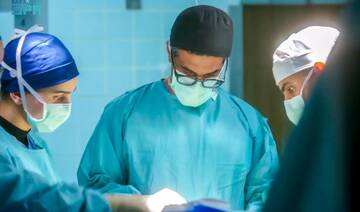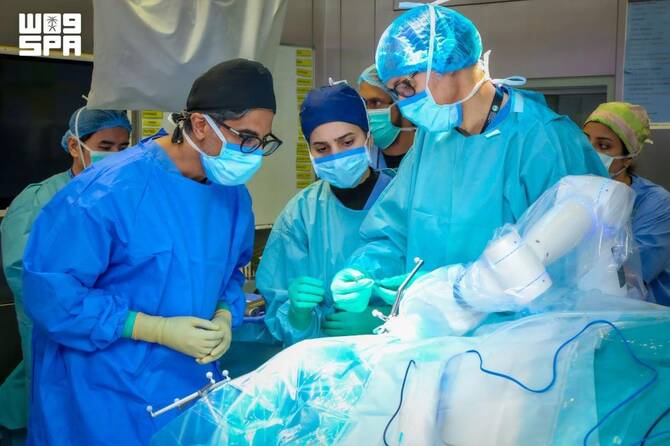

RIYADH: King Faisal Specialist Hospital and Research Centre in Riyadh has performed Saudi Arabia’s first laser interstitial thermal therapy procedure, expanding treatment options for selected patients with drug-resistant focal epilepsy and certain brain tumors.
The minimally invasive procedure, which may be used as an alternative to open surgery in appropriate cases, was offered by the hospital’s Neuroscience Centre of Excellence and involves inserting thin laser fibers through a small opening in the skull and guiding them to the target area.
MRI is used to confirm location and monitor heat distribution in real time, allowing doctors to deliver controlled thermal energy while minimizing damage to surrounding healthy tissue.
The first patient treated with the technique was discharged within 24 hours, with no complications reported. The procedure may help shorten hospital stays and support faster recovery in suitable patients.
Dr. Faisal Alotaibi, functional and epilepsy surgery consultant at KFSHRC, said the patient was selected after a multidisciplinary assessment involving neurosurgeons, radiologists, and epilepsy specialists.
He said the technique can be used in selected cases previously considered high risk because of their proximity to sensitive areas of the brain. He added that the hospital plans to expand its use by training more clinical teams and gradually increasing the number of eligible patients.
Laser interstitial thermal therapy is a less invasive alternative to open brain surgery, which typically requires a larger incision and an opening in the skull. In appropriate cases the technique may reduce the extent of surgery, shorten hospital stays, and support faster recovery.
It adds to the hospital’s neurological care program, which combines clinical expertise, advanced neuroimaging, and minimally invasive surgical techniques to determine the most appropriate treatment for each patient.
For epilepsy patients, the assessment includes specialized techniques to identify the source of seizures — including stereoelectroencephalography, along with neuroimaging and multidisciplinary clinical evaluations — before determining whether the patient is suitable for laser interstitial thermal therapy.