

Bangladesh to launch Myanmar curriculum for Rohingya refugee children

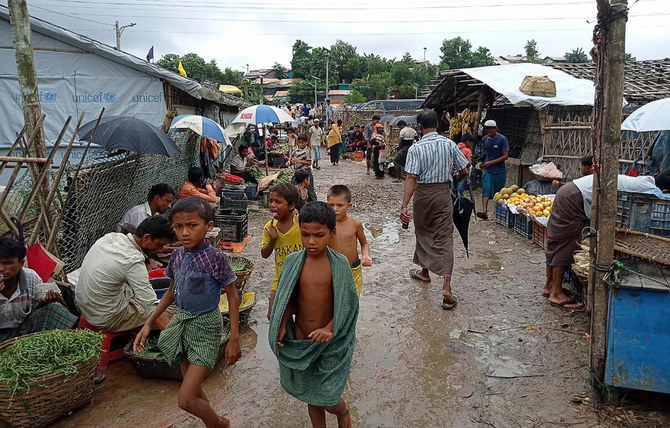
Bangladesh authorities and the UN will start a formal education program using Myanmar curriculum to benefit Rohingya children at refugee camps in Cox’s Bazar. (File/AFP)
Short Url
Updated 27 October 2021
Follow

Bangladesh to launch Myanmar curriculum for Rohingya refugee children

  • Stalled by COVID-19 lockdowns, pilot program now set to swing into action

DHAKA: Bangladeshi authorities and the UN are preparing to introduce formal education using a Myanmar curriculum for hundreds of thousands of Rohingya children living in refugee camps in Cox’s Bazar.

The fishing port in southeastern Bangladesh, hosts more than 1.1 million Rohingya Muslims — members of an ethnic and religious minority group who fled persecution in neighboring Myanmar during a military crackdown in northern Rakhine state in 2017.

The children, who constitute half of the refugee population, now attend 6,250 informal learning centers run by UN agencies and aid partners at 34 camps in Cox’s Bazar, which provide basic education to more than 354,000 students.

The Bangladeshi government in January 2020 agreed with the UN that the Rohingya children should be provided with Myanmar education to prepare them for a future return to their country. Stalled by coronavirus disease pandemic lockdowns for one-and-half years, a pilot program is now set to be launched as Bangladeshi schools reopened last month.

Regina de la Portilla, UN refugee agency spokesperson at Cox’s Bazar, recently told Arab News: “The Myanmar curriculum is to be introduced in learning centers, as per the government of Bangladesh request, with the objective that children can restart their education when they are able to safely and voluntarily return to their home country. Preparations are completed to roll out the pilot.”

The foreign ministry expected the program to be launched soon as final preparations are underway. A ministry official, who wished to remain anonymous, said: “We are working on it and are currently busy with last-minute preparations. We hope to roll out the curriculum anytime soon.

“We have made some observations in the curriculum to incorporate Myanmar culture. Our objective is to prepare them to integrate with the Myanmar society once they are repatriated,” he said.

BRAC, the largest development organization based in Bangladesh, which has been running learning centers for 65,000 Rohingya children in Cox’s Bazar, plans to teach them in Myanmar’s main language, Burmese.

Khan Mohammed Ferdous, BRAC’s education program chief at Cox’s Bazar, told Arab News: “Teachers at our learning centers have received basic training but are yet to be trained for the new curriculum.

“Currently, we are following a learning competence framework and approach, a government-approved guideline for the informal education system. Gradually, the framework will jump into the Myanmar curriculum.”

Rohingya parents in Cox’s Bazar are waiting for the introduction of the new curriculum, which would help prepare them for future repatriation.

Fatema Begum, 35, said she had been worrying about her four children as formal education was not available at the camps.

“The introduction of the Myanmar curriculum in the camps is inspiring news to me because my children will have the opportunity to learn more about their homeland. They will have the eligibility to pursue higher education,” she added.

Abdur Rahim, 41, a father-of-three, was also hoping for a better future for his children.

He said: “The boys and girls at Rohingya camps have nothing to do except roam around. When the Myanmar curriculum is launched, they will be able to receive some quality education, which will help them to pursue a better career in Myanmar.”

Prof. Amena Mohsin from the University of Dhaka’s international relations department described the move as a “message” to the world that Rohingya refugees were Myanmar citizens whose opportunities in Bangladesh were limited.

She said: “There is no point in teaching the refugee children with the Bangladeshi curriculum since they are not allowed to get engaged in any formal job in Bangladesh. The Myanmar curriculum will help them prepare for livelihoods when they return to Myanmar.”


Russia-ally Touadera seeks third term in Central African Republic

Updated 1 sec ago
Follow

Russia-ally Touadera seeks third term in Central African Republic

BANGUI: Central African Republic President Faustin-Archange Touadera is seeking a third term in an election on Sunday, campaigning on security gains after signing deals with rebel groups and enlisting support from Russian mercenaries and Rwandan ​forces.
He faces six opposition candidates including Anicet-Georges Dologuele, a former prime minister and runner-up in the 2020 election, but is likely to win in part due to his control over state institutions, analysts say.
Such a result would likely further the interests of Russia, which has traded security assistance for access to resources including gold and diamonds. Touadera is also offering access to the country’s lithium and uranium reserves to anyone interested.
The 68-year-old mathematician took power in 2016 after the worst crisis in the chronically unstable country’s history, when three years of intercommunal strife forced a fifth of the population to flee their homes, either internally or abroad.
Touadera has signed peace deals this year with several rebel groups, while ‌others have been ‌weakened in the face of Russian mercenaries and troops from Rwanda deployed to ‌shore ⁠up Touadera’s ​government as ‌well as UN peacekeepers.
“During the 10 years that we have been working together, you yourselves have seen that peace is beginning to return, starting from all our borders and reaching the capital,” Touadera told a rally at a stadium in the capital Bangui this month.
His opponents, meanwhile, have denounced a constitutional referendum in 2023 that scrapped the presidential term limit, saying it was proof Touadera wants to be president for life.
They have also accused him of failing to make significant progress toward lifting the 5.5 million population out of poverty.
“The administrative infrastructure has been destroyed and, as you know, the roads are in a ⁠very poor state of repair,” Dologuele told a recent press conference.
“In short, the Central African economy is in ruins.”
SECURITY THREATS REMAIN DESPITE PEACE DEALS
The presidential ‌contest is taking place alongside legislative, regional and municipal elections, with provisional results ‍expected to be announced by January 5.
If no ‍candidate gets more than 50 percent of the vote, a presidential runoff will take place on February 15, while legislative ‍runoffs will take place on April 5.
A smooth voting process could reinforce Touadera’s claim that stability is returning, which was buttressed last year with the UN Security Council’s lifting of an arms embargo and the lifting of a separate embargo on diamond exports.
“The fact that these measures were lifted, it shows that we’re gradually getting back to normal. Or at least that’s the narrative,” said Romain ​Esmenjaud, associate researcher at the Institut Francais de Geopolitique.
The peace deals are credited with a decline in violence in some areas and an expected boost in economic growth projections to 3 percent this ⁠year, according to the International Monetary Fund. US President Donald Trump’s administration has said the UN should hand security back to the government soon.
But serious security threats remain. Rebels have not fully disarmed, reintegration is incomplete, and incursions by combatants from neighboring Sudan fuel insecurity in the east.
Pangea-Risk, a consultancy, wrote in a note to clients that the risk of unrest after the election was high as opponents were likely to challenge Touadera’s expected victory.
“The election will take place in an atmosphere marked by heightened grievances over political marginalization, increasing repression, and allegations of electoral fraud,” said chief executive Robert Besseling.
Dologuele alleged fraud after he was recorded as winning 21.6 percent of the vote in 2020, when rebel groups still threatened the capital and prevented voting at 800 polling stations across the country, or 14 percent of the total. A court upheld Touadera’s win.
Paul-Crescent Beninga, a political analyst, said voters will be closely scrutinizing the voting and counting processes.
“If they do not go well, it gives those ‌who promote violence an excuse to mobilize violence and sow panic among the population of the Central African Republic. So that is why we must ensure that the elections take place in relatively acceptable conditions,” he said.