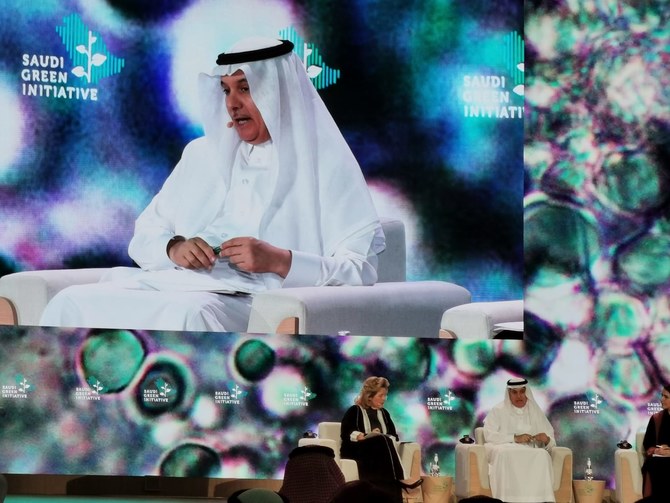
Saudi Arabia to tap private sector, NGOs for Saudi Green Initiative

Short Url
Updated 24 October 2021
Follow

Saudi Arabia to tap private sector, NGOs for Saudi Green Initiative

RIYADH: Saudi Arabia will seek involvement from the private sector and other organizations in the Kingdom to help plant 10 billion trees under the Saudi Green Initiative.

The Minister of Water, Environment, and Agriculture Abdulrahman Al-Fadly told Arab News that the government cannot do it all alone, adding that the final budget and amount of funding available for the entire project is currently under review.

“All the private sector, non-governmental organizations, citizens, agricultural associations, environmental associations, companies, government companies, and the government as well, will participate in planting the trees” he told Arab News on the sideline of Saudi Green Initiative Forum in Riyadh.

“Planting 10 billion trees is one of the milestone initiatives here in the Kingdom of Saudi Arabia,” he said. 

Degradation is one of the major issues under focus in the Kingdom. By achieving the goal of planting 10 billion trees under the Saudi Green Initiative, 50 million hectares of Saudi Arabia will be rehabilitated and redeveloped. 

The minister highlighted that 50 percent of the degraded land in the Kingdom will be rehabilitated to reduce the negative impacts of climate change and new land will be designated solely for the protection of wildlife. 

“The Kingdom will plant 1 percent of the global tree plantation target,” he said. 

As announced by Crown Prince Mohammed bin Salman the private sector will have numerous investment opportunities and contributions along the way.     

“Naturally speaking when it comes to planting 10 billion trees in the Kingdom with this kind of climate it is a great challenge, but I do believe we will be able to put this initiative into action through the use of renewable water, desalinated water, or treated water,” the minister emphasized. 

The initiative will mainly focus on local and native plants that can endure the climate change or the drought along with the implementation of new technology that can research and limit the usage of water. 

Speaking earlier in the day, the minister told the forum the government is planning to use 50 million hectares of land to plant the trees, as it aims to “provide a green cover to reduce the negative impact of climate change."

The minister also reiterated the Saudi crown prince’s commitment to the Kingdom’s environmental objectives. 

He said the crown prince has increased the percentage of the Kingdom’s protected land from 16 percent to 20 percent. 


Multilateralism strained, but global cooperation adapting: WEF report

Updated 10 January 2026
Follow

Multilateralism strained, but global cooperation adapting: WEF report

DUBAI: Overall levels of international cooperation have held steady in recent years, with smaller and more innovative partnerships emerging, often at regional and cross-regional levels, according to a World Economic Forum report.

The third edition of the Global Cooperation Barometer was launched on Thursday, ahead of the WEF’s annual meeting in Davos from Jan. 19 to 23.

“The takeaway of the Global Cooperation Barometer is that while multilateralism is under real strain, cooperation is not ending, it is adapting,” Ariel Kastner, head of geopolitical agenda and communications at WEF, told Arab News.

Developed alongside McKinsey & Company, the report uses 41 metrics to track global cooperation in five areas: Trade and capital; innovation and technology; climate and natural capital; health and wellness; and peace and security.

The pace of cooperation differs across sectors, with peace and security seeing the largest decline. Cooperation weakened across every tracked metric as conflicts intensified, military spending rose and multilateral mechanisms struggled to contain crises.

By contrast, climate and nature, alongside innovation and technology, recorded the strongest increases.

Rising finance flows and global supply chains supported record deployment of clean technologies, even as progress remained insufficient to meet global targets.

Despite tighter controls, cross-border data flows, IT services and digital connectivity continued to expand, underscoring the resilience of technology cooperation amid increasing restrictions.

The report found that collaboration in critical technologies is increasingly being channeled through smaller, aligned groupings rather than broad multilateral frameworks.  

This reflects a broader shift, Kastner said, highlighting the trend toward “pragmatic forms of collaboration — at the regional level or among smaller groups of countries — that advance both shared priorities and national interests.”

“In the Gulf, for example, partnerships and investments with Asia, Europe and Africa in areas such as energy, technology and infrastructure, illustrate how focused collaboration can deliver results despite broader, global headwinds,” he said.

Meanwhile, health and wellness and trade and capital remained flat.

Health outcomes have so far held up following the pandemic, but sharp declines in development assistance are placing growing strain on lower- and middle-income countries.

In trade, cooperation remained above pre-pandemic levels, with goods volumes continuing to grow, albeit at a slower pace than the global economy, while services and selected capital flows showed stronger momentum.

The report also highlights the growing role of smaller, trade-dependent economies in sustaining global cooperation through initiatives such as the Future of Investment and Trade Partnership, launched in September 2025 by the UAE, New Zealand, Singapore and Switzerland.

Looking ahead, maintaining open channels of communication will be critical, Kastner said.

“Crucially, the building block of cooperation in today’s more uncertain era is dialogue — parties can only identify areas of common ground by speaking with one another.”