

Philippines seeks out witnesses to probe abuses in Duterte’s drug war

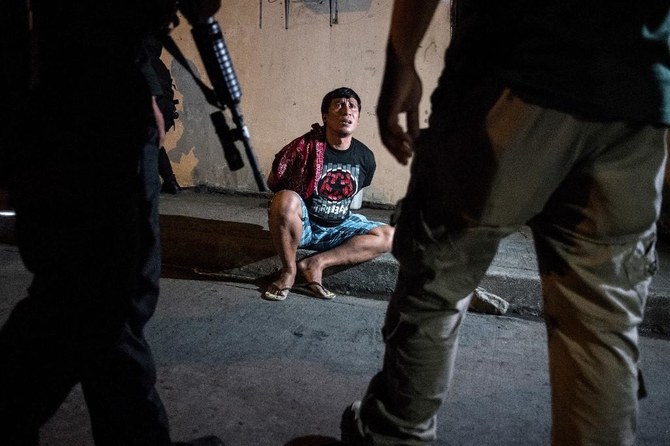
At least 6,191 people have died in more than 200,000 anti-drug operations conducted since July 2016. (AFP)
Short Url
Updated 20 October 2021
Follow

Philippines seeks out witnesses to probe abuses in Duterte’s drug war

  • Last month, the ICC authorized a full investigation into the Philippine ‘war on drugs’

MANILA: The Philippines Justice Department on Wednesday called on witnesses to help investigate dozens of police officers suspected of criminal abuse in operations that have killed thousands of people as part of President Rodrigo Duterte’s anti-drug campaign.

Since taking office in 2016, Duterte has carried out a “war on drugs” that according to official records has led to the deaths of over 6,000 Filipinos to date. Human Rights Watch estimates the actual death toll is over 12,000, with most victims belonging to urban poor backgrounds.

The DOJ has said it is reviewing cases of deaths in anti-drug operations as “recognition of the importance of transparency.” The review follows last year’s UN Human Rights Council report that said the drug war was an “illegal, murderous state policy.”

On Wednesday, the DOJ released its initial findings in 52 cases, in which 154 police officers had been involved.

The purpose of releasing the material, it said, was “inviting any witnesses or persons with first-hand information helpful to the resolution of the 52 cases to come forward and approach the National Bureau of Investigation for the taking of their statements, if any.”  

The DOJ is expected to review thousands of other cases. It remains unclear when the whole review will be completed.

“The process has no specific termination date,” Justice Secretary Menardo Guevarra told Arab News. “It is a continuing process.”

When the deadly anti-drug campaign began in July 2016, Duterte openly ordered police to kill suspects if officers’ lives were endangered.

But the information released by the DOJ on the 52 cases shows that in many instances the suspects posed no real danger and did not even resist arrest or carry weapons. Many of those killed in drug operations bore multiple gunshot wounds.

One of the cases included in the review was of Nave Perry Alcantara, 17, who was killed in a “buy-bust” operation in Cagayan province in August 2018. Officers said Alcantara had fired at them, but according to an internal police investigation, the teenager was standing only one meter away from the law enforcers.

“Reading the matrix of 52 cases supposedly in relation to the drug war released by the DOJ is deja vu of the feeling I got when I read the Marcos martial law victims accounts,” Cristina Palabay Palabay, secretary-general of the human rights watchdog KARAPATAN, told Arab News.

“The public, especially the victims and their families and human rights advocates, hope that the review can be done in a more expeditious, effective, transparent, inclusive manner,” she said, adding that accountability should also extend to those who “instituted policies, incited, encouraged, drove and ordered the killings.”

National Union of Public Lawyers Secretary-General Edre Olalia said the review was indicating “progress in investigating and eventually making those responsible liable.”

However, he added that the insignificant number of cases suggests the department might lack a “proactive desire to decisively stop the carnage and the impunity.”

Last month, the International Criminal Court authorized a full investigation into the anti-drug campaign, which it said appeared to have been “a widespread and systematic attack against the civilian population” and could amount to crimes against humanity.

After previously saying ICC investigators would not be allowed in the Philippines, Duterte said this month he would prepare his defense against the court’s probe.


WHO chief says reasons US gave for withdrawing ‘untrue’

Updated 5 sec ago
Follow

WHO chief says reasons US gave for withdrawing ‘untrue’

  • US Secretary of State Marco Rubio and US Health Secretary Robert F. Kennedy Jr. announced in a joint statement Thursday that Washington had formally withdrawn from the WHO
  • And in a post on X, Tedros added: “Unfortunately, the reasons cited for the US decision to withdraw from WHO are untrue”

GENEVA: The head of the UN’s health agency on Saturday pushed back against Washington’s stated reasons for withdrawing from the World Health Organization, dismissing US criticism of the WHO as “untrue.”
Tedros Adhanom Ghebreyesus warned that US announcement this week that it had formally withdrawn from the WHO “makes both the US and the world less safe.”
And in a post on X, he added: “Unfortunately, the reasons cited for the US decision to withdraw from WHO are untrue.”
He insisted: “WHO has always engaged with the US, and all Member States, with full respect for their sovereignty.”
US Secretary of State Marco Rubio and US Health Secretary Robert F. Kennedy Jr. announced in a joint statement Thursday that Washington had formally withdrawn from the WHO.
They accused the agency, of numerous “failures during the Covid-19 pandemic” and of acting “repeatedly against the interests of the United States.”
The WHO has not yet confirmed that the US withdrawal has taken effect.

- ‘Trashed and tarnished’ -

The two US officials said the WHO had “trashed and tarnished” the United States, and had compromised its independence.
“The reverse is true,” the WHO said in a statement.
“As we do with every Member State, WHO has always sought to engage with the United States in good faith.”
The agency strenuously rejected the accusation from Rubio and Kennedy that its Covid response had “obstructed the timely and accurate sharing of critical information that could have saved American lives and then concealed those failures.”
Kennedy also suggested in a video posted to X Friday that the WHO was responsible for “the Americans who died alone in nursing homes (and) the small businesses that were destroyed by reckless mandates” to wear masks and get vaccinated.
The US withdrawal, he insisted, was about “protecting American sovereignty, and putting US public health back in the hands of the American people.”
Tedros warned on X that the statement “contains inaccurate information.”
“Throughout the pandemic, WHO acted quickly, shared all information it had rapidly and transparently with the world, and advised Member States on the basis of the best available evidence,” the agency said.
“WHO recommended the use of masks, vaccines and physical distancing, but at no stage recommended mask mandates, vaccine mandates or lockdowns,” it added.
“We supported sovereign governments to make decisions they believed were in the best interests of their people, but the decisions were theirs.”

- Withdrawal ‘raises issues’ -

The row came as Washington struggled to dislodge itself from the WHO, a year after US President Donald Trump signed an executive order to that effect.
The one-year withdrawal process reached completion on Thursday, but Kennedy and Rubio regretted in their statement that the UN health agency had “not approved our withdrawal and, in fact, claims that we owe it compensation.”
WHO has highlighted that when Washington joined the organization in 1948, it reserved the right to withdraw, as long as it gave one year’s notice and had met “its financial obligations to the organization in full for the current fiscal year.”
But Washington has not paid its 2024 or 2025 dues, and is behind around $260 million.
“The notification of withdrawal raises issues,” WHO said Saturday, adding that the topic would be examined during WHO’s Executive Board meeting next month and by the annual World Health Assembly meeting in May.
“We hope the US will return to active participation in WHO in the future,” Tedros said Saturday.
“Meanwhile, WHO remains steadfastly committed to working with all countries in pursuit of its core mission and constitutional mandate: the highest attainable standard of health as a fundamental right for all people.”