British lawmaker stabbed to death in ‘terrorist incident’

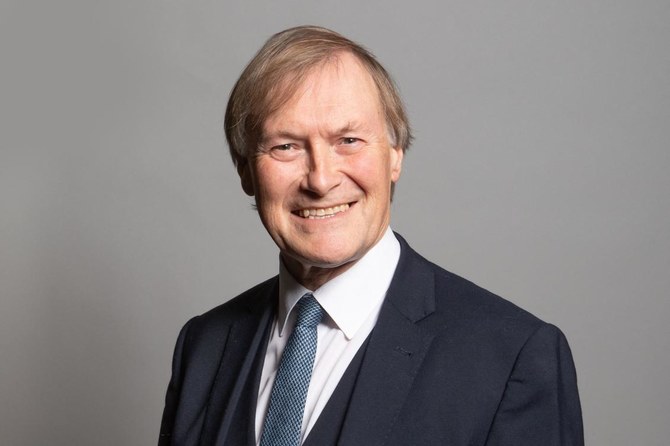
Conservative MP for Southend West, David Amess, posing for an official portrait photograph at the Houses of Parliament. (AFP/Richard Townshend/UK Parliament)
Short Url
Updated 16 October 2021
Follow

British lawmaker stabbed to death in ‘terrorist incident’

  • Police said a man had been arrested after a stabbing

LEIGH-ON-SEA, England: British lawmaker David Amess was stabbed to death in an Essex church on Friday by an assailant who lunged at him as he met voters, in what police said was a terrorist attack.
Amess, 69, from Prime Minister Boris Johnson’s Conservative Party, was knifed repeatedly in the attack at about midday in the Belfairs Methodist Church in Leigh-on-Sea, east of London.
The Metropolitan Police, whose counter-terrorism unit are leading the investigation of the incident, said in a statement early on Saturday that they declared the fatal stabbing as a terrorist incident.
The early investigation has revealed a “potential motivation linked to Islamist extremism,” the police added.
A 25-year-old man was arrested at the scene on suspicion of murder, and detectives said specialist counter-terrorism officers were leading the initial investigation.
“As part of the investigation, officers are currently carrying out searches at two addresses in the London area and these are ongoing,” the police said, adding that it is believed that the suspect in custody acted alone.
Politicians described the attack as an assault on democracy.
“David was a man who believed passionately in this country and in its future and we have lost today a fine public servant and a much loved friend and colleague,” said Johnson, who rushed back to London from the west of England after the news broke.
Armed police swooped on the church and paramedics fought in vain to save the lawmaker’s life on the floor of the church, where a sign says: “All are welcome here: where old friends meet and strangers feel at home.”
“Tragically, he died at the scene,” Essex Police Chief Constable Ben-Julian Harrington told reporters. He said police at the time of the incident did not believe there was any immediate threat to anyone else.
He gave no other details about the killing, the second fatal attack on a British lawmaker in their constituency in the last five years, which has prompted questions about the safety of politicians.


Broadcaster Sky News said the arrested man was understood to be a British national of Somali heritage.
Colleagues from across parliament expressed their shock and paid tribute to Amess, one of Britain’s longest-serving lawmakers, for his commitment to his constituents, with whom he held regular meetings on the first and third Friday of the month.
Flags on all British government buildings will be flown at half-staff in tribute.
Amess, married with five children, was first elected to parliament to represent the town of Basildon in 1983, and then nearby Southend West in 1997. He was knighted by Queen Elizabeth for his public service in 2015.
His website listed his main interests as “animal welfare and pro-life issues.” He was popular with lawmakers and known for his active contributions to debates — often about issues relating to his Essex constituency or animal rights.
Bob Hazel, secretary of a local residents’ group, said Amess regularly chatted with commuters on the train from London.
“He wouldn’t be stuck behind a book or a newspaper, he would be talking to people and he was that sort of person. He was really approachable and he’s going to be very, very much missed,” Hazel told Reuters.


In Amess’ last contribution to the House of Commons last month, he asked for a debate about animal welfare.
Residents left flowers beside the church with a tribute: “David Amess RIP Such a gentleman xxx.”
The knife attack at a meeting with constituents has echoes of a 2010 incident when Labour lawmaker Stephen Timms survived a stabbing in his constituency office, and the 2016 fatal shooting of Labour’s Jo Cox just days before the Brexit referendum.
Cox’s husband, Brendan, called the attack on Amess “as cowardly as it gets,” while her sister, Kim Leadbeater, who earlier this year was elected as member of parliament for the same area Cox represented, said it showed the “massive risks” lawmakers had to take.
“That another family is having to go through that again, it’s horrific,” Leadbeater said. “So many MPs today will be scared by this. My partner came home and said: ‘I don’t want you to do this anymore, because next time that phone goes it could be a different conversation.’“
US Secretary of State Antony Blinken also conveyed his condolences. “An attack on elected officials is an attack on democracy,” he said.
The speaker of the House of Commons, Lindsay Hoyle, said the incident would send shockwaves across the parliamentary community and the whole country, adding the security of lawmakers would have to be discussed.
“Questions are rightly being asked about the safety of our country’s elected representatives,” Home Secretary (interior minister) Priti Patel said, adding she had asked police to review lawmakers’ security.
The Conservative Party suspended all campaigning activities until further notice.
“Heartbreaking to hear of the death of Sir David Amess,” former Prime Minister Theresa May said. “A decent man and respected parliamentarian, killed in his own community while carrying out his public duties. A tragic day for our democracy.”


Reference to Trump’s impeachments is removed from the display of his Smithsonian photo portrait

Updated 12 January 2026
Follow

Reference to Trump’s impeachments is removed from the display of his Smithsonian photo portrait

  • For now, references to Presidents Andrew Johnson and Bill Clinton being impeached in 1868 and 1998, respectively, remain as part of their portrait labels, as does President Richard Nixon’s 1974 resignation as a result of the Watergate scandal

WASHINGTON: President Donald Trump’s photo portrait display at the Smithsonian’s National Portrait Gallery has had references to his two impeachments removed, the latest apparent change at the collection of museums he has accused of bias as he asserts his influence over how official presentations document US history.
The wall text, which summarized Trump’s first presidency and noted his 2024 comeback victory, was part of the museum’s “American Presidents” exhibition. The description had been placed alongside a photograph of Trump taken during his first term. Now, a different photo appears without any accompanying text block, though the text was available online. Trump was the only president whose display in the gallery, as seen Sunday, did not include any extended text.
The White House did not say whether it sought any changes. Nor did a Smithsonian statement in response to Associated Press questions. But Trump ordered in August that Smithsonian officials review all exhibits before the nation celebrates the 250th anniversary of the Declaration of Independence on July 4. The Republican administration said the effort would “ensure alignment with the president’s directive to celebrate American exceptionalism, remove divisive or partisan narratives, and restore confidence in our shared cultural institutions.”
Trump’s original “portrait label,” as the Smithsonian calls it, notes Trump’s Supreme Court nominations and his administration’s development of COVID-19 vaccines. That section concludes: “Impeached twice, on charges of abuse of power and incitement of insurrection after supporters attacked the US Capitol on January 6, 2021, he was acquitted by the Senate in both trials.”
Then the text continues: “After losing to Joe Biden in 2020, Trump mounted a historic comeback in the 2024 election. He is the only president aside from Grover Cleveland (1837– 1908) to have won a nonconsecutive second term.”
Asked about the display, White House spokesman Davis Ingle celebrated the new photograph, which shows Trump, brow furrowed, leaning over his Oval Office desk. Ingle said it ensures Trump’s “unmatched aura ... will be felt throughout the halls of the National Portrait Gallery.”
The portrait was taken by White House photographer Daniel Torok, who is credited in the display that includes medallions noting Trump is the 45th and 47th president. Similar numerical medallions appear alongside other presidents’ painted portraits that also include the more extended biographical summaries such as what had been part of Trump’s display.
Sitting presidents are represented by photographs until their official paintings are commissioned and completed.
Ingle did not answer questions about whether Trump or a White House aide, on his behalf, asked for anything related to the portrait label.
The gallery said in a statement that it had previously rotated two photographs of Trump from its collection before putting up Torok’s work.
“The museum is beginning its planned update of the America’s Presidents gallery which will undergo a larger refresh this Spring,” the gallery statement said. “For some new exhibitions and displays, the museum has been exploring quotes or tombstone labels, which provide only general information, such as the artist’s name.”
For now, references to Presidents Andrew Johnson and Bill Clinton being impeached in 1868 and 1998, respectively, remain as part of their portrait labels, as does President Richard Nixon’s 1974 resignation as a result of the Watergate scandal.
And, the gallery statement noted, “The history of Presidential impeachments continues to be represented in our museums, including the National Museum of American History.”
Trump has made clear his intentions to shape how the federal government documents US history and culture. He has offered an especially harsh assessment of how the Smithsonian and other museums have featured chattel slavery as a seminal variable in the nation’s development but also taken steps to reshape how he and his contemporary rivals are depicted.
In the months before his order for a Smithsonian review, he fired the head archivist of the National Archives and said he was firing the National Portrait Gallery’s director, Kim Sajet, as part of his overhaul. Sajet maintained the backing of the Smithsonian’s governing board, but she ultimately resigned.
At the White House, Trump has designed a notably partisan and subjective “Presidential Walk of Fame” featuring gilded photographs of himself and his predecessors — with the exception of Biden, who is represented by an autopen — along with plaques describing their presidencies.
The White House said at the time that Trump himself was a primary author of the plaques. Notably, Trump’s two plaques praise the 45th and 47th president as a historically successful figure while those under Biden’s autopen stand-in describe the 46th executive as “by far, the worst President in American History” who “brought our Nation to the brink of destruction.”