

Iraqi elections were competitive and ‘surprisingly’ well-managed, observers say

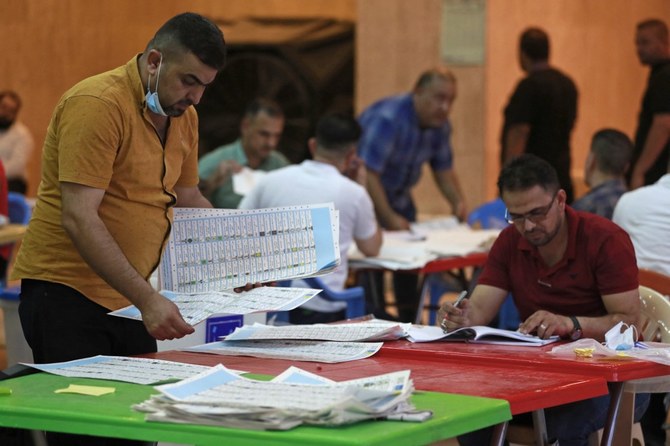
Employees of Iraq’s Independent High Electoral Commission conduct a manual count of votes following the parliamentary elections in Baghdad’s Green Zone area on Oct. 13, 2021. (AFP)
Short Url
Updated 15 October 2021
Follow

Iraqi elections were competitive and ‘surprisingly’ well-managed, observers say

  • Chief EU observer Viola Von Cramon-Taubadel said although the low turnout and exclusion of some groups was a concern, the vote was well run in terms of administration and integrity
  • Iran is the country with the biggest stake in the outcome of Iraq’s election, because of the influence it exerts over its neighbor, says an expert

LONDON: Despite some lack of clarity, low voter turnout, the exclusion of several groups and the overarching security, the Iraqi elections this week were “surprisingly” well run and managed and were genuinely competitive, according to experts.
“It was a special experience being the first chief observer of the European Union Election Observation Mission to Iraq,” said Viola Von Cramon-Taubadel, a member of the European Parliament.
“Coming from a, let’s say, very civil society in Germany and even more-robust political environments in a post-Soviet world, something like this I have never experienced or seen before.”
She was speaking on Thursday during a panel discussion, organized by UK think tank Chatham House, about the Iraqi elections last Sunday and what they mean for the government. Only about 9 million of 22 million eligible voters cast a vote, a turnout of just over 40 percent.
Cramon-Taubadel said observers’ preliminary statement was fairly critical and that the low voter turnout was in part due to structural problems, including a lack of access and services for people with special needs, including those with vision and hearing impairments and in wheelchairs. The high level of security at polling stations also hindered access and several sections of the population were excluded, such as internally displaced persons, she added, and there were technical issues with voter cards that did not work and biometric systems that failed to recognize fingerprints.
However she compared this with election experiences in Berlin, where significant problems have also been encountered. And in terms of the fundamentals, Iraq fared relatively well, she added.
“In terms of administration, in terms of having everything, people knew what they were doing and the technology worked, mainly — I cannot say this for Berlin, honestly,” said Cramon-Taubadel.


(L to R) Head of the European Parliament’s delegation Domenec Ruiz Devesa, Chief Observer of the EU Election Observation Mission to Iraq Viola von Cramon, and deputy chief Alexander Matus hold a press conference to announce their preliminary report in Baghdad’s Green Zone on Oct. 12, 2021. (AFP)

Many democratic countries are experiencing increasingly low levels of voter turnout, even the US, she added, but rather than comparing Iraq’s elections with those in the West she suggested that a more relevant comparison was with the previous elections in Iraq, in 2018.
“The level of security, the level of professionalism...in general, if you look through the process how it went in 2018 and now, I would say this was a huge upgrade,” said Cramon-Taubadel. “And I have only heard that people were surprised by how many independent candidates in the end have made it, and they kind of regretted their decision to boycott (the election) because they didn’t believe, they didn’t trust the institution and there was no confidence in the IT system.”
Authorities ran election simulations before and after the vote and have precautionary measures in place to prevent fraud or tampering, she explained, and eradicated a number of loopholes in the past month.
Cramon-Taubadel said she saw highly-sophisticated precautionary measures in place at a warehouse in Basra where ballots were being stored, to protect it and avoid a repeat of incidents such as a warehouse fire in Baghdad during the 2018 election in which votes were destroyed. Staff at polling stations were well trained and committed, she added, but they were sad and frustrated because they had hoped for higher turnouts that would have given then more to do, especially in urban areas.
Regarding accusations of fraud and ballot-rigging, Cramon-Taubadel said the UN Assistance Mission for Iraq has access to the raw election data and has not found any evidence of this. Expressing her trust in Iraq’s Independent High Electoral Commission, she said any indications of fraudulent activity should be submitted to it so that their and EU observers can implement the proper legal mechanisms and investigate.
She said the main thing now is for the government to listen to the people and include the views of protest movements in the political process, focus on rebuilding the nation’s infrastructure, particularly the “awful” schools, and try to capitalize on oil and other resources while it can because the Iraqi people “deserve better.”
Harith Hasan, a non-resident senior fellow at the Malcolm H. Kerr Carnegie Middle East Center, said the low turnout had favored some parties and hurt others.
Muqtada Al-Sadr’s bloc was the biggest winner, taking more than 70 seats, followed by Mohammed Al-Halbousi’s Progress Party, Masoud Barzani’s Kurdistan Democratic Party, and Nouri Al-Maliki’s State of Law, all of whom won more than 30 seats. The most notable loser was the Fatah bloc, pro-Iranian Shiite parties with links to armed groups, affiliated with the Popular Mobilization Forces (Hashd Al-Shaabi).


Iraq’s populist cleric Moqtada Al-Sadr shows his ink-stained finger after casting his vote at a polling station in the central Iraqi shrine city of Najaf on Oct. 10, 2021. (AFP)

Hasan said Iran is the country with the biggest stake in the outcome of Iraq’s election, because of the influence it exerts over its neighbor.
“The Iranians have three interests in Iraq,” he explained. “The first is, of course, the ending of the US military presence and making sure there are no threats coming from Iraq.
“The second is maintaining the Hashd Al-Shaabi, and the third is keeping the Iraqi markets open for Iranian products.”
Tehran would prefer an Iraqi government dominated by its allies, which they believe would secure their interests much better than a government dominated by Al-Sadr, Hasan said, but much will depend on who is responsible for Iraqi policy in President Ebrahim Raisi’s government.
Hanaa Edwar, the founder and general secretary of the Iraqi Al-Amal Association, a non-political, non-sectarian organization of volunteers that works to improve the lives of all Iraqis, said that if there is an effort to “really build an opposition for the first time inside the parliament,” that would be a positive first step.
“And if they really can confront cutting MPs’ privileges, materially and funding and so on, I think this is also something we can take into consideration as a positive step,” she added.
She said this will depend on how established national parties and MPs cooperate with new parties, as well as civil society, intellectuals and “the movement in the street,” which have a large role to play “in the development of this new era in the country.”


A father awaits Rafah crossing reopening after 2-year separation from family in Gaza

Updated 4 sec ago
Follow

A father awaits Rafah crossing reopening after 2-year separation from family in Gaza

  • Belal, 51, has packed his suitcases, bought gifts for his children, and is ready to go as soon as he is allowed
  • Gaza has been closed to entry for Palestinians since Israel launched its retaliatory campaign against Hamas for its Oct. 7, 2023, attack on southern Israel

BADRASHIN, Egypt: Stranded in Egypt for the past two years, Raed Belal has had to watch helplessly as his wife and children in the Gaza Strip endured bombardment, displacement and hunger. Now he finally has hope he might return to them.
With Israel preparing to reopen the vital Rafah crossing between Egypt and Gaza, Belal, 51, has packed his suitcases, bought gifts for his children, and is ready to go as soon as he is allowed.
“It’s the moment I have been waiting for,” he said, speaking at the rented apartment where he has been living in the Egyptian village of Badrashin. “The moment when I reunite with my children, when I return to my home and homeland, even if everything is destroyed.”
Belal, who left Gaza to get treated for back pain three months before the war broke out, is one of tens of thousands of Palestinians eager to return to the territory, despite the vast destruction wreaked by Israel’s military campaign against Hamas. The Rafah border crossing is expected to reopen within days, a process jump-started by Israel’s recovery on Monday of the last hostage’s remains in Gaza, where a ceasefire with Hamas has held for four months.
Gaza has been closed to entry for Palestinians since Israel launched its retaliatory campaign against Hamas for its Oct. 7, 2023, attack on southern Israel. In the first months of the war, some 110,000 Palestinians were able to leave Gaza. The Rafah crossing was completely closed in May 2024 when Israeli troops took it over.
Since then, people like Belal have been trapped abroad – most of them in Egypt. Many feared Israel would never allow them back to Gaza.
A ‘limited opening’ of the Rafah crossing
Still, Palestinians will likely face a long wait before going home even after Rafah reopens. Israel intends to keep returns to a trickle.
The exact date of Rafah’s reopening has not been announced. Israeli Prime Minister Benjamin Netanyahu on Tuesday called it a “limited opening,” saying 50 Palestinians a day would be allowed into Gaza and that Israel will keep tight control over who enters, subject to security inspections. Before the war, several hundred people a day would enter Gaza from Egypt.
So far, some 30,000 Palestinians have registered with the Palestinian Embassy in Egypt to return to Gaza, according to an embassy official, speaking on condition of anonymity because details of the reopening remain under discussion.
Hamas in a statement Monday called on Israel to open the Rafah crossing in both directions “without restrictions.” Ali Shaath, head of the new Palestinian committee administering Gaza’s daily affairs, last week said the crossing would be opened this week to facilitate movement into and out of the territory.
Palestinians are also hoping that the crossing’s reopening will mean medical evacuations out of Gaza will increase. Some 20,000 Palestinians needing urgent treatment abroad for war wounds or chronic medical conditions have been waiting for evacuation, according to the Gaza Health Ministry.
Throughout the war, the numbers allowed out have been low. The ceasefire since October brought only a tiny uptick, with an average of only 25 medical evacuations a week, according to UN figures.
Watching his family’s trauma from afar
Belal, who owned a mobile phone store in the northern Gaza town of Beit Lahiya, left the territory in July 2023 to get treatment for his back. Weeks later, Hamas launched its attack on Israel, Israel’s massive bombardment of Gaza began, and Gaza’s borders slammed shut.
Belal was stranded, struggling to keep up with the turmoil that had enveloped his loved ones.
A few days into the war, he got a video call from his sons, who were rushing to move the merchandise out of the shop after they got a warning from the Israeli military that it was about to bomb the building, where both the shop and their family home was located.
The strike demolished the building, and Belal’s 15-year-old son Younis was wounded in the back, he said. At first, doctors said he might be paralyzed, but after months of treatment he was able to walk again.
That began a long trek for his wife and children, who were displaced 12 times over the course of the war. They first moved to a neighbor’s house, but that was bombed the next day. They sheltered for several weeks along with other displaced families in the nearby Indonesian Hospital, until Israeli forces besieged and raided the facility, forcing them to flee again in November 2023.
They eventually made it to a school-turned-shelter in the southern city of Khan Younis, but soon after Israeli forces invaded the area and they had to move again.
Sometimes, Belal spent days unable to reach his family because of communication blackouts.
One of his brothers, Mohammed, was killed along with his 2-year-old child when Israel bombed the school where they were sheltering in the Shati Refugee camp in northern Gaza in mid-2025.
At one point last year, Belal got a phone call from Gaza City’s Shifa Hospital telling him that his son Younis had been killed. They sent him a photo of the body of someone who looked like Younis. He couldn’t reach his family, and it was only after a day of torment that he was able to call them and learned it was a case of mistaken identity.
“Being far away, while your children and family were in such a situation is awful. You live in constant fear; you don’t eat because you’re thinking about your hungry children,” Belal said. “Sometimes you wake up at night, terrified. You rush to the phone and call them to make sure that they are OK.”
A family reunion that can’t come soon enough
Belal’s wife and five children now shelter in a tent in Gaza City, depending on charity kitchens for food. Belal has been sending them money when he can, but his wife, Asmahan, told the AP their savings have almost run out and they’ve had to borrow money from others to get by.
Asmahan said she has had to bear the burden of moving from place to place and keeping her children fed and safe.
“I’m mentally exhausted. The responsibility is immense,” she said. “We have been humiliated and degraded.”
“God willing, the crossing will open, my husband will return, and we will be reunited,” she said.
Belal’s brother, Jaber, left Gaza on Oct. 1, 2023, seeking a job in the West Bank. After the war began, Israel launched a crackdown in the occupied territory, carrying out destructive raids targeting armed groups and imposing tough restrictions on movement.
“Life became impossible in the West Bank,” Jabel said. So in February he joined his brother in Egypt, and he married an Egyptian woman in June. He, too, has registered to return to Gaza with his wife.
“This is our land. Our house is there, even though it’s destroyed. We will rebuild it and rebuild Gaza,” Jaber said.
Raed Belal knows it may still be a long time. After news of Rafah’s opening came, he said, his children “think it will happen tomorrow.” But it could be months, he said, before he presents the gifts he has bought for his children – shoes and clothes for his teenage sons, and makeup and perfume requested by his 8-year-old daughter.
With his bags packed, he is ready.