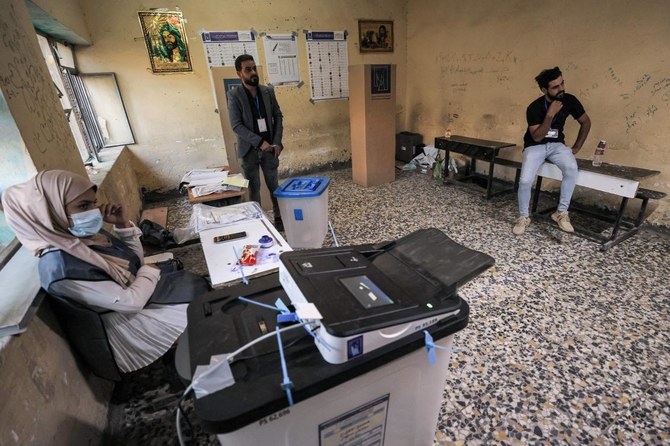
BAGHDAD: Iraq saw a record low election turnout since the US-led invasion that toppled dictator Saddam Hussein, the independent body that oversees the election said Monday. The preliminary results signal widespread dissatisfaction and distrust in this weekend’s vote for a new parliament.
The election was held months ahead of schedule as a concession to a youth-led popular uprising against corruption and mismanagement. But the vote was marred by widespread apathy and a boycott by many of the same young activists who thronged the streets of Baghdad and Iraq’s southern provinces in late 2019, calling for change and new elections.
The Independent High Electoral Commission on Monday said preliminary results show turnout from Sunday’s election was 41 percent. That’s down from 44 percent in the 2018 elections, which was an all-time low.
Tens of thousands of people protested in late 2019 and early 2020, and were met by security forces firing live ammunition and tear gas. More than 600 people were killed and thousands injured within just a few months.
Although authorities gave in and called the early elections, the death toll and the heavy-handed crackdown — as well as a string of targeted assassinations — prompted many protesters to later call for a boycott of the vote.
More definitive results were expected later Monday, but negotiations to choose a prime minister tasked with forming a government are expected to drag on for weeks or even months.
The election was the sixth held since the fall of Saddam Hussein after the US-led invasion of Iraq in 2003. Many were skeptical that independent candidates from the protest movement stood a chance against well-entrenched parties and politicians, many of them backed by powerful armed militias.
There was a marked reluctance among young Iraqis — the country’s largest demographic — to get out and vote. Many said the election would only bring back the same faces and parties responsible for the corruption and mismanagement that has plagued Iraq for decades. The problems have left the country with crumbling infrastructure, growing poverty and rising unemployment rates.
Groups drawn from Iraq’s majority Shiite Muslim factions were expected to come out on top, with a tight race expected between the country’s influential Shiite cleric Moqtada Al-Sadr, and the Fatah Alliance, led by paramilitary leader Hadi Al-Ameri.
The Fatah Alliance is comprised of parties and affiliated with the Popular Mobilization Forces, an umbrella group of mostly pro-Iran Shiite militias that rose to prominence during the war against the Sunni extremist Daesh group. It includes some of the most hard-line Iran-backed factions, such as the Asaib Ahl Al-Haq militia. Al-Sadr, a black-turbaned nationalist leader, is also close to Iran, but publicly rejects its political influence.
Under Iraq’s laws, the party that wins the most seats gets to choose the country’s next prime minister, but it’s unlikely any of the competing coalitions can secure a clear majority. That will require a lengthy process involving backroom negotiations to select a consensus prime minister and agree on a new coalition government.
Iraq’s current prime minister, Mustafa Al-Kadhimi, has played a key role as a mediator in the region’s crises, particularly between regional rivals Iran and Saudi Arabia. Many in the region and beyond will be watching to see if he will secure a second term.
The new parliament will also elect Iraq’s next president.


![]()

Record low turnout in Iraq parliamentary election
Short Url
https://arab.news/nx8cs
Record low turnout in Iraq parliamentary election
- Election was held months ahead of schedule as a concession to a youth-led popular uprising
- There was a marked reluctance among young Iraqis to get out and vote


Latest updates


© 2026 SAUDI RESEARCH & PUBLISHING COMPANY, All Rights Reserved And subject to Terms of Use Agreement.