

Pakistan orders screening of travelers at entry points amid Nipah virus threat

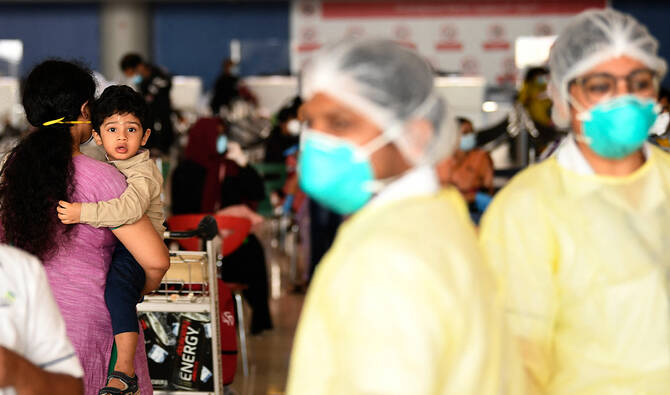
Health workers look on as Pakistani nationals check in at the Dubai International Airport before leaving the Gulf Emirate on a flight back to their country, on May 7, 2020, amid the novel coronavirus pandemic crisis. (AFP/ file)
Short Url
Updated 28 January 2026
Follow

Pakistan orders screening of travelers at entry points amid Nipah virus threat

  • Outbreak of Nipah virus in India has forced Asian countries such as Indonesia and Thailand to screen passengers
  • Pakistan says screening applicable at all entry points including airports, seaports and ground or land border crossings

ISLAMABAD: The Border Health Services-Pakistan (BHS-P) on Wednesday issued an advisory ordering the screening of all passengers at the country’s entry points to curb the cross-border spread of Nipah virus. 

An outbreak of the Nipah virus in India’s West Bengal state has sparked concern in Asian countries such as Thailand and Indonesia, who have started screening passengers. Two cases have been confirmed in India’s West Bengal since December, reportedly in health care workers. 

Nipah, a zoonotic virus first identified during a 1990s outbreak in Malaysia, spreads through fruit bats, pigs and human-to-human contact. There is no vaccine for the virus, which can cause raging fevers, convulsions and vomiting. The only treatment is supportive care to control complications and keep patients comfortable.

The BHS-P, a department of the Ministry of National Health Services, issued an advisory on Wednesday saying that the outbreak of the virus in India had made it imperative to strengthen preventive and surveillance measures at borders. 

“All In-Charges at Points of Entry shall ensure 100 percent screening of all arriving passengers, transit passengers, crew members, drivers, helpers, and support staff,” a copy of the advisory seen by Arab News read. 

“No individual shall be allowed entry into Pakistan without health clearance by Border Health Services – Pakistan.”

It said these measures will be applicable at all points of entry, including international airports, seaports and ground or land border crossings.

The BHS-P said mandatory verification of every traveler’s country of origin and complete travel and transit history for the preceding 21 days will be carried out, irrespective of their nationality or travel status. 

“Screening staff shall remain alert for early signs and symptoms of Nipah virus infection, including fever, headache, respiratory symptoms, and neurological signs such as confusion, drowsiness, or altered consciousness,” the advisory said.

It added that individuals “consistent with suspected Nipah Virus case definition” will be immediately isolated at the entry point, restricted from onward movement and managed strictly in accordance with the Infection Prevention and Control (IPC) protocols.

“Such suspected cases shall be promptly referred to the designated isolation facility or tertiary care hospital in coordination with provincial and district health authorities,” it said. 


IMF mission begins talks in Islamabad as Pakistan seeks next program review

Updated 59 min ago
Follow

IMF mission begins talks in Islamabad as Pakistan seeks next program review

  • Finance ministry confirms ‘kick-off meeting’ with visiting IMF delegation
  • Review critical for next tranche under $7 billion bailout program

KARACHI: Pakistan began formal talks with a visiting International Monetary Fund (IMF) delegation on Monday as the country prepares for the next review of its $7 billion bailout program.

The IMF team is in Pakistan to conduct a review under the Extended Fund Facility (EFF) approved in September 2024, a multi-year program aimed at stabilizing the economy after a balance-of-payments crisis, high inflation and dwindling foreign exchange reserves.

Pakistan has so far received roughly $3 billion of the EFF. Successful completion of the latest review could pave the way for the release of the next tranche of funds, subject to IMF board approval.

Separately in 2024, Pakistan also secured about $1.3 billion under the IMF’s Resilience and Sustainability Facility, a climate-focused funding window aimed at strengthening the country’s capacity to manage environmental and disaster-related risks.

“Kick-off meeting with IMF Mission held today,” the finance ministry said on Monday as it shared visuals of Finance Minister Muhammad Aurangzeb and senior officials meeting the delegation in Islamabad.

IMF country representative in Pakistan, Mahir Binici, told Arab News in an emailed statement; 

“An IMF mission led by Ms. Iva Petrova has started discussions with the authorities in Karachi and Islamabad on the third review of Pakistan’s Extended Fund Facility (EFF) arrangement and the second review of the Resilience and Sustainability Facility (RSF).”

The discussions are expected to focus on Pakistan’s fiscal performance, revenue collection targets, structural reform implementation and broader macroeconomic stability measures agreed under the program.

The review comes at a sensitive time for Pakistan’s economy, with rising global oil prices and regional instability adding pressure to inflation and external accounts. Analysts say continued IMF engagement remains crucial for maintaining investor confidence and securing external financing.

Pakistan entered the IMF program to restore macroeconomic stability, strengthen public finances and rebuild foreign exchange reserves. Authorities have repeatedly described the reform agenda as necessary to ensure long-term economic resilience.

Further meetings between technical teams are expected over the coming days.