

IMF trims global GDP growth forecast to below 6%: Economic wrap

Short Url
Updated 06 October 2021
Follow

IMF trims global GDP growth forecast to below 6%: Economic wrap

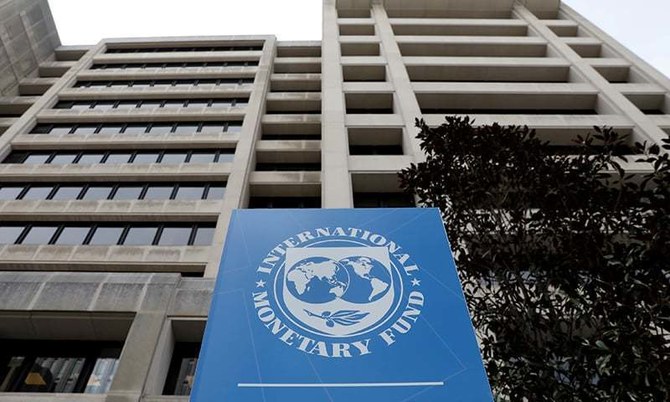
RIYADH/CAIRO: The International Monetary Fund on Tuesday revised its global GDP growth forecast to below 6 percent citing several risks including debt and infaction.

IMF Managing Director Kristalina Georgieva, however, said the main obstacle is the “great vaccination divide” that has left several countries with too little access to COVID-19 vaccines.

Global trade

With poor countries likely to struggle with their vaccination rollouts, global trade is expected to remain on its expansionary trend, the Wall Street Journal reported citing the World Trade Organization.

European construction

The IHS Markit Construction PMI for the euro zone is now showing signs of stability at 50 points in September. Commercial construction fell slightly and infrastructure activity continued its trend of steep decline. However, home building activity rose for the seventh consecutive month as demand exhibited strong growth.

Moreover, construction PMI for the UK fell to 52.6 in September, indicating a slower growth compared to the previous months. This was driven by weaker demand and supply chain problems which led to a more pessimist business sentiment in September.

Retail sales

The euro zone retail sales were weaker than expected in August reaching only a 0.3 month-on-month growth rate compared to the projected 0.8 percent, according to Eurostat data. This marks a slight recovery from the setback recorded in July when it declined by 2.6 percent.

Swedish economy 

In August, Sweden's GDP declined by 3.8 percent, compared to the previous month, data by Statistics Sweden showed. Businesses produced less and households decreased their spending contributing to this contraction.

German industrial orders

After a record month in July, Germany’s industrial orders in August fell sharply as a result of weaker foreign demand, official data showed on Wednesday. 

Korea’s inflation

The annual inflation rate for Korea reached 2.5 percent in September, barely changing from the August figure which stood at 2.6 percent. This is the sixth consecutive month in which the inflation rate was higher than the central bank’s target of 2 percent.
Similarly, the month-on-month inflation rate slightly dropped from 0.6 percent in August to 0.5 percent in September.

Interest rate

For the first time in 7 years, New Zealand’s central bank increased its interest rate to 0.5 percent from 0.25 percent on Wednesday, eliminating some of the support placed when the pandemic began. Its aim is to cool down inflationary pressures in the housing market and elsewhere.

Portuguese growth

Portugal's central bank said that the Portuguese economy would grow at 4.8 percent this year, expanding after the pandemic-induced recession last year. This means that its June expectation remains the same.

Unemployment 

The unemployment rate in Ireland (which includes people receiving temporary COVID-19 jobless benefits) declined to 10 percent in September, compared to the 12.4 percent recorded in the previous month, Ireland’s Central Statistics Office said. However, youth unemployment rose slightly to 17.4 percent in September from 17 percent in August.


Saudi Arabia’s approach to AI transformation delivering business value: Publicis Sapient CEO

Updated 22 January 2026
Follow

Saudi Arabia’s approach to AI transformation delivering business value: Publicis Sapient CEO

  • Nigel Vaz: We’re reimagining how, in the case of tourism, we transform Saudi Arabia into a destination that is actually relevant and attractive for people to explore
  • Vaz: Our Slingshot platform handles everything from design to deployment, allowing legacy modernization and new digital apps to be built

DAVOS: As 2026 emerges as a tipping point for artificial intelligence, executives across the Middle East are moving from experimentation to scaling AI in ways that can deliver real business value, according to Nigel Vaz, CEO of Publicis Sapient.

Speaking to Arab News at the World Economic Forum in Davos, Vaz highlighted Saudi Arabia’s proactive approach to integrating technology into national and sectoral strategies.

“I was in meetings with the minister for tourism in Saudi Arabia (Ahmed Al-Khateeb), where we do a lot of work for them, and meetings with (Communications) Minister Abdullah Alswaha,” he said.

“What you realize is technology is incredibly critical, but it’s critical to the extent that we’re reimagining how, in the case of tourism, we transform Saudi Arabia into a destination that is actually relevant and attractive for people to explore.”

Vaz also highlighted applications of AI beyond tourism, including energy and healthcare.

“You’re thinking about how it can enable a greener approach to energy, which is a big goal for their government,” he said.

“And in healthcare, predictive and preventative approaches allow trends to be addressed before they occur, which is a significant cost saving for the government,” he added.

The shift in mindset around AI reflects a broader trend globally.

“Last year there was a lot of excitement about AI, but most work was at a proof-of-concept stage,” Vaz said. “What’s tipped this year is the recognition that AI is only valuable if it drives real business outcomes.”

This involves moving beyond automating individual tasks to enabling entire workflows or decision sets that produce superior results.

“Individual tasks being automated by AI don’t create business benefit,” he said. “Entire workflows or decision sets need to be enabled by AI, and they must deliver better outcomes than are currently possible today.”

Vaz underscored the importance of integrating people and AI rather than treating technology as a replacement, adding: “Unless you’re a technology nerd, you’re not really caring about the technology for its own sake.”

Geopolitical tensions further heighten the importance of AI for real-time, intelligent decision-making. Vaz explained that Publicis Sapient has developed platforms such as Slingshot, Bodhi and SustainAI to deliver enterprise-grade AI solutions with measurable business impact.

“Our Slingshot platform handles everything from design to deployment, allowing legacy modernization and new digital apps to be built two to three times faster and 30 to 40 percent cheaper,” he said.

Bodhi leverages industry expertise to create agentic capabilities for autonomous decision-making, while Sustain transforms IT service management, using AI to monitor systems, self-heal, and reduce manual workload, he explained

“All of this is not to sell software; it’s to deliver outcomes to clients. That’s what we care about,” Vaz added.

He offered guidance for leaders navigating the AI era.

“An AI North Star is focusing on an area of the business where untapped value can be unlocked,” he said. “Focus on how that value will drive growth, reduce costs, or improve experiences for customers or employees, and use AI to achieve those outcomes, rather than experimenting in small pockets.”

For Vaz, 2026 represents a year when enterprises, particularly in forward-looking Middle Eastern economies like Saudi Arabia, are moving from theory to practice, scaling AI to deliver tangible impact and measurable outcomes for businesses, governments, and citizens alike.