

AI no longer an experiment, but a necessity for business, says Publicis Sapient chief

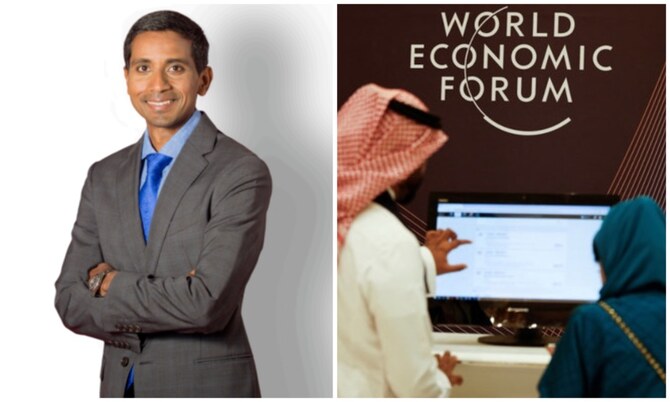
Technological innovation and its potential to reshape economies is inspiring growing optimism among business leaders despite a global backdrop of geopolitical tension, economic uncertainty, and the urgent challenges of climate change, CEO of Publicis Sapient Nigel Vaz (pictured, left) told Arab News. (Supplied/AFP)
Short Url
Updated 26 January 2025
Follow

AI no longer an experiment, but a necessity for business, says Publicis Sapient chief

  • Nigel Vaz calls for end to ‘wait-and-see’ approach, saying businesses need to ‘act now or risk being left behind’
  • Middle East laying the groundwork for ‘truly transformational moment’ in global digital future, says CEO 

DAVOS: Technological innovation and its potential to reshape economies is inspiring growing optimism among business leaders despite a global backdrop of geopolitical tension, economic uncertainty, and the urgent challenges of climate change, the CEO of Publicis Sapient told Arab News.

Nigel Vaz, speaking at the annual meeting of the World Economic Forum in Davos, said he sees a moment of both caution and opportunity for businesses worldwide. 

“In many ways, businesses thrive on certainty,” Vaz said. “After years of unpredictability, there’s now a sense of optimism about what lies ahead. Investments in technology, particularly in AI, are helping unlock new economic opportunities, from reducing costs to driving transformational growth.”

While acknowledging lingering concerns over inflation and the impact of macroeconomic policies such as tariffs, Vaz believes the focus is shifting toward pro-growth initiatives, including government-led reforms to alleviate pressure on businesses.

“Governments are increasingly exploring tax reforms and other measures to create a more favorable environment for growth,” he said. “And alongside that, investments in AI and digital innovation are starting to deliver real results, moving from proof-of-concept to large-scale implementation.”

With artificial intelligence the hot topic of the day, Vaz said enthusiasm around AI is no longer solely about its potential but also its measurable impact on businesses.

“Last year, AI was something everyone was interested in. This year, they’re seeing the economic benefits of it,” he said.

Vaz pointed to several ways Publicis Sapient is leveraging AI to accelerate transformation, with one significant area in marketing, where AI-driven platforms are enabling businesses to personalize their messages and reach audiences more efficiently.

Publicis Sapient has partnered with its parent company, Publicis Groupe, to invest $300 million in advanced marketing technologies.

“It’s not just about content generation anymore,” Vaz said. “AI is helping with everything from content audits to ensuring the right message gets to the right person at the right time. The ability to connect identity and tailor communication is driving incredible acceleration.”

AI’s influence is also being felt in operational areas traditionally weighed down by inefficiencies.

Publicis Sapient’s work includes modernizing mainframe systems — once seen as expensive and slow — through AI-driven solutions.

“We’ve taken what used to be 10-year migration projects involving millions of lines of code and compressed them into just three years,” Vaz said. “This is digital red-tape removal in action, and it’s allowing businesses to innovate far more quickly than they ever thought possible.”

Vaz also highlighted the Middle East as a critical player in the future of AI and digital transformation. He pointed to countries such as Saudi Arabia and the UAE, where governments are making significant infrastructure investments to foster innovation.

“The Middle East is laying the groundwork for a truly transformational moment,” Vaz said. “If you think of AI as the electricity of the 21st century, the investments being made here are akin to building the power grids of the industrial revolution. It’s about creating an environment where businesses can innovate and thrive.”

He also praised the region’s commitment to developing local talent to drive these initiatives.

“I was speaking with a minister (this week), and he stressed that while they’re putting the infrastructure in place, it’s Saudi talent that’s building and leading these projects. That’s a powerful message about the long-term vision here.”

Looking ahead, Vaz urged business leaders to abandon a “wait-and-see” approach to AI and instead embrace the transformative potential of the technology.

He said that 2025 will be a pivotal year, adding that “the gap between those who adopt AI and those who don’t is going to widen dramatically. Businesses need to act now to ensure they don’t get left behind.”

Vaz added that leaders should move beyond treating AI as a technical tool and instead reimagine their entire business models. “This is not just about technology — it’s about fundamentally rethinking how your business operates and delivers value.” 

As Publicis Sapient continues to expand its footprint in key regions such as the Middle East, Vaz is clear about his priorities for the future. “Our focus is on enabling businesses to learn and iterate in real-world applications,” he said. “Whether it’s in travel, financial services, or retail, we’re seeing tremendous benefits from these transformations. The key now is to keep moving forward.”

In a world still grappling with uncertainty, leaders such as Vaz see the promise of AI and digital transformation as a beacon of opportunity. “The future is here — it’s just a matter of who seizes it first,” he said.


G7 countries to release oil reserves as IEA agrees to largest ever market intervention

Updated 11 March 2026
Follow

G7 countries to release oil reserves as IEA agrees to largest ever market intervention

  • IEA recommends release of 400 million barrels

RIYADH: Germany, Japan and Austria will release part of their oil reserves after the International Energy Agency recommended the release of 400 million barrels of oil ‌from stockpiles, the largest ‌such move in IEA ​history.

In a statement, IEA Executive Director Fatih Birol said the flow of oil, gas and other commodities through the Strait of Hormuz have all but stopped, leading global energy supply to fall by around 20 percent.

Ahead of the confirmation of the move — a larger intervention than the 182.7 million barrels that were released in 2022 by in response to Russia’s invasion of Ukraine — several countries began setting out plans to bring their reserves into play as countries grapple with ​soaring crude prices amid ​the US-Israeli war with Iran. 

Birol said: “I can now announce that IEA countries have decided to launch the largest ever release of emergency oil stocks in our agency's history. 

“IEA countries will be making 400 million barrels of oil available to the market to offset the supply lost through the effective closure of the strait.

“This is a major action aiming to alleviate the immediate impacts of the disruption in markets.”

Germany’s Economy ⁠Minister ​Katherina Reiche ⁠confirmed on Wednesday her government plans to limit petrol price increases at filling stations to once a day and to introduce more stringent antitrust regulation of the sector.

She did not ⁠give an exact timing for ‌those measures, but added that ‌the US and ​Japan would be the ‌largest contributors to the release of the ‌oil reserves.

The US has not confirmed it would do so, but its Interior Secretary Doug Burgum told Fox News on Wednesday that “these are the kinds of moments that these reserves are used for.”

The announcements did not stop oil prices rising, with Brent crude up 3.26 percent to $90.66 a barrel at 4:29 p.m Saudi time, and West Texas Intermediate up 3.12 percent to $86.05. Both were some way below the $119 a barrel seen earlier in the week.

“The situation regarding oil supplies is tense, as the Strait of Hormuz is currently virtually impassable,” Germany’s Reiche said.

“We will comply with this request and ‌contribute our share, because Germany stands behind the IEA’s most important principle: mutual ⁠solidarity,” Reiche ⁠said about the IEA’s request.

According to a statement by Reiche’s ministry, Germany will contribute 2.64 million tonnes of oil. This corresponds to 19.51 million barrels.

Reiche stressed there was no supply shortage in the country, which has a legally mandated reserve of oil and oil products intended to cover 90 days’ demand.

South Korea will release 22.46 million ​barrels of oil, which represents 5.6 percent of the total IEA ask, the ⁠country's industry ministry said.

“The government will consult with the IEA ⁠secretariat on details, such ‌as ‌the ​timing ‌and amount, from ‌the perspective of national interests in accordance with domestic conditions,” ‌the ministry said in a statement.

The ⁠ministry ⁠said it would continue to coordinate closely with major countries in responding to high oil prices to minimise any domestic ​impact.

Austrian Economy Minister Wolfgang Hattmannsdorfer said his country was releasing part of the emergency oil reserve and extending the national strategic gas reserve, adding: “One thing is clear: in a crisis, there must be no crisis winners at the expense of commuters and businesses.”

Acting ahead of the IEA move, G7 ​member Japan announced plans to release 15 days' worth of ‌private-sector oil reserves and one month's worth of state oil reserves.

“Rather than wait for formal IEA approval ‌of a coordinated international reserve release, Japan will act first to ease global energy market supply and demand, releasing reserves as early as the 16th of this month,” Prime Minister Sanae Takaichi said in a broadcast statement.

Following a meeting with the IEA on Wednesday, G7 energy ministers said: “In principle, we support the implementation of proactive measures to address the situation, including the use of strategic reserves.”

All IEA member countries are required to keep 90 days’ worth of their nation’s oil use in reserve in case of global disruption.