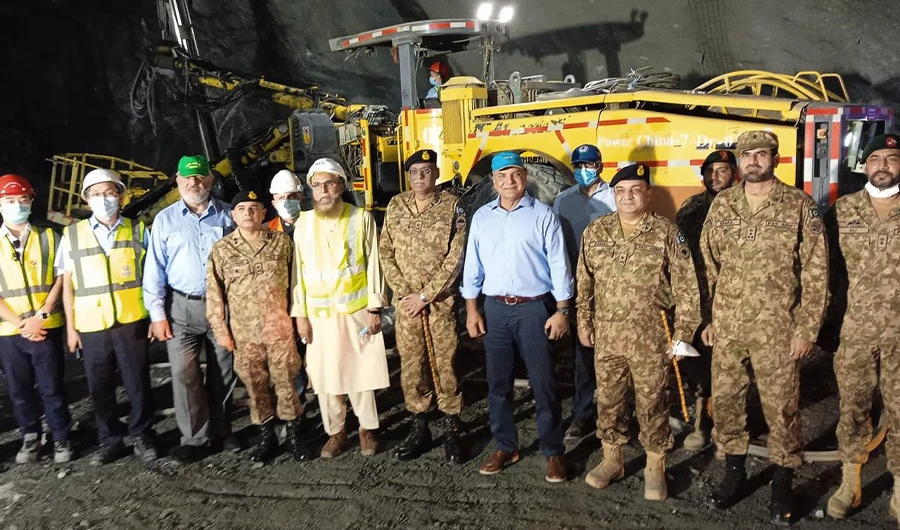
- ’Stands committed to providing a safe and secure environment’ in the Diamer-Bhasha project area, says Lt. Gen. Sahir Shamshad Mirza
- Once ready, the Diamer-Bhasha dam will be Pakistan’s third mega dam after Tarbela and Mangla
ISLAMABAD: Pakistan’s army is committed to providing security for all workers at the Diamer-Bhasha dam construction site in the mountainous Gilgit-Baltistan region to ensure a “smooth” running of operations, the Water and Power Development Authority (WAPDA) said in a statement.
The Diamer-Bhasha project was announced by Pakistan’s military ruler General Pervez Musharraf 15 years ago, with a Rs 442 billion construction deal signed by the Pakistan Tehreek-e-Insaf (PTI) government, China Power and the Frontier Works Organization (FWO) last year.
On Sunday, WAPDA officials accompanied Commander 10 Corps Pakistan Army Lt. Gen. Sahir Shamshad Mirza to the Diamer-Basha site to review construction work in the area.
“Reiterating the support of Pakistan Army for construction of Diamer Basha Dam, he [Lt. Gen. Mirza] said that we stand committed to providing safe and secure environment in the project area so as to enable the project management to smoothly continue construction activities on all sites of the project,” a WAPDA statement said.
Once ready by 2029, the Diamer Bhasha dam – one of Pakistan’s three mega dams after Tarbela and Mangla – is expected to be a “game-changer,” significantly contributing to the country’s water and electricity needs.
“The project will change the destiny of the nation by stabilizing economy and alleviating poverty from the country,” Muzammil Hussain, chairman of WAPDA, was quoted as saying in the statement.
“It’s turning out to be a game-changer for the locals, as a hefty amount of Rs 78.5 billion is being spent on various development schemes...in the project area,” he said.
Hussain added that the Diamer-Bhasha dam is one of the “most significant projects for sustained development” as it would provide water for agricultural purposes, mitigate floods and generate low-cost electricity in the South Asian nation of over 220 million people.
With a gross water storage capacity to irrigate 1.23 million acres of additional land and an installed power generation capacity of 4,500 MW, the project will also provide more than 18 billion units per annum to the national grid and generating over 16,500 jobs.
“The people residing in the project area are being given priority for the jobs, as about 3,200 locals have already been employed at the project by WAPDA...” the statement said.
Gilgit-Baltistan, which borders Afghanistan and China, is the gateway of over $60 billion China-Pakistan Economic Corridor (CPEC) infrastructure plan.