PARIS: The leader of a resistance movement to the Taliban has vowed to never surrender but is open to negotiations with the new rulers of Afghanistan, according to an interview published by Paris Match on Wednesday.
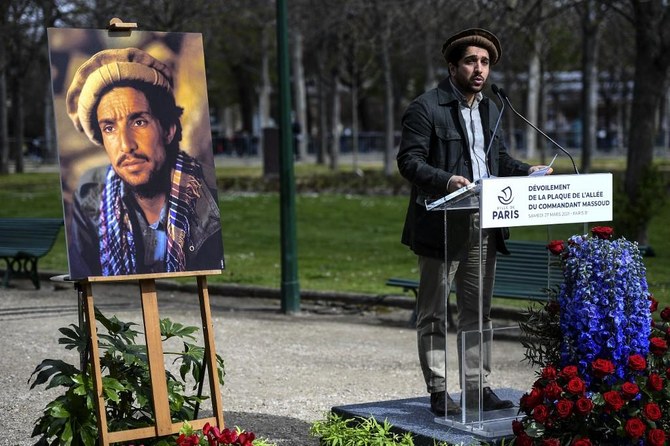
Ahmad Massoud, the son of legendary Afghan rebel commander Ahmad Shah Massoud, has retreated to his native Panjshir valley north of Kabul along with former vice president Amrullah Saleh.
“I would prefer to die than to surrender,” Massoud told French philosopher Bernard-Henri Levy in his first interview since the Taliban took over Kabul. “I’m the son of Ahmad Chah Massoud. Surrender is not a word in my vocabulary.”
Massoud claimed that “thousands” of men were joining his National Resistance Front in Panjshir valley, which was never captured by invading Soviet forces in 1979 or the Taliban during their first period in power from 1996-2001.
He renewed his appeal for support from foreign leaders, including French President Emmanuel Macron, and expressed bitterness at being refused weapons shortly before the fall of Kabul earlier this month.
“I cannot forget the historic mistake made by those I was asking for weapons just eight days ago in Kabul,” Massoud said, according to a transcript of the interview published in French.
“They refused. And these weapons — artillery, helicopters, American-made tanks — are today in the hands of the Taliban,” he said.
Massoud added that he was open to talking to the Taliban and he laid out the outlines of a possible agreement.
“We can talk. In all wars, there are talks. And my father always spoke with his enemies,” he said.
“Let’s imagine that the Taliban agreed to respect the rights of women, of minorities, democracy, the principles of an open society,” he added. “Why not try to explain that these principals would benefit all Afghans, including them?
Massoud’s father, a francophile with close links to Paris and the West, was nicknamed the “Lion of Panjshir” for his role in fighting against the Soviet occupation of Afghanistan in the 1980s and the Taliban regime in the 1990s.
He was assassinated by Al-Qaeda two days before the September 11, 2001 attacks.

Afghan resistance leader vows ‘no surrender’ to Taliban
https://arab.news/jv937
Afghan resistance leader vows ‘no surrender’ to Taliban
- Ahmad Massoud, the son of legendary Afghan rebel commander Ahmad Shah Massoud, has retreated to his native Panjshir valley
Mali plans fuel rationing
- Officials say the rationing system will ensure a more equitable distribution of fuel among consumers
- Mali’s fuel importers’ union said that over 2,000 tanker trucks have entered the country since the start of the year — significantly fewer than the up to 6,000 per month that arrived prior to the attacks
LAGOS: Mali’s government has moved to impose fuel rationing to counter widespread shortages caused by Al-Qaeda-linked groups operating in the border regions that have, in recent months, cut off fuel supplies to the landlocked African country.
In announcing the rationing, officials did not say when it would start.
The measure was cast as an effort to reduce long lines at gas stations, especially with the Muslim holy month of Ramadan only a few weeks away.
Since September, Al-Qaeda-linked militants and other extremists in Mali have increasingly attacked fuel trucks — more than a hundred trucks have been burned in the violence, which has crippled fuel imports and distribution.
Mali’s fuel importers’ union said that over 2,000 tanker trucks have entered the country since the start of the year — significantly fewer than the up to 6,000 per month that arrived prior to the attacks.
Officials say the rationing system will ensure a more equitable distribution of fuel among consumers.
The new measures will include registering vehicle plates and wait periods for cars and vehicles to refuel.
Cars will be allowed to tank up every 72 hours and motorcycles every 48 hours.
Moussa Alassane Diallo, Mali’s trade and industry minister, told a union of petroleum product importers that the rationing will “give us complete control” over gas stations, and allow authorities to “monitor the quantities of fuel sold.”
“We are committed to ending the fuel crisis as long as the military continues to escort our tanker trucks”, said Ibrahim Toure, head of the petroleum importers union.
But many residents — especially taxi drivers — expressed concerns that the fuel limits would impact their daily lives.
“These measures may work for private cars, but for us taxi drivers, it’s going to be difficult because we don’t earn enough money to fill up our taxis every time we go,” said Oumar Coulibaly, a taxi driver in the capital, Bamako.
“We do a lot of trips, and we need fuel,” he said.
Experts say the junta’s move was likely spurred by concerns about popular discontent over the prolonged fuel shortage.
Beverly Ochieng, a senior analyst with the consultancy Control Risks’ Global Risk Analysis team, said the “insecurity on supply routes due to militant presence and activity will remain a challenge to the transportation of fuel in the coming weeks, and the stability of supplies will vary.”


