

Malala Yousafzai writes to PM Khan urging him to admit Afghan refugees

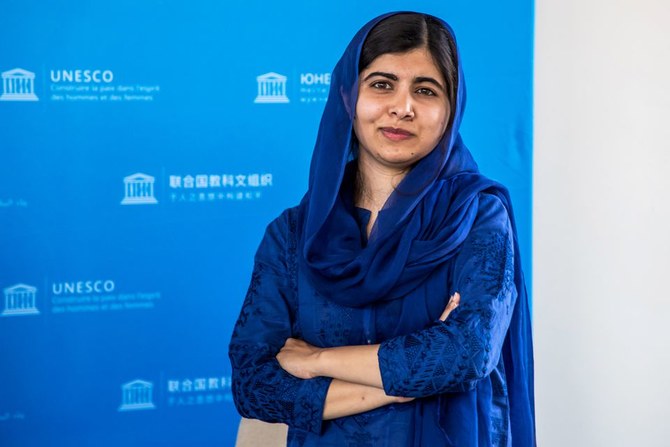
Nobel Peace Prize laureate Malala Yousafzai poses for photographs during the Education and Development G7 Ministers Summit in Paris, France, July 5, 2019. (REUTERS)
Short Url
Updated 17 August 2021
Follow

Malala Yousafzai writes to PM Khan urging him to admit Afghan refugees

  • Says deeply concerned about situation in Afghanistan, particularly the safety of women and girls
  • Biden “has a lot to do” and must “take a bold step” to protect the Afghan people, Nobel prize winner says

LONDON: Nobel Peace Prize winner Malala Yousafzai has said she had sent a letter to Pakistani Prime Minister Imran Khan urging him to admit Afghan refugees, adding that she was deeply concerned about the situation in Afghanistan, particularly the safety of women and girls.

Yousafzai called on Monday for world leaders to take urgent action, saying US President Joe Biden “has a lot to do” and must “take a bold step” to protect the Afghan people, adding she had been trying to reach out to several global leaders.

“This is actually an urgent humanitarian crisis right now that we need to provide our help and support,” Yousafzai told BBC Newsnight, saying she had asked Khan to admit Afghan refugees and ensure that all refugee children “have access to education, have access to safety and protection, that their futures are not lost.”

Yousafzai, 23, survived being shot in the head by a Pakistani Taliban gunman in 2012, after she was targeted for her campaign against its efforts to deny women education.

She had become known as an 11-year-old, writing a blog under a pen name for the BBC about living under the rule of the Pakistani Taliban.

“I am deeply concerned about the situation in Afghanistan right now, especially about the safety of women and girls there,” Yousafzai told Newsnight.

“I had the opportunity to talk to a few activists in Afghanistan, including women’s rights activists, and they are sharing their concern that they are not sure what their life is going to be like.”

Yousafzai moved to England after she was shot, where she received medical treatment and last year graduated from Oxford University with a Philosophy, Politics and Economics degree.


Islamabad offers skilled manpower to help Iraq in reconstruction, development efforts

Updated 10 sec ago
Follow

Islamabad offers skilled manpower to help Iraq in reconstruction, development efforts

  • The development comes during Pakistan President Asif Ali Zardari’s four-day visit to Iraq to strengthen bilateral cooperation
  • Zardari says current levels of bilateral trade do not reflect true potential of Pakistan-Iraq ties, highlights opportunities

ISLAMABAD: Pakistan has offered to provide skilled manpower to support Iraq’s reconstruction and development efforts, the Pakistani government said on Sunday, signaling Islamabad’s willingness to deepen cooperation with Baghdad in sectors including infrastructure, technical services and human resource development.

The development comes during Pakistan President Asif Ali Zardari’s four-day visit to Iraq to strengthen cooperation in trade, investment, religious tourism, energy and other sectors.

Zardari held a one-on-one meeting with his Iraqi counterpart, Dr. Abdul Latif Jamal Rashid, at Baghdad Palace, which was followed by delegation-level talks to review the state of bilateral relations.

“President Zardari reiterated Pakistan’s willingness to support Iraq’s reconstruction and development efforts through the provision of skilled and semi-skilled manpower under the existing Memorandum of Understanding on manpower transmission,” Pakistan’s Press Information Department (PID) said in a statement.

“He also highlighted Pakistan’s capacity in medical services, financial expertise and digital governance, and expressed readiness to share technical experience, including in secure data management, to support institutional capacity-building in Iraq.”

Iraq has been working to rebuild its economy and infrastructure after decades of conflict, including the 2003 US-led invasion and years of instability caused by sectarian violence and the fight against Daesh group. Although security conditions have improved in recent years, large parts of the country still face damaged roads, power plants, hospitals and housing, requiring large-scale reconstruction and public service delivery.

During Sunday’s meeting, Zardari noted that the current levels of bilateral trade do not reflect the true potential of Pakistan-Iraq economic, cultural and security relations, highlighting opportunities in agriculture, defense production, information technology, construction, pharmaceuticals and other sectors. He underscored the importance of business-to-business engagement and the establishment of direct banking channels to facilitate trade and commercial activity, according to the PID.

Zardari also requested improved facilitation for Pakistani pilgrims visiting Iraq and expressed hope for early finalization and implementation of a proposed Memorandum of Understanding on Zaireen (pilgrims) Management, aimed at ensuring orderly travel. He expressed his firm resolve to work with the Iraqi government to stop illegal entry and overstay of those Pakistanis who violate Iraqi law.

“Both Presidents expressed their resolve to fight extremism, terrorism and narco trade and enhance bilateral cooperation,” the PID said. “The two leaders reaffirmed their commitment to further deepening bilateral cooperation across political, economic and social domains.”

Pakistan and Iraq established diplomatic relations in 1947 and have traditionally maintained cordial ties, though commercial links remain modest. The volume of trade between both countries stood at $268 million in 2023.

Pakistan’s major exports to Iraq include machinery and mechanical appliances, pharmaceutical products, fish, cereals, essential oils and resinoids. Islamabad’s imports from Iraq include mineral fuels, mineral, organic chemicals, edible fruit and nuts.