

Aramco joins PIF-backed consortium to finance Saudi Arabia’s biggest solar project

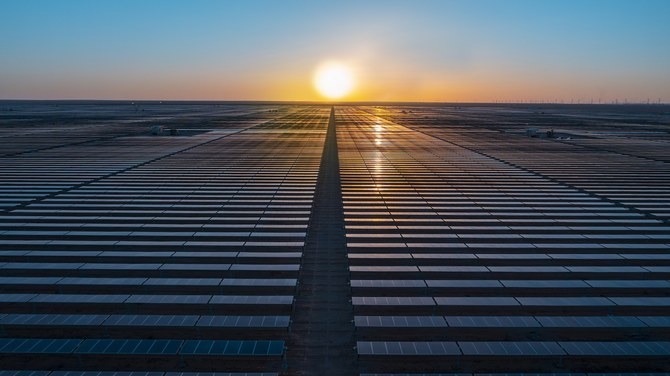
Around SR3.4 billion ($900 million) in investments were announced to build the Sudair solar plant. (Supplied)
Short Url
Updated 15 August 2021
Follow

Aramco joins PIF-backed consortium to finance Saudi Arabia’s biggest solar project

  • The developer also announced that Aramco-owned SAPCO has joined the consortium

DUBAI: A consortium led by developer ACWA Power has reached financial closure for the 1,500-megawatt Sudair solar plant, a key project in Saudi Arabia’s renewable energy push.

The developer also announced that Aramco-owned SAPCO has joined the consortium, marking the oil giant’s first participation in the Saudi Public Investment Fund’s renewable energy program.

Announced in April, the Sudair plant is a major part of PIF’s renewable program. The fund has a 30 percent stake in ACWA Power and owns utility company Badeel, another member of the consortium.

The site, which is pegged to be the world’s largest single-contracted solar photovoltaic plant, will be located in Sudair Industrial City in Saudi Arabia’s north.

“A specialized Saudi technical team at the Ministry of Energy selected the Sudair project site and carried out the engineering requirements and preliminary studies of the project,” ACWA Power said in a statement.

“Sudair solar is testament to the Kingdom’s continuous efforts to reduce energy sector emissions,” it added.

The program aims to support Saudi Arabia’s energy transition and diversification, delivering 70 percent of the Kingdom’s renewable energy under the National Renewable Energy Program (NERP).

Around SR3.4 billion ($900 million) in investments were announced to build the Sudair solar plant, which is expected to power 185,000 homes, while offsetting nearly 2.9 million tons of emissions per year.


Saudi POS spending jumps 28% in final week of Jan: SAMA

Updated 06 February 2026
Follow

Saudi POS spending jumps 28% in final week of Jan: SAMA

RIYADH: Saudi Arabia’s point-of-sale spending climbed sharply in the final week of January, rising nearly 28 percent from the previous week as consumer outlays increased across almost all sectors. 

POS transactions reached SR16 billion ($4.27 billion) in the week ending Jan. 31, up 27.8 percent week on week, according to the Saudi Central Bank. Transaction volumes rose 16.5 percent to 248.8 million, reflecting stronger retail and service activity. 

Spending on jewelry saw the biggest uptick at 55.5 percent to SR613.69 million, followed by laundry services which saw a 44.4 percent increase to SR62.83 million. 

Expenditure on personal care rose 29.1 percent, while outlays on books and stationery increased 5.1 percent. Hotel spending climbed 7.4 percent to SR377.1 million. 

Further gains were recorded across other categories. Spending in pharmacies and medical supplies rose 33.4 percent to SR259.19 million, while medical services increased 13.7 percent to SR515.44 million. 

Food and beverage spending surged 38.6 percent to SR2.6 billion, accounting for the largest share of total POS value. Restaurants and cafes followed with a 20.4 percent increase to SR1.81 billion. Apparel and clothing spending rose 35.4 percent to SR1.33 billion, representing the third-largest share during the week. 

The Kingdom’s key urban centers mirrored the national surge. Riyadh, which accounted for the largest share of total POS spending, saw a 22 percent rise to SR5.44 billion from SR4.46 billion the previous week. The number of transactions in the capital reached 78.6 million, up 13.8 percent week on week. 

In Jeddah, transaction values increased 23.7 percent to SR2.16 billion, while Dammam reported a 22.2 percent rise to SR783.06 million. 

POS data, tracked weekly by SAMA, provides an indicator of consumer spending trends and the ongoing growth of digital payments in Saudi Arabia.  

The data also highlights the expanding reach of POS infrastructure, extending beyond major retail hubs to smaller cities and service sectors, supporting broader digital inclusion initiatives.  

The growth of digital payment technologies aligns with Saudi Arabia’s Vision 2030 objectives, promoting electronic transactions and contributing to the Kingdom’s broader digital economy.