

Pakistan, China agree to expedite Dasu bus blast probe

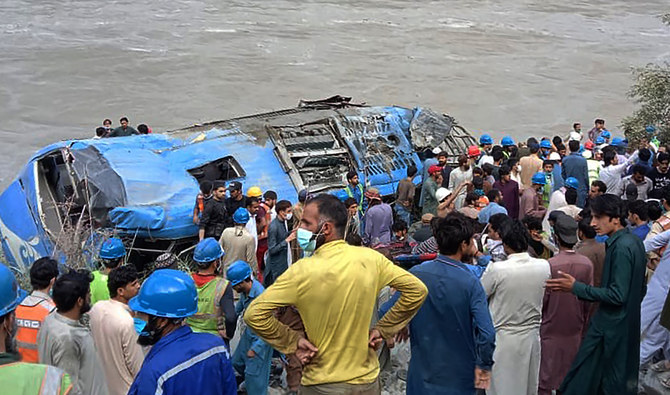
Rescue workers and onlookers gather around a wreck after a bus plunged into a ravine following a bomb explosion in Kohistan district of Khyber Pakhtunkhwa province on July 14, 2021. (AFP/File)
Short Url
Updated 09 August 2021
Follow

Pakistan, China agree to expedite Dasu bus blast probe

  • Nine Chinese workers were among 13 killed in the attack in northwestern Pakistan on July 14
  • Pakistan's interior minister has assured “foolproof security” to Chinese nationals working under CPEC projects

ISLAMABAD: Pakistan and China have agreed to complete investigations into a bus blast that killed 13 people in northwestern Pakistan in mid-July "as soon as possible."

It follows a meeting between Pakistan’s Interior Minister Sheikh Rashid Ahmed and Chinese Ambassador in Pakistan Nong Rong in Islamabad on Sunday.

“Both discussed matters related to probe into Dasu bus incident and agreed to complete the investigation as soon as possible,” Sheikh Rashid’s office said in a statement.

Nine Chinese nationals, employed to work on the project in Dasu, were among those killed when the bus carrying them to the construction site came under attack.  

The project is part of the China-Pakistan Economic Corridor (CPEC), a $65 billion investment plan aiming to link western China to the southern Pakistani port of Gwadar.

Beijing had initially called it a bomb attack but backed away from the assertion after Pakistan stated it was an accident. Later Beijing said it would send a team to help investigate the matter jointly with Pakistan.

A team of 15 Chinese investigators visited Pakistan the same week and, accompanied by Pakistani officials, began investigations into the incident.

The attack led to speculation on social media that China had canceled its contract to build the Dasu project.

However, Pakistan’s foreign ministry spokesperson, Zahid Hafeez Chaudhri, said that construction of the Dasu Hydropower Project would resume “soon,” reiterating that Pakistan and China were committed to the timely completion of all projects being built in Pakistan with Chinese cooperation.

On Sunday, Sheikh Ahmed assured the Chinese ambassador that Pakistan would provide “foolproof security” to Chinese nationals employed in CPEC projects.

“We will not let CPEC be sabotaged by any foreign conspiracy,” the minister said, adding that no power can "create hurdles in the way of Pakistan-China friendship."

Ambassador Rong, for his part, said that several Chinese companies were operating their businesses in Pakistan and “we thank Pakistani government for the facilities it has been extending to Chinese workers,” the statement read.


Pakistani president arrives in Iraq to deepen trade, energy cooperation

Updated 20 December 2025
Follow

Pakistani president arrives in Iraq to deepen trade, energy cooperation

  • Visit follows recent high-level contacts as Islamabad seeks to expand limited commercial ties with Baghdad
  • Talks are expected to cover investment, manpower and facilitation of Pakistani pilgrims visiting holy sites in Iraq

ISLAMABAD: President Asif Ali Zardari arrived in Iraq on Saturday on an official visit aimed at expanding cooperation in trade, energy and investment, as Pakistan seeks to deepen ties with Baghdad after years of limited engagement.

Pakistan and Iraq established diplomatic relations in 1947 and have traditionally maintained cordial ties, though commercial links remain modest, with officials and business groups identifying scope for cooperation in construction services, pharmaceuticals, manpower and agricultural exports.

“President Asif Ali Zardari arrived in Baghdad on a four-day official visit to Iraq,” his office said in a post on X. “He was received by Culture Minister Dr. Ahmed Fakkak Al-Badrani. During the visit, meetings with senior Iraqi leadership are expected to advance cooperation and further strengthen Pakistan-Iraq relations.”

Zardari’s visit follows a series of recent high-level contacts between the two countries, reflecting efforts to broaden bilateral engagement beyond traditional diplomatic ties and explore collaboration across economic, political and people-to-people domains.

According to Pakistan’s foreign office, the president is expected to hold meetings with Iraq’s senior leadership to discuss cooperation in various areas such as trade and investment, energy, technology, education and manpower.

He is also expected to discuss regional and international issues with Iraqi officials.

Earlier this month, Pakistan’s Interior Minister Mohsin Naqvi met his Iraqi counterpart, Abdul Ameer Al-Shammari, on the sidelines of meetings in Brussels, where both sides agreed to enhance cooperation on security and facilitate travel for Pakistani Shia pilgrims to Najaf and Karbala.

The two officials discussed measures to ensure the smoother movement of these pilgrims and their compliance with visa regulations.