

UK sanctions former Iraqi governor for embezzling funds

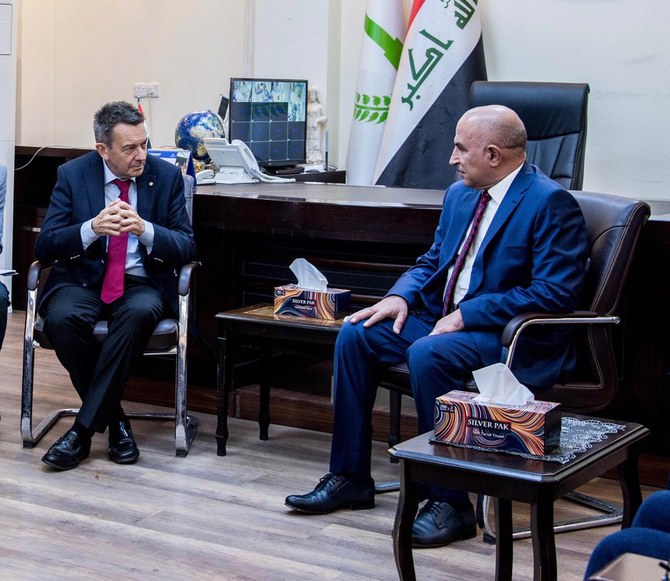
ICRC President Peter Maurer (L) and Nawfal Hammadi Al-Sultan (R). (File/@ICRC_IQ)
Short Url
Updated 22 July 2021
Follow

UK sanctions former Iraqi governor for embezzling funds

  • Nawfal Hammadi Al-Sultan was jailed for embezzling $3.4 million when he ran Niveneh Province
  • UK also sanctions four other individuals in Equatorial Guinea, Zimbabwe and Venezuela

DUBAI: The United Kingdom imposed sanctions on Thursday against the former governor of the Iraqi province of Nineveh, Nawfal Hammadi Al-Sultan, as part of its global anti-corruption regime.

The announcement said that Al-Sultan was "involved in serious corruption in his role as Governor of Nineveh province, Iraq, where he misappropriated public funds intended for reconstruction efforts to provide support for civilians, and improperly awarded contracts and other state property."

Al-Sultan is currently serving a combined five-year prison sentence in Iraq for corruption offences, including squandering 5 billion Iraqi dinars (approximately $3.4 million) through bogus public works.

The US welcomed the UK’s announcement. “We commend the UK’s actions today against four corrupt individuals already designated by the United States and a fifth whose US-based assets purchased with corrupt proceeds were successfully forfeited in US courts,” the State Department said.

“Corruption has a corrosive effect on society: it undermines democratic institutions, hinders economic development, drains the wealth of nations, and keeps people in poverty,” the department's spokesperson added.

Iraq’s parliament removed Al-Sultan from office after a ferry accident in March 2019 in Nineveh province’s capital Mosul.

Almost 100 people were killed when the ferry, loaded to five times its capacity, sank as it carried families to an island on the Tigris River.

In a letter to members of parliament after the ferry accident, the then Prime Minister Adel Abdul Mahdi accused Al-Sultan of negligence and dereliction of duty.

Foreign Secretary Dominic Raab said new sanctions were also being imposed against four other individuals involved in serious corruption in Equatorial Guinea, Zimbabwe and Venezuela.
“One of those designated spent millions of misappropriated funds on mansions, private jets and a $275,000 glove that Michael Jackson wore on his “Bad” tour, another ruthlessly exploited public food programs in Venezuela,” Britain's Foreign Secretary said. 

The UK will impose asset freezes and travel bans against the five individuals to ensure they will no longer be able to channel their money through UK banks or enter the country.

Nineveh province suffered devastation during the time it was occupied by Daesh and the fight to liberate it from the terrorist organisation in 2017.

Incomplete reconstruction of the province and its capital Mosul continues to undermine stability in these areas and is hindering the recovery of vulnerable populations affected by Daesh’s occupation.


Virtual museum preserves Sudan’s plundered heritage

Updated 6 sec ago
Follow

Virtual museum preserves Sudan’s plundered heritage

CAIRO: Destroyed and looted in the early months of Sudan’s war, the national museum in Khartoum is now welcoming visitors virtually after months of painstaking effort to digitally recreate its collection.
At the museum itself, almost nothing remains of the 100,000 artefacts it had stored since its construction in the 1950s. Only the pieces too heavy for looters to haul off, like the massive granite statue of the Kush Pharaoh Taharqa and frescoes relocated from temples during the building of the Aswan Dam, are still present on site.
“The virtual museum is the only viable option to ensure continuity,” government antiquities official Ikhlass Abdel Latif said during a recent presentation of the project, carried out by the French Archaeological Unit for Sudanese Antiquities (SFDAS) with support from the Louvre and Britain’s Durham University.
When the museum was plundered following the outbreak of the war between the regular army and the paramilitary Rapid Support Forces (RSF) in April 2023, satellite images showed trucks loaded with relics heading toward Darfur, the western region now totally controlled by the RSF.
Since then, searches for the missing artefacts aided by Interpol have only yielded meagre results.
“The Khartoum museum was the cornerstone of Sudanese cultural preservation — the damage is astronomical,” said SFDAS researcher Faiza Drici, but “the virtual version lets us recreate the lost collections and keep a clear record.”
Drici worked for more than a year to reconstruct the lost holdings in a database, working from fragments of official lists, studies published by researchers and photos taken during excavation missions.
Then graphic designer Marcel Perrin created a computer model that mimicked the museum’s atmosphere — its architecture, its lighting and the arrangement of its displays.
Online since January 1, the virtual museum now gives visitors a facsimile of the experience of walking through the institution’s galleries — reconstructed from photographs and the original plans — and viewing more than 1,000 pieces inherited from the ancient Kingdom of Kush.
It will take until the end of 2026, however, for the project to upload its recreation of the museum’s famed “Gold Room,” which had housed solid-gold royal jewelry, figurines and ceremonial objects stolen by looters.
In addition to the virtual museum’s documentary value, the catalogue reconstructed by SFDAS is expected to bolster Interpol’s efforts to thwart the trafficking of Sudan’s stolen heritage.