

Arab News brings Hajj pilgrimage to the people with painting exhibition in Islamabad

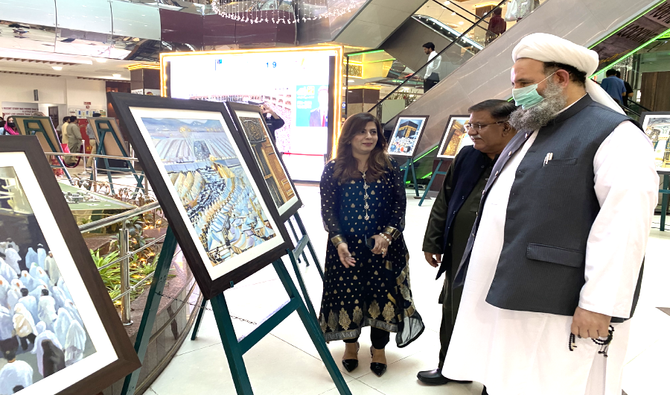
Artist Rabia Zakir walks Federal Minister of Religious Affairs and Interfaith Harmony Noor-Ul-Haq Qadri through her exhibition, "The Spiritual Journey," held at Centaurus Mall in Islamabad, Pakistan, on July 12, 2021 (AN Photo)
Short Url
Updated 13 July 2021
Follow

Arab News brings Hajj pilgrimage to the people with painting exhibition in Islamabad

  • Arab News Pakistan sponsors exhibition entitled “The Spiritual Journey” by Rabia Zakir which captures the journey of performing Hajj
  • Chief guest Tahir Mahmood Ashrafi says exhibition “stirred” people’s emotions, “birthed” anticipation to go for Hajj after pandemic

ISLAMABAD: As the world prepares for yet another year of the annual Hajj restricted only to Saudi citizens and residents in response to the coronavirus pandemic, one Pakistani artist is bringing the pilgrimage to the people through a series of paintings.
An exhibition of the collection, entitled “The Spiritual Journey,” was sponsored by Arab News Pakistan and held in the lobby of the Centaurus Mall in the federal capital. All the paintings are the creations of Rabia Zakir, who in Islamabad’s circles has come to be known as the artist who painted a portrait of Saudi Crown Prince Mohammed bin Salman when he visited Pakistan in February 2019. Zakir is also president of the sports and culture wing of the ruling Pakistan Tehreek-i-Insaf party.
Zakir has painted portraits of members of royal families across the Middle East, including Saudi Arabia, the United Arab Emirates, and Bahrain. Her portraits and landscapes hang in 50 embassies in Pakistan, most prominently of Arab countries such as Saudi Arabia, the UAE, Kuwait, Bahrain, and Oman.
The paintings in Zakir’s latest collection capture the journey of performing Hajj from arrival to praying at the Kaaba and traveling among fellow pilgrims. It also includes intricately detailed pieces that show recognizable features of the Kaaba.
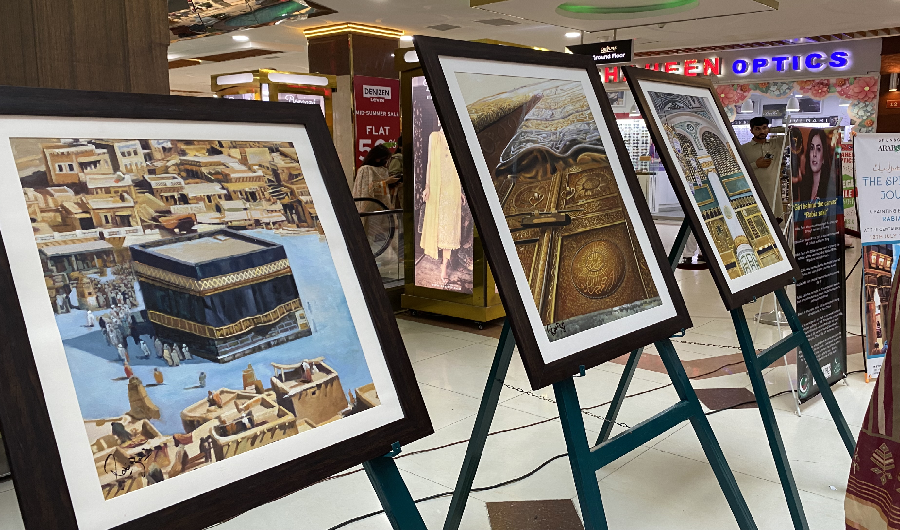


Rabia Zakir's paintings from her collection, "The Spiritual Journey," on display in Islamabad, Pakistan, on July 12, 2021 (AN Photo)

“I would like to thank Arab News for giving me such a great opportunity to present my paintings of Hajj,” Zakir said at the launch of her exhibition in Islamabad on Monday. “My main focus and point of this exhibition is for people to feel the essence of Hajj. After performing Hajj [in 2018], I painted these images from memory to express my own feelings on the amazing experience.”
Zakir called the exhibition her “best received collection” in the past three years, which she believes is because the theme is Hajj: “It is the most heavily appreciated because of the theme … The theme unifies so many of us.”
The event was inaugurated by chief guest Tahir Mahmood Ashrafi, the Pakistani prime minister’s adviser on religious harmony and the Middle East.
Ashrafi told Arab News he was moved by the collection.

“Today, in Islamabad, I can say after this exhibition many people’s emotions have been stirred,” Ashrafi said. “In their hearts, it [exhibition] has birthed an excitement, anticipation, to go again. God willing this pandemic will be over soon and we hope next year Muslims will be able to return to perform Hajj.”
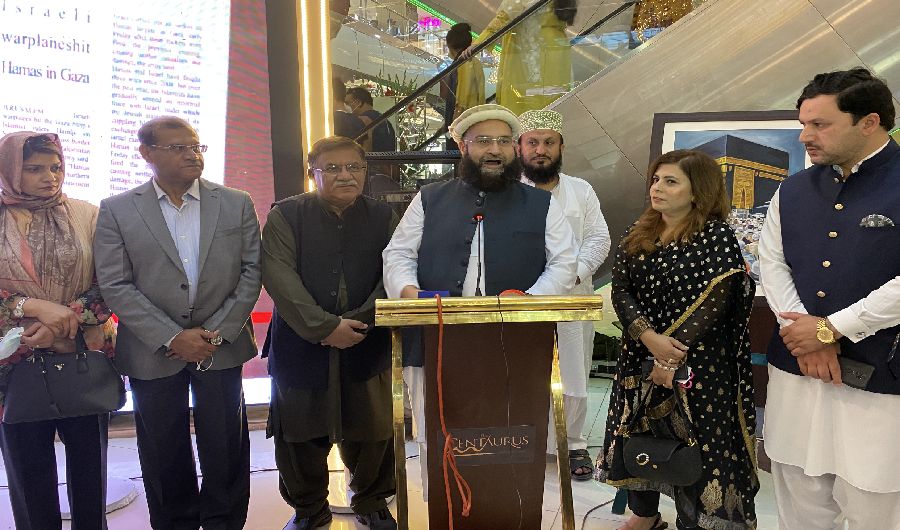


Tahir Mahmood Ashrafi, PM's aide on religious harmony and the Middle East addresses the launch ceremony of "The Spiritual Journey" art exhibition at Centaurus Mall in Islamabad, Pakistan, on July 12, 2021 (AN Photo)

“Looking at these photos one wishes they could just fly away right now and land in Madina and Makkah,” Noor-Ul-Haq Qadri, Pakistan’s Minister of Religious Affairs, told Arab News at the exhibition. “We need to encourage such events in Pakistan ... encourage our emerging talents to take part in such events that encourage our culture, our values and our religion.”
Palestinian Ambassador to Pakistan Ahmed Rabei also attended the event.


Pakistan says military operation concluded in Balochistan, 216 militants killed 

Updated 05 February 2026
Follow

Pakistan says military operation concluded in Balochistan, 216 militants killed 

  • Separatist BLA militant group claimed responsibility for coordinated attacks across Balochistan last week 
  • Military says 36 civilians, 22 law enforcement and security forces personnel have been killed in attacks 

PESHAWAR: Pakistani forces have concluded a security operation in the southwestern Balochistan province and killed 216 militants after a series of coordinated attacks by separatist militants last week, the military’s media wing said on Thursday. 

Separatist militant group Baloch Liberation Army (BLA) claimed responsibility for a series of attacks in Balochistan last Friday and Saturday in multiple districts across the province, one of the deadliest flare-ups in the area in recent years. 

Pakistan military’s media wing, the Inter-Services Public Relations (ISPR), said security forces launched operations in Panjgur and Harnai district’s outskirts on Jan. 29 based on intelligence confirming the presence of “terrorist elements,” killing 41 militants. 

It said the military launched a broader series of intelligence-based operations in multiple areas of the province after that to dismantle “terrorist sleeper cells,” referring to it as “Operation Radd-ul-Fitna-1.”

“As a result of these well-coordinated engagements and subsequent clearance operations, 216 terrorists have been sent to hell, significantly degrading the leadership, command-and-control structures and operational capabilities of terrorist networks,” the ISPR said in a statement.

The military said 36 civilians, including women and children, were killed by militants while 22 security forces and law enforcement personnel also lost their lives. 

The ISPR said a substantial cache of foreign-origin weapons, ammunition, explosives and equipment were also recovered during the counteroffensive operations. 

“Preliminary analysis indicates systematic external facilitation and logistical support to these extremist proxies,” the statement said. 

The military said Pakistan’s armed forces remain steadfast in their resolve to combat “terrorism,” vowing that counterterror operations will continue until militants are completely eliminated. 

“Operation Radd-ul-Fitna-1 stands as a testament to Pakistan’s and particularly Balochistan’s proud peoples’ unwavering commitment to always prefer peace over violence, unity over division and development over violence,” the ISPR said. 

Pakistan’s government has accused India of being behind the militant attacks in Balochistan, charges that New Delhi has rejected as “baseless.”

Balochistan, Pakistan’s largest province by land area, has long faced a separatist insurgency that has intensified in recent years. Militants frequently target security forces, government officials, infrastructure projects, foreigners and non-local workers.

The province holds vast reserves of minerals and hydrocarbons and is central to the multibillion-dollar China-Pakistan Economic Corridor (CPEC), a flagship component of China’s Belt and Road Initiative.

Separatist groups such as the BLA accuse Islamabad of exploiting Balochistan’s natural resources while denying locals a fair share. Pakistan’s civilian and military leadership reject the claim and say they are investing in the province’s development.