


ALEXANDRIA: Yemen’s government and major political parties on Friday welcomed Saudi Arabia’s call for the signatories to the landmark Riyadh Agreement to stick to their peace plan pledges.
The sides highlighted the need for the return of Cabinet ministers to the southwestern coastal city of Aden to help restore security, revive state bodies, and address basic service requirements.
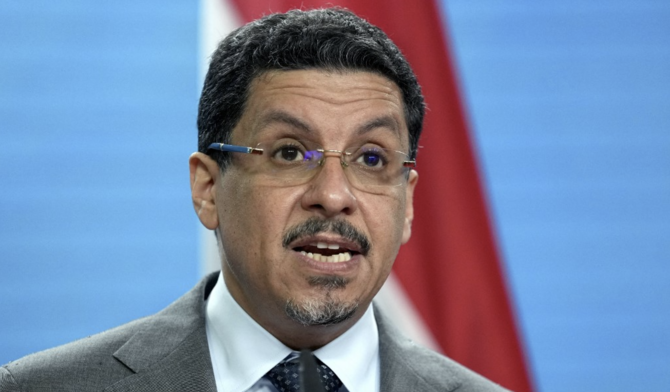
Yemeni Foreign Minister Ahmed Awad bin Mubarak, said: “We welcome the statement issued by Saudi Arabia, which includes clear messages to respect the agreed commitments to stop the escalation and prepare for the speedy return of the Yemeni government to Aden.”
On Friday, Yemeni government and Southern Transitional Council (STC) representatives held talks in the Saudi capital to discuss ways of speeding up the implementation of the Riyadh Agreement and halting all forms of military, security, economic, social, and media escalation.
The meeting described recent STC military and political appointments and media activities as being “inconsistent” with commitments made in the deal.
Signed by the Yemeni government and the STC in late 2019, the Riyadh Agreement defused hostilities between both sides in Aden and the other liberated provinces in the country’s south and led to the formation of a new unity administration that included the separatists, and the withdrawal of forces from Abyan province.
Hostilities between the internationally recognized government of Yemen and the STC resurfaced in March when dozens of protesters stormed the presidential palace in Aden, demanding unpaid salaries and the fixing of basic services.
The Yemeni government blamed the STC for inciting the protesters, accusing it of disrupting the work of the government.
The STC recently appointed new military commanders for allied military units and seized control of key media establishments in Aden, claiming the Yemeni government had failed to carry out its duties and pay salaries.
Mubarak told Arab News last month that the STC had not put into place security and military components of the Riyadh Agreement, including disbanding its military units and bringing them under the unity government’s control.
The Yemeni government implemented political and security aspects of the agreement by appointing a new governor and security chief for Aden, the minister said.
He pointed out that the STC’s reluctance to merge its military units with the state bodies had led to the Yemeni Prime Minister Maeen Abdulmalik Saeed and most of the Cabinet leaving Aden.
“We believe that this matter led to negative repercussions, including the government’s inability to perform its work in the capital, Aden,” Mubarak added.
The STC accused the Yemeni government of appointing a new attorney general and head of the Shoura Council without consulting it and suppressing a protest by its supporters in Shabwa province.
On Friday, the STC was unavailable for comment.
Meanwhile, a number of Yemen’s main political parties released a joint statement calling for the implementation of security and military components of the Riyadh Agreement and demanded the Yemeni government return to Aden to activate state bodies and put an end to security problems, including the drive-by shootings of politicians and activists in Aden, the official Yemeni news agency SABA reported.
On Friday, two people were killed and others wounded in clashes between government forces and separatists in the Abyan town of Lowder, Aden Al-Ghad news site reported.
The fighting broke out when a separatist security leader refused to hand over the town’s security office to a new security chief appointed by the Yemeni government.
“There are street fights and terrifying sounds next to our house in the vicinity of the security office and Lowder hospital,” Mohammed Muhayem, a journalist in Lowder, said on Facebook.
Separately, the US State Department said it was “beyond fed up” with Iran-backed Houthi attacks in Yemen, spokesperson Ned Price told a press briefing, adding that the assaults were exacerbating the humanitarian crisis in the country.


